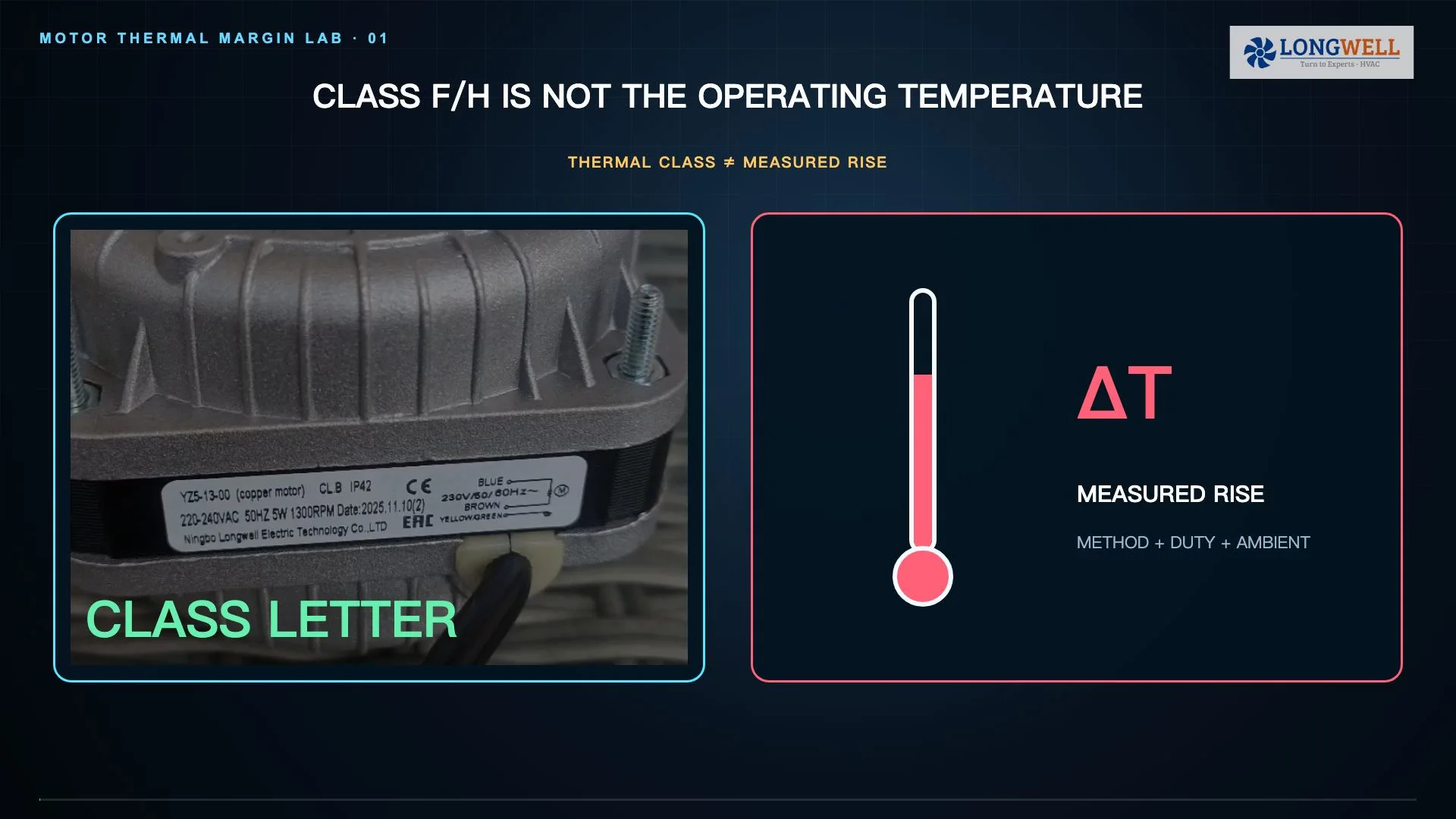
Insulation class and temperature rise appear next to each other on every motor nameplate, and together they predict service life better than any other pair of numbers.
One is the limit. The other is how close the motor runs to it.
Insulation class gives the maximum winding temperature the materials tolerate: 130 °C for class B, 155 °C for F and 180 °C for H. Temperature rise says how much the winding heats above ambient in normal operation. A class F motor with class B rise runs 25 K below its limit, which roughly quadruples expected insulation life.
What the classes allow
| Class | Maximum winding temperature | Typical rise allowed |
|---|---|---|
| A | 105 °C | 60 K |
| E | 120 °C | 75 K |
| B | 130 °C | 80 K |
| F | 155 °C | 105 K |
| H | 180 °C | 125 K |
| N | 200 °C | 145 K |
Class F is the modern default for industrial motors. Meanwhile class H turns up in hot and heavy-duty work.
How rise and ambient combine
Winding temperature is ambient plus rise plus a hot spot allowance. So all three numbers matter.
A class F motor with class F rise in 40 °C ambient sits at its limit. The same motor in a 55 °C roof plant room exceeds it, even though nothing about the motor changed.
So ambient belongs in the specification rather than in the notes. Ask for derating figures whenever the installation is unusual, since a roof plant room in August is exactly that.
Why class F with class B rise is common
You see this pairing constantly on good motors, and it is a deliberate choice.
The insulation copes with 155 °C, yet the motor is built to reach only about 130 °C. That 25 K gap is not wasted capacity. It is reserve.
Insulation life roughly doubles for every 10 K below its rated temperature. So a 25 K margin gives roughly four to five times the expected life, plus tolerance for a hot day, a dirty filter or a voltage dip.
The ten degree rule
This one rule explains most motor failures.
- Insulation life roughly halves for every 10 K above its rated temperature.
- It roughly doubles for every 10 K below.
- Grease life in the bearings follows the same rule.
- Electrolytic capacitors in EC electronics age the same way.
- So a 20 K overheat cuts expected life to about a quarter.
- Finally, thermal cycling adds stress even when the peak is acceptable.
Our overheating motor guide covers what actually causes those extra degrees.
Reading it on a nameplate
- Find the insulation class letter, often shown as INS CL or ISOL.
- Find the temperature rise, sometimes shown as a separate class letter.
- Check the maximum ambient, commonly 40 °C unless stated otherwise.
- Note the duty rating, since S1 continuous differs from short-duty ratings.
- Look for an altitude limit, usually 1,000 m before derating applies.
- Finally, note any thermal protection device fitted inside the motor.
Our nameplate reading guide works through a complete example.
EC motors and their electronics
On an EC fan the winding is only half the story, since the board ages too.
The drive board holds capacitors and chips that age with heat, just as insulation does. It also sits in the warmest part of the assembly. So the rating at the electronics often limits you more than the motor class does.
For the underlying definitions, IEC 60034 covers insulation classes and temperature rise limits.
One point is worth passing to whoever writes the specification. Ask for class F insulation with class B rise, and state the site ambient. Those two lines cost nothing at tender stage, and they usually add years to the motor.
Insulation class FAQ
Is class H better than class F?
It tolerates higher temperature, although that does not automatically mean longer life. A class F motor running cool often outlasts a class H motor running at its limit.
Can I run a motor above its ambient rating?
Only with derating, which means reducing the load. Ask the manufacturer for derating curves rather than assuming the thermal protector will manage it.
What is a hot spot allowance?
The winding is hotter in the middle than at the surface where it is measured. Standards add 5 to 15 K to account for that difference when setting rise limits.
Does insulation class affect efficiency?
Not directly. However, a motor designed for a lower rise usually has more copper and better cooling, and both of those tend to raise efficiency as well.
Insulation class sets the ceiling and temperature rise says how close you fly to it. The gap between them is the service life you actually get.