Two diameters, one hard temperature limit
An industrial ventilation OEM needed pipeline axial fans for a factory exhaust system, in two sizes: 400mm and 450mm. One line in the specification decided the impeller material, and with it the risk of polymer embrittlement.
In short, that line was the operating range: -30C to +60C, under continuous S1 duty.
The rest of the envelope
- First, 5,583 m3/h on a 380 VAC 50 Hz supply.
- Next, a maximum housing depth of 214mm for both diameters.
- Meanwhile IP54 and Class F insulation, for dust, damp and internal heat.
- Finally, 30,000 hours L10 at 40C, which their maintenance interval depends on.
They also asked for testing to ISO 5801 for airflow and GB/T 2888 for noise, plus CE, RoHS and Reach. Meanwhile altitude was capped at 1000 meters for the rated figures.
Why the depth limit mattered
A 214mm deep housing is shallow for this much airflow. So it limits how much blade you can fit, and that pushed us toward a lighter impeller first.
Polymer embrittlement reversed our choice
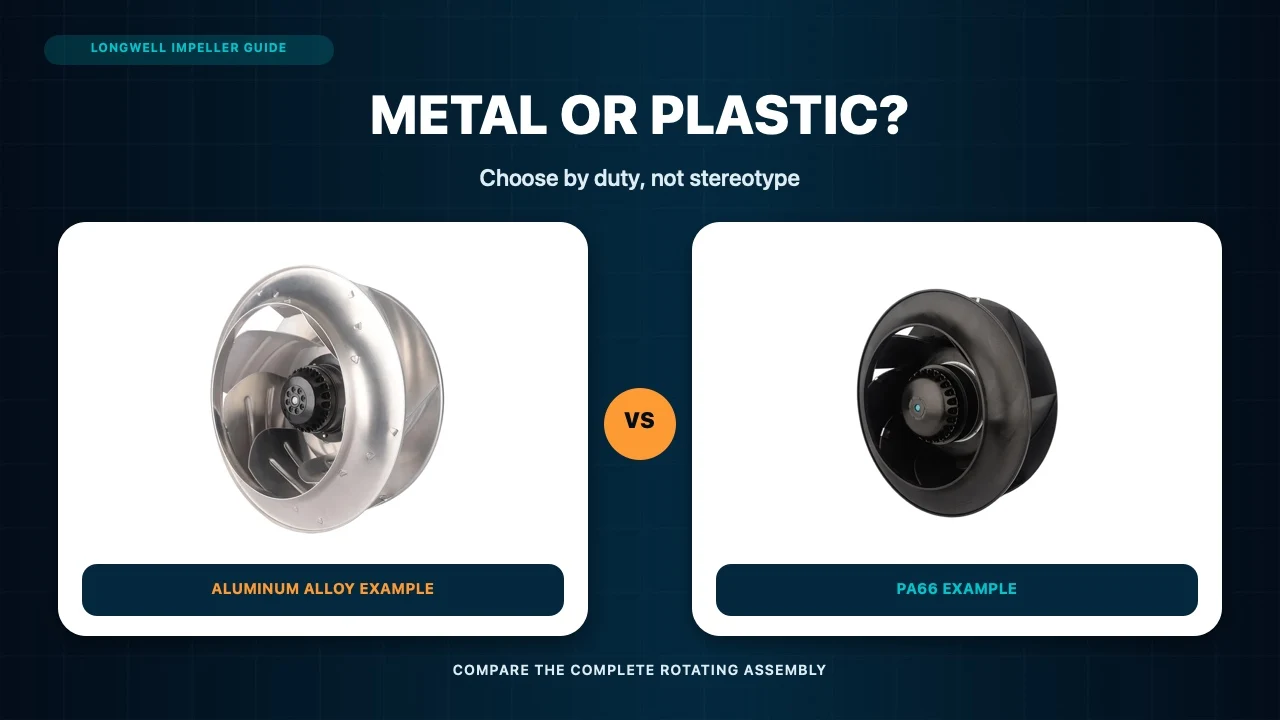
Our first approach was a plastic impeller. Lower mass means less motor load and less bearing load, which suits a shallow housing well.
Why we reversed it
However, that approach failed on the cold end of the range.
Polymers lose toughness as they get colder. Below a certain point, a material that flexes at room temperature will crack instead. Therefore the risk of polymer embrittlement rises as the air gets colder. Glass fiber raises stiffness, but it does not remove that behavior.
On a fixed part this matters less. On a spinning impeller under load at -30C, polymer embrittlement is a structural failure waiting for a cold morning.
What we used instead
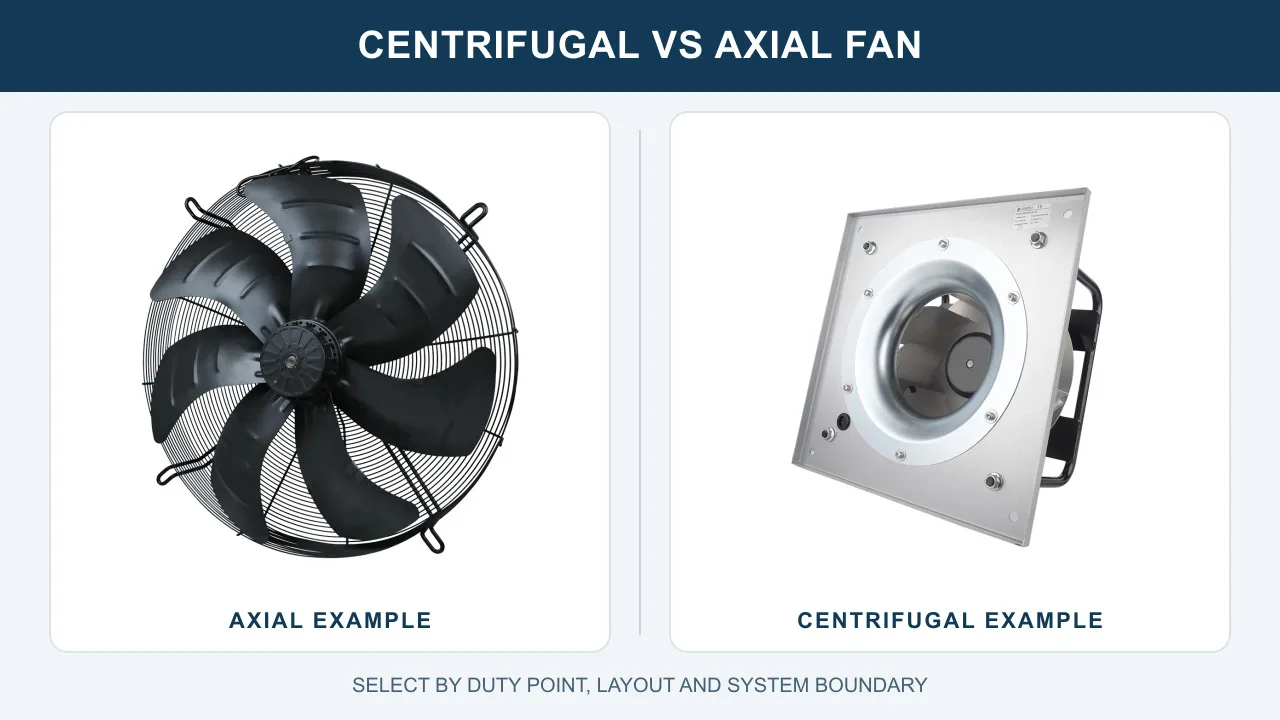
Instead we used five-blade impellers in cold-rolled sheet steel, on both the 400mm and 450mm models.
Steel holds its properties across the whole -30C to +60C span. So the material question stopped being about cold. It became one about weight and rust, which the housing and the IP54 rating already answered.
What the change cost
Weight, honestly. After all, a steel impeller loads the bearings harder than a plastic one, and it demands more starting torque.
So the motor and bearings had to suit the heavier wheel, not the lighter one we started with. That is the real cost of the reversal, and it is why finding the constraint early matters.
The motors
Furthermore we built custom AC motors for the 380 VAC input, so no step-down transformer sits in front of the fan. Class F insulation handles the internal rise from the 450 W and 260 W inputs.
Test methods for airflow follow ISO 5801.
Technical Specifications
The temperature row is the one that changed the build. Everything else could have been met either way.
| Parameter | LWAA2D400S-5MYB-28-00 | LWAA4D450S-5MYB-32-00 |
|---|---|---|
| Nominal Voltage | 380 VAC (342~418V) | 380 VAC (342~418V) |
| Frequency | 50 Hz | 50 Hz |
| Speed | 2350 RPM | 1390 RPM |
| Current | 2.2 A | 0.55 A |
| Power Input | 450 W | 260 W |
| Airflow (Max) | 5253 m³/h (3090 CFM) | 5583 m³/h (3284 CFM) |
| Noise Level (LpA) | 85 dB(A) | 69 dB(A) |
| Temperature Range | -30°C to +60°C | -30°C to +60°C |
| Insulation Class | Class F | Class F |
| Protection Type | IP54 | IP54 |
| Life Expectancy | 30,000 Hours (L10) | 30,000 Hours (L10) |
| Dimensions (Outer/Depth) | Ø464 mm / 214 mm | Ø514 mm / 214 mm |
Technical Documentation
The following original documents outline the physical dimensions, wiring diagrams, and P-Q performance curves for both approved axial fan configurations.
Download LWAA4D450S-5MYB-32-00 Technical (PDF)
Engineering specification sheet for the 450 mm axial fan, containing the 69 dB(A) acoustic data and 260 W power parameters required by electrical integrators.
Open LWAA2D400S-5MYB-28-00 Technical (PDF)
Dimensional and performance file for the 400 mm axial fan, providing the G6.3 balancing standards and mechanical housing constraints for factory layout planners.
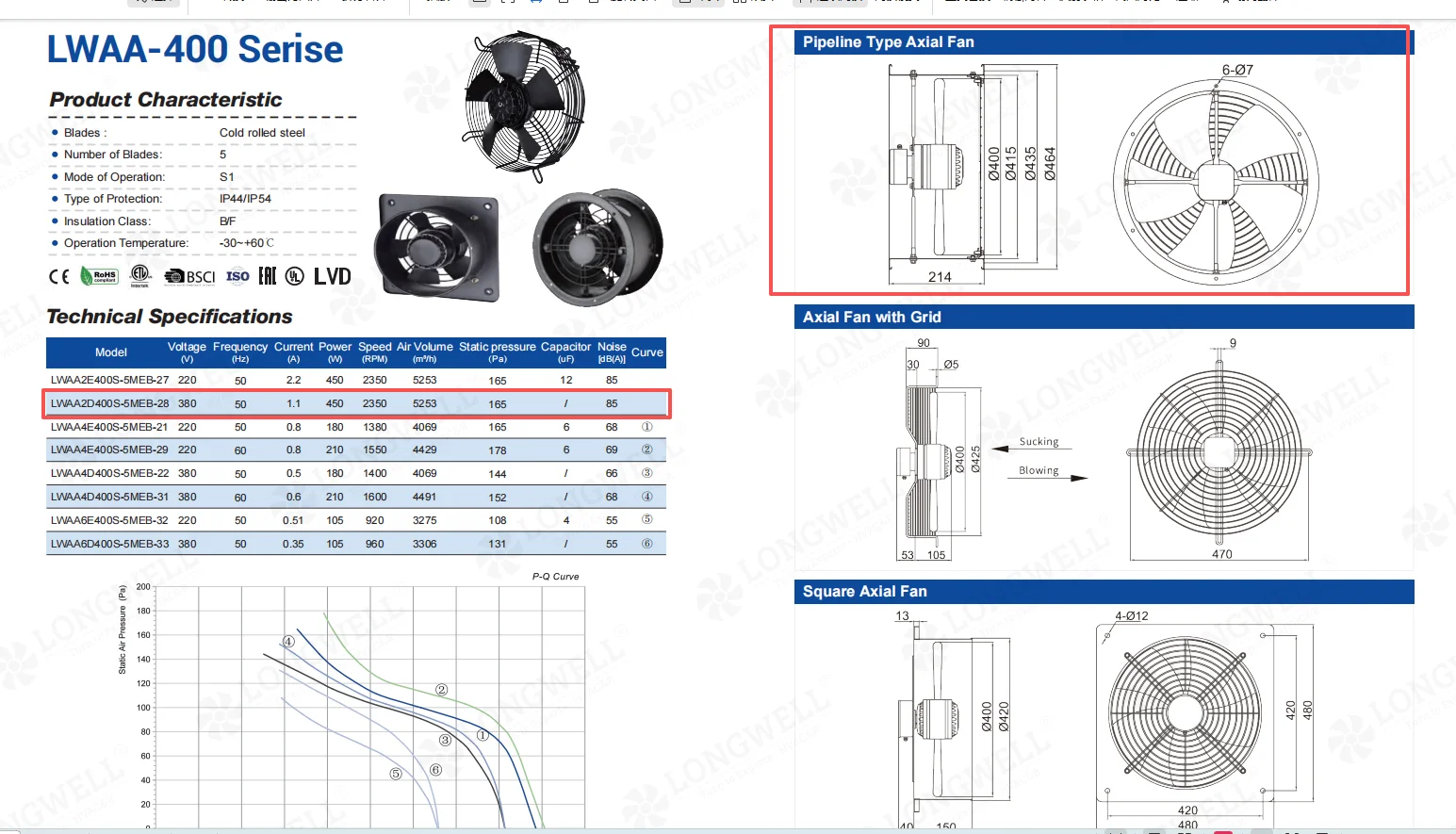
Visual reference sheet comparing the pipeline housing dimensions against the standard grid-mounted variants.
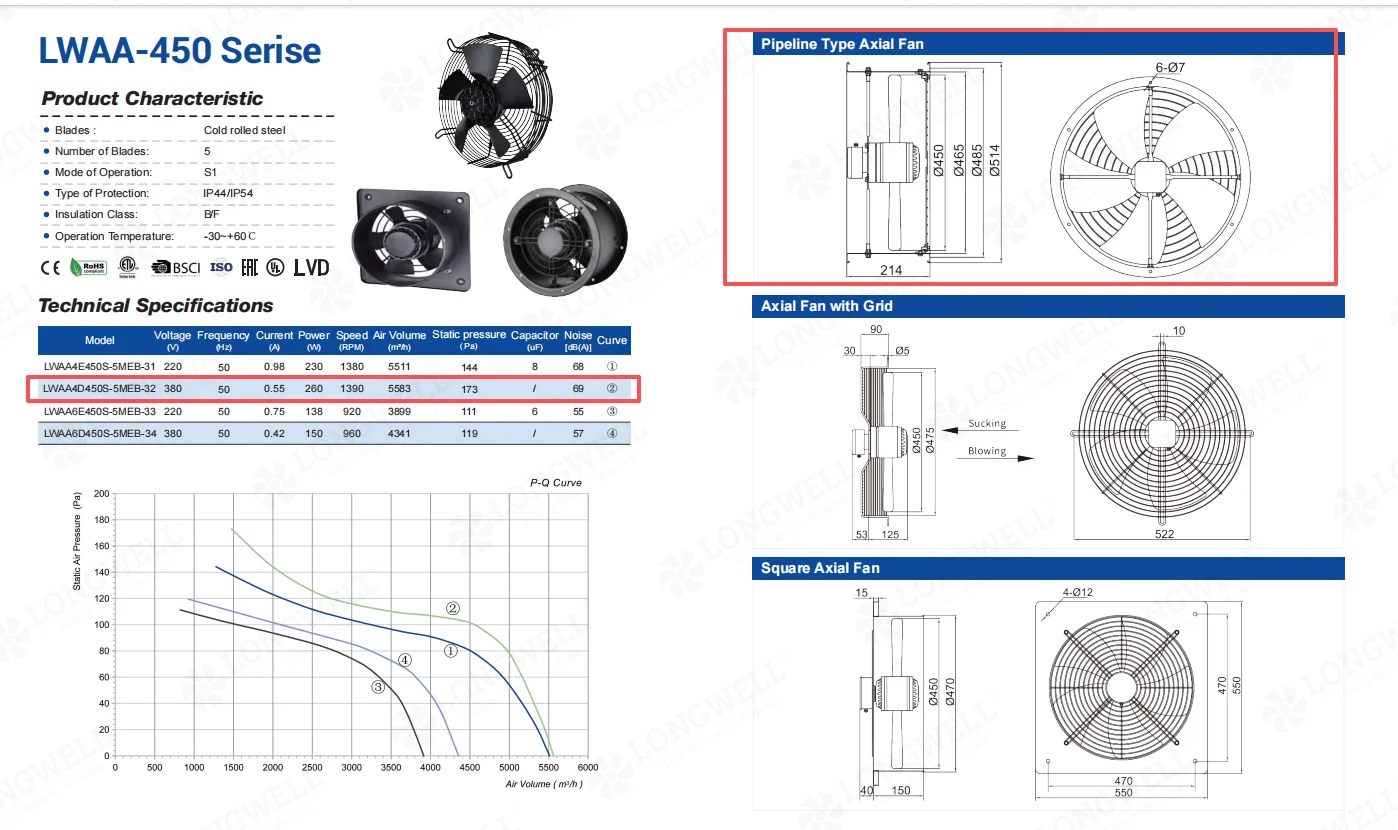
Detailed P-Q (pressure-volume) curves detailing static pressure capabilities at multiple operational points up to 5583 m³/h.
For internal design integration, CAD reference files are available: 450mm Docx Data and 400mm Docx Data.
Choosing an impeller material
Impeller material gets discussed as if it were a quality question. In truth it is nearly always a question about the environment, and polymer embrittlement is the clearest case.
- State your lowest temperature, including storage and transport. Polymer embrittlement depends on the coldest condition the part ever sees, not the coldest it operates in. A fan that ships through a winter warehouse has already been there.
- Do not assume glass fiber solves cold. Reinforcement raises stiffness and strength at normal temperatures. It does not stop a polymer becoming brittle as it cools, so a filled grade is not automatically a cold-weather grade.
- Separate the cold question from the span question. Long plastic impellers are routine at ordinary temperatures. If a supplier rejects plastic, ask whether the reason is temperature, speed or length, because only one of those is about the material itself.
- Budget for the weight if you switch to steel. A metal impeller changes starting torque and bearing load. Discovering that after the motor is selected means selecting it twice.
See our axial fans range, the industrial axial fans section, or fan impellers.
Questions about cold-weather impellers
At what temperature does a plastic impeller become unsafe?
There is no single figure, since polymer embrittlement depends on the exact grade. What matters is the transition below which the material fractures rather than flexes. Ask your supplier for the rated minimum temperature of the specific grade, not of plastic in general.
Does glass fiber reinforcement help at low temperatures?
Firstly, it raises stiffness and strength, which is why filled grades suit demanding impellers. It does not prevent the loss of toughness as temperature falls, so a reinforced part can still fail in cold conditions where an unreinforced one would.
Is a steel impeller always the safer choice?
For wide temperature ranges, usually yes. It costs weight, which raises bearing load and starting torque, and it can rust where a polymer would not. On an indoor fan at mild temperature, plastic is often the better answer.
Why does storage temperature matter if the fan runs warm?
Because the first start after a cold night is the worst case. The impeller is still at ambient, not at running temperature, and full torque arrives at once. Cold-weather failures happen at start, not during steady running.
Technical Documentation & Resources
Sizing something comparable?
Share the airflow, pressure, voltage and control interface, and we come back with a tested curve and a drawing. Meanwhile custom work runs to 90 days for spec sheets and samples. Since 1990 Longwell has supplied fans to HVAC and industrial OEMs.
Browse Related Products:
🏆 ISO 9001 / ISO 14001 / ISO 45001 | CE (TÜV) | UL/ETL | ATEX Zone 21/22 | AMCA 210/211 / ISO 5801 tested
Choose the right fan impeller
Longwell manufactures 10 fan impellers in-house. Send airflow, static pressure and voltage — an engineer replies with a matching model, performance curve and price within one working day.