What was failing in the field
A Russian OEM contacted us because their HVAC units kept failing in service. They wanted an IP54 AC motor to replace a 220V, 50Hz, three-speed, 160W open-frame design.
Their brief listed five fixes they wanted. Close all the holes. Add a dust shield. Improve water resistance. Insulate the cable outlet. Provide stronger overheating protection.
Four of those are one specification
The first four requests all describe one thing: an ingress rating. Together they mean IP54, so the motor is sealed against dust and safe from splashing water.
An open-frame motor is cheap and fine indoors. However, in dust, damp and splashing it will not last. Their field data was already telling them so.
The fifth request was a different problem
Stronger overheating protection points somewhere else. Either the motor ran close to its thermal limit, or its cutoffs tripped too readily.
Crucially, one line changed our options. They would accept a larger motor. That gave our engineers room to fix the cause rather than patch the symptom.
Specifying the IP54 AC motor
We logged this as minor development. In other words the answer already sat in our portfolio. The work lay in choosing right and writing it down.
Why we did not modify their existing motor
Sealing an open-frame motor after the fact was the obvious first idea, and we dismissed it quickly.
It costs a lot, the seal is never as good as a designed one, and it makes the heat worse. Trapping heat inside a motor that already runs hot is the wrong move.
So the right answer was an IP54 AC motor built that way from the start.
Solving the heat rather than the alarm
We could have simply upgraded the thermal protector. That stops the nuisance trips, yet it leaves the real temperature untouched.
Because the customer allowed a larger envelope, a better answer opened up. A stronger motor doing the same work runs further from its limit, so it sits cooler. Consequently windings and bearings both last longer, and the protector stops seeing anything worth tripping on.
Two options, one recommendation
- The LWYDK160-4P-002 matches the original 160W exactly, built in our standard IP54 housing.
- Meanwhile the LWYDK180-4P-002 is the one we recommended. Same 170mm footprint, also IP54, with 20W more headroom.
That extra 20W is the thermal buffer. It costs little, and it fixes the real failure mode. We sent full drawings and quotations for both IP54 AC motor options, so the customer could decide with the numbers in front of them.
Technical Specifications
Both proposed motors appear below. The mounting rows are identical, which is what made the choice easy for the customer.
| Parameter | LWYDK160-4P-002 | LWYDK180-4P-002 |
|---|---|---|
| Voltage (V) | 220 | 220 |
| Frequency (Hz) | 50 | 50 |
| Input Power (W) | 160 | 180 |
| Speed (RPM) | 1100 / 900 / 700 | 1250 / 970 / 750 |
| Protection Type | IP54 | IP54 |
| Insulation Class | Class B | Class B |
| Overall Diameter (mm) | Ø170 ± 0.5 | Ø170 ± 0.5 |
| Overall Height (mm) | 174 ± 1.5 | 174 ± 1.5 |
| Shaft Diameter (mm) | Ø10 | Ø10 |
| Bearing Type | 6202 2Z | 6202 2Z |
| Compliance Standard | GB14711-2013 | GB14711-2013 |
Technical Documentation
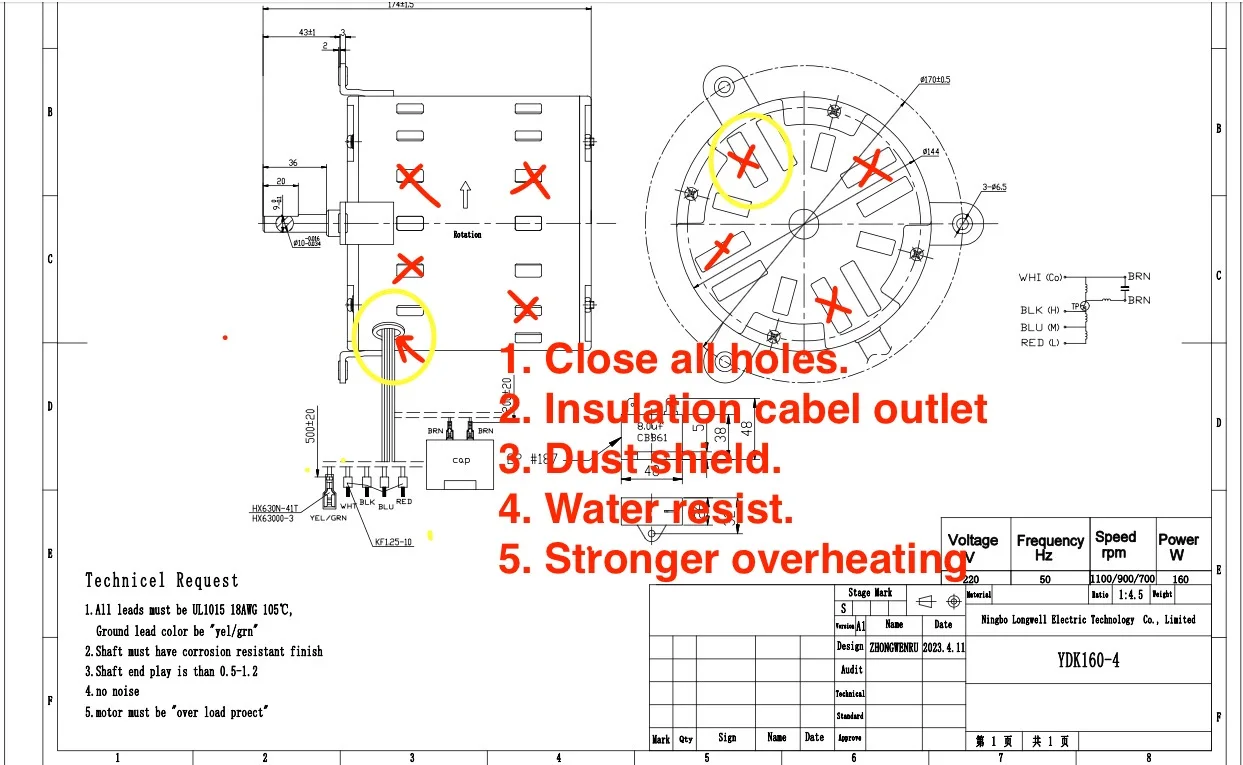
Here the image, based on the customer’s original submission, visually details the required improvements, highlighting the open holes and cable outlet that needed sealing. It serves as the primary input for the engineering brief.
Original Customer Motor Specification (YDK160-4)
Here the document provides the baseline technical specifications for the customer’s original 160W open-frame motor, which procurement managers use for initial comparison.
Longwell Proposed Solution 1 (LWYDK160-4P-002)
This is the final engineering drawing for the 160W IP54-rated motor, providing all mechanical dimensions, electrical specifications, and material callouts for system integrators.
Longwell Proposed Solution 2 (LWYDK180-4P-002)
This technical drawing details the 180W IP54 upgrade option, allowing design engineers to verify form, fit, and function for the higher-performance replacement.
Why this took days rather than months
A reliability problem in the field is urgent. So what matters is how fast a supplier turns it into a part number.
- Existing platforms, not a new project. A European competitor might have opened a 12-month custom development here. Instead the requirements mapped onto pre-certified LWYDK platforms, so the answer came back in days.
- A reliability upgrade they could afford. Moving from a failure-prone open frame to a sealed IP54 AC motor needed no tooling and no development cycle. The upgrade cost the customer a part number change rather than a project.
- We make the motors. Answering quickly with firm specifications and pricing depends on owning motor design and production. Our engineers can see capability, cost and lead time directly rather than asking a supplier.
- Compliance ready if it is needed. The proposed motors conform to GB14711-2013 for electrical safety. Should their equipment later need CE marking for the EU, our China-local TUV NORD relationship shortens that process considerably.
Browse our fan motor range, or the AC motor section. Ingress ratings are defined in IEC 60529.
Questions about the motor swap
What actually changes between the original motor and the IP54 version?
The ingress protection. The replacement is an IP54 AC motor, so it resists dust and water splashes. Meanwhile the original is an open frame with a low rating, which is fine indoors and poor anywhere damp. Everything else about the duty stays comparable.
Can a 180W motor replace a 160W one?
Yes, and it is a common reliability upgrade. Running a 180W motor at a 160W load creates real thermal margin, so it operates cooler. That extends insulation and bearing life while cutting nuisance thermal trips. The 170mm mounting pattern is identical, though do check the 174mm height against your assembly.
How long does a semi-custom IP-rated motor take?
For a change based on an existing platform, complete documentation and pricing come back within a few working days. Standard make-to-order production then runs 15 to 25 days. A genuinely new design is different: that follows our 90-day NPI process from specification to first sample.
Does a higher IP rating make a motor run hotter?
It can, which is why the sealing and the heat had to be solved together. A sealed housing loses one cooling path. Consequently a motor designed for IP54 from the start compensates in its thermal design. Sealing an open-frame motor yourself does not, and that is the failure we were asked to prevent.
Technical Documentation & Resources
Need the same thing for your own unit?
Give us the numbers and the envelope, and you get a shortlist rather than a catalog. Meanwhile custom spec sheets and samples run to 90 days. Since 1990 Longwell has supplied EC fans and blowers to OEMs in HVAC, cold chain, data center and industrial markets.
Browse Related Products:
🏆 ISO 9001 / ISO 14001 / ISO 45001 | CE (TÜV) | UL/ETL | ATEX Zone 21/22 | AMCA 210/211 / ISO 5801 tested
Choose the right ac motor
Longwell manufactures 22 ac motors in-house. Send airflow, static pressure and voltage — an engineer replies with a matching model, performance curve and price within one working day.