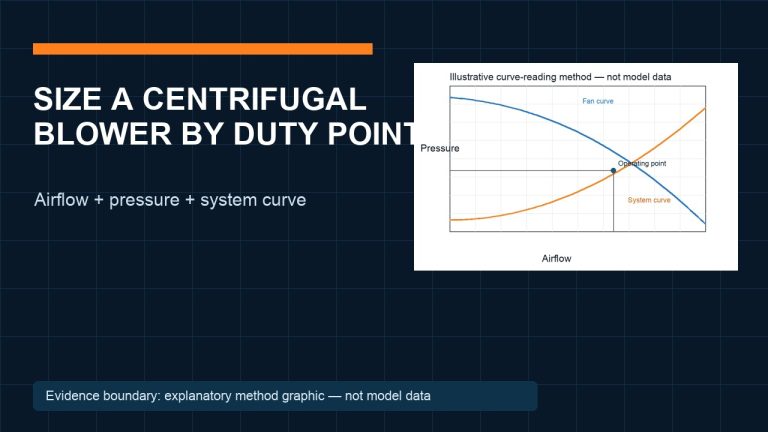
“High pressure” and “high volume” sound like two blower types. For a buyer, they are better treated as two ends of a selection problem. Maximum airflow is measured near the low-resistance end of a curve, while maximum pressure is near shutoff. Those headline numbers do not occur together.
Short answer: choose the complete blower whose verified curve reaches the required airflow at the required pressure. Then check power, sound, speed and operating margin at the same point. A label on a product page cannot do that work for you.
Start the RFQ with airflow at pressure
A usable duty is a pair: volume flow and pressure. “We need 3,000 CFM” is incomplete because the installed airflow depends on the resistance of filters, coils, ducts, fittings, dampers and process equipment. “We need a high-pressure blower” is also incomplete because pressure without delivered flow does not describe the job.
State whether the pressure is external static, fan static or total pressure. Add the air temperature, altitude or density, and identify the test or calculation boundary. If one supplier quotes total pressure and another quotes external static pressure, the numbers may look comparable while describing different things.
The operating point is where selection happens
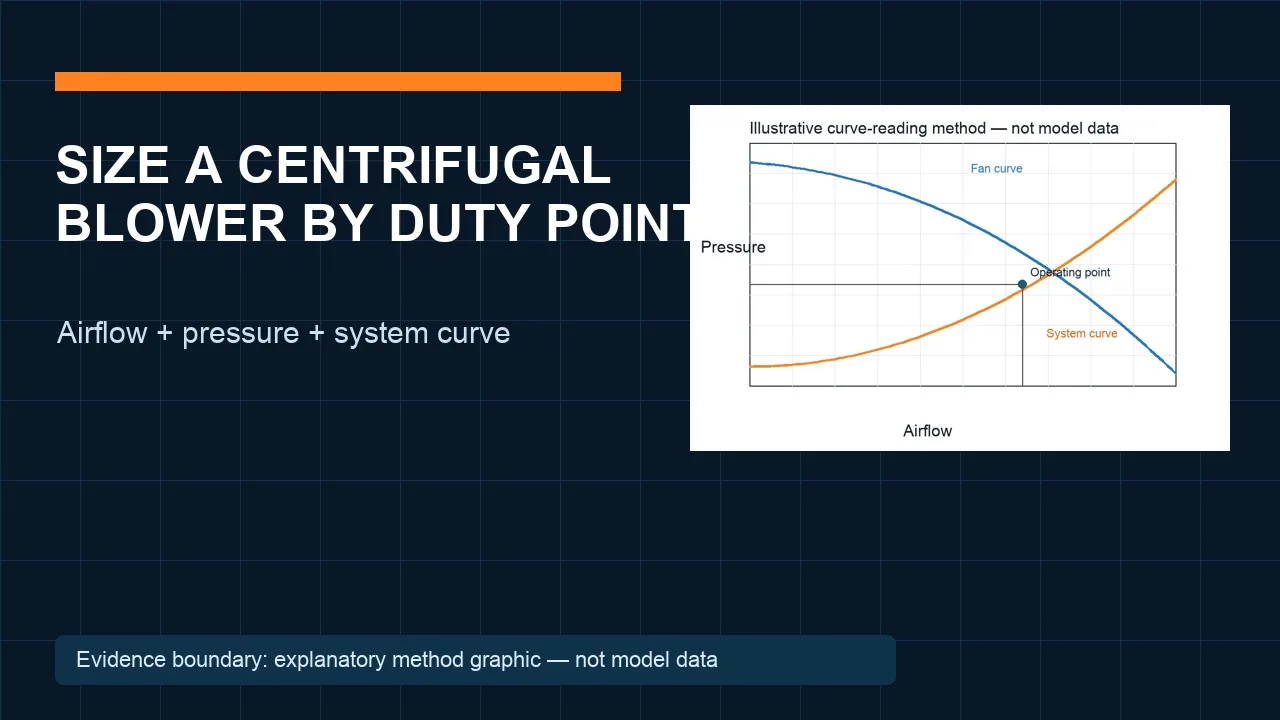
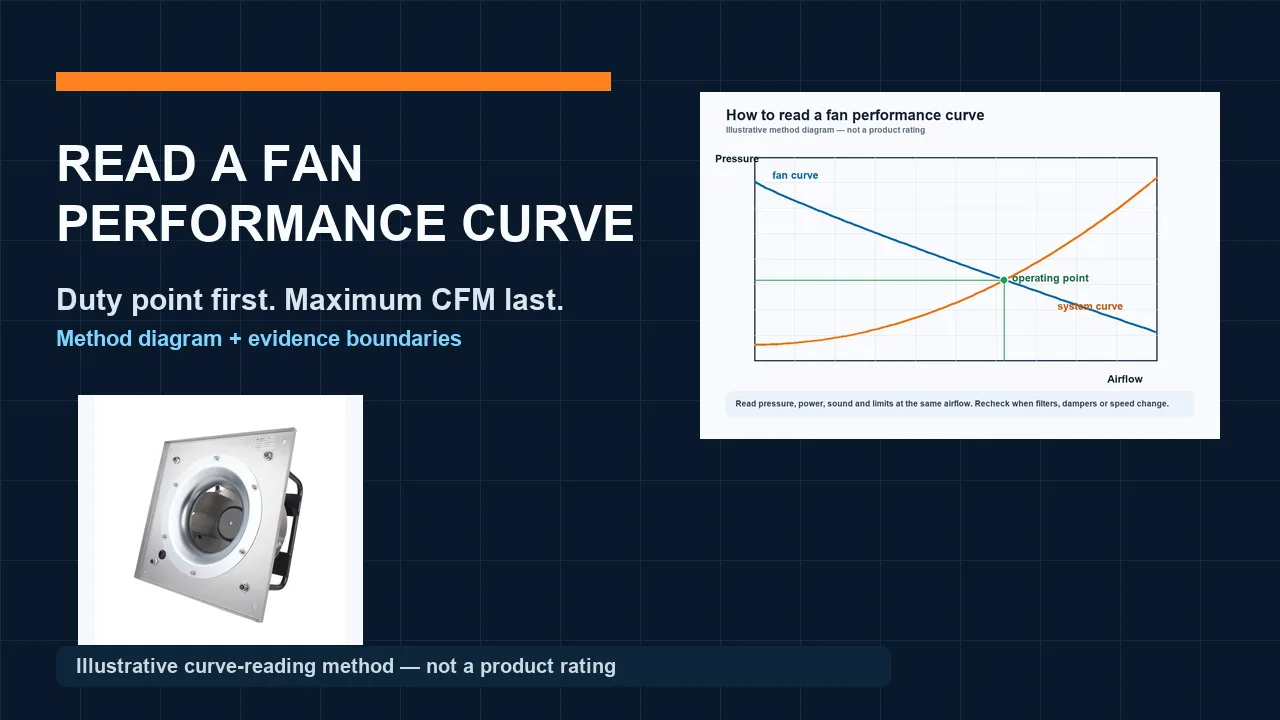
A fan curve normally falls as airflow increases. A system curve rises because resistance increases with flow. Their intersection is the expected operating point. Our centrifugal fan curve guide explains how to read pressure, power and efficiency on the same chart.
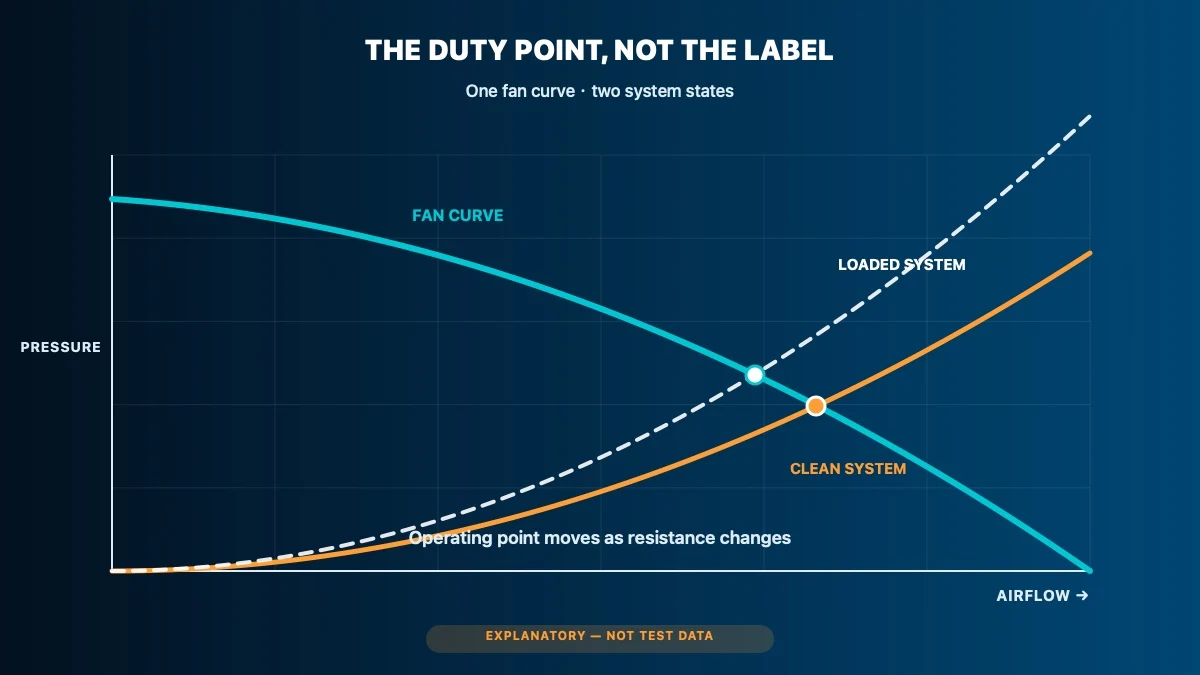
That intersection is not fixed forever. A loaded filter adds resistance, a damper changes position, or a coil becomes dirty. The system curve moves and the blower settles at a new point. Put clean, normal and worst-credible system states on the curve before approving a selection. A free-air demonstration cannot predict performance inside a finished machine.
Hardware is a clue, not a verdict
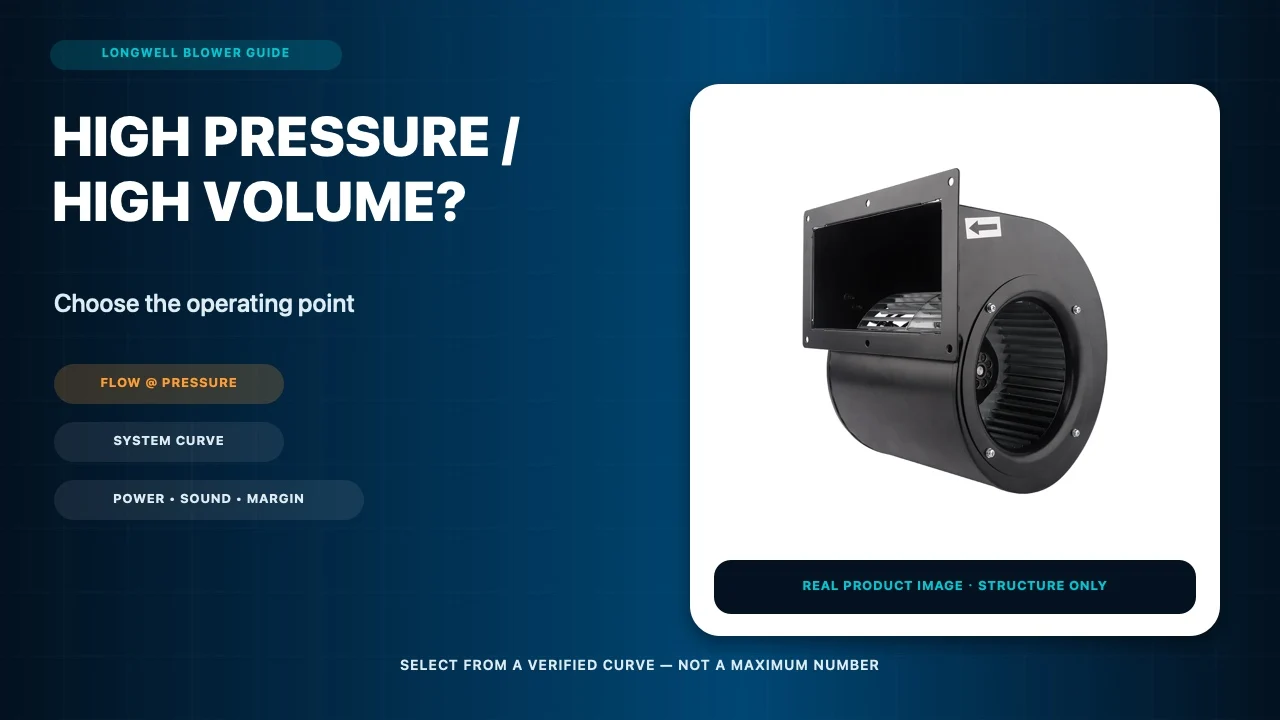
A scroll housing, wheel diameter, blade form and inlet arrangement help an engineer understand the architecture. They do not prove that one blower is “high pressure” or “high volume.” Size, speed, density and the complete tested configuration can move the curve substantially.
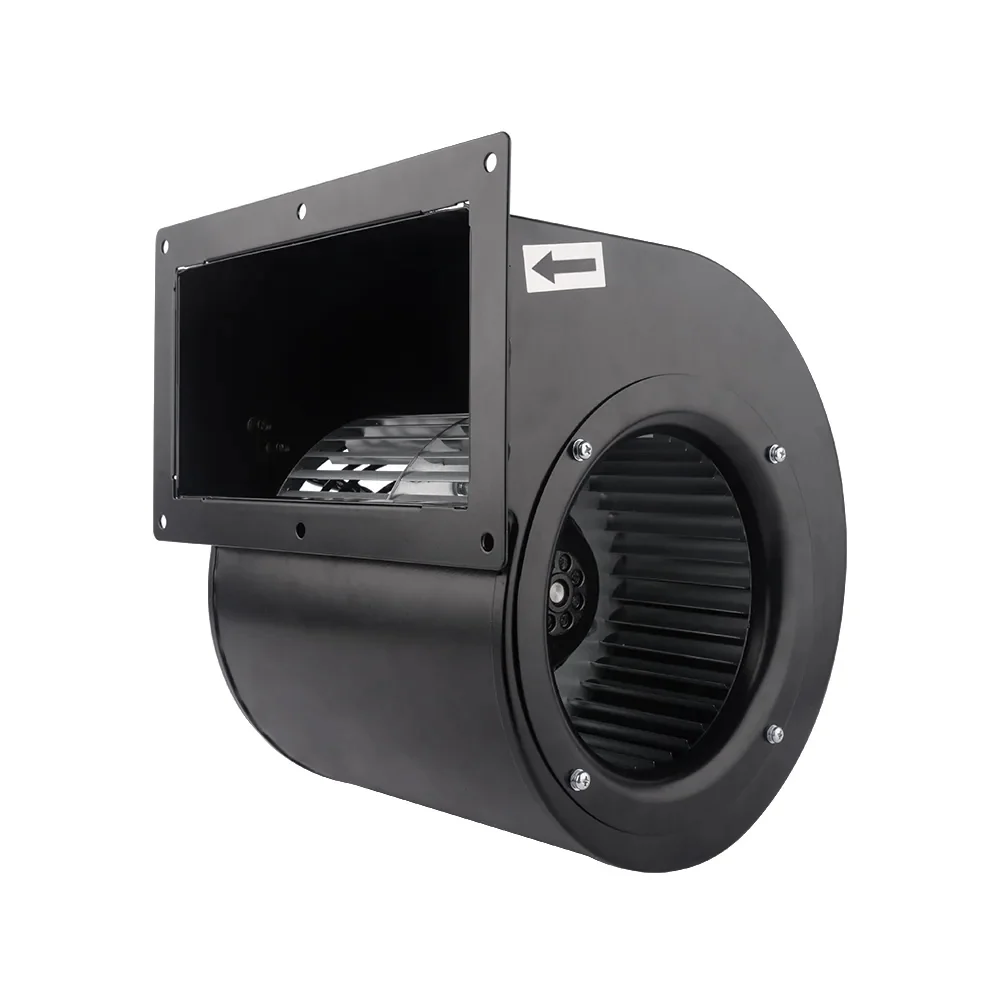
The real LONGWELL blower shown above makes the physical boundary clear. Authenticated master data identifies it as a dual-inlet centrifugal blower; the photograph itself shows the housing, outlet and one visible inlet side. It does not establish a duty point, efficiency, sound, certification or project suitability. Use the centrifugal blower family for architecture and sourcing discovery, then request the exact model and revision data.
When a volume-first shortlist makes sense
Open ventilation, broad cooling paths and low-restriction drying often put the duty toward higher flow and lower pressure. That makes a volume-first shortlist reasonable. It does not justify choosing the largest free-air figure. Guards, louvers, heat exchangers and the equipment enclosure can add enough resistance to change the ranking between candidates.
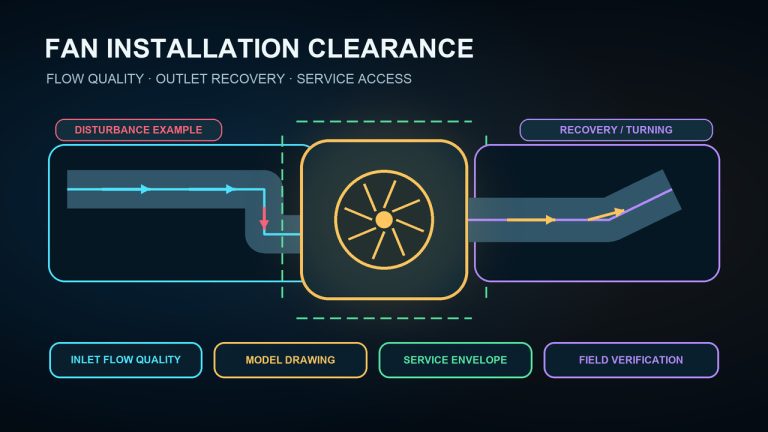
Check the curve at the installed resistance. Also confirm inlet and outlet conditions: a cramped inlet, abrupt transition or poorly placed elbow can prevent an installed blower from matching a laboratory curve.
When pressure capability becomes decisive
Dense filtration, compact heat exchangers, long duct runs, silencers, cyclones and nozzles usually push the duty toward more pressure. The selection still starts with flow at pressure, not with an application label. For a separate family used in general-purpose blower applications, the LONGWELL air blower range is a sourcing route, not proof that every model fits a high-resistance system.
If resistance is uncertain, do not hide it inside a generous pressure allowance. List the components, estimate each loss and ask suppliers to mark the resulting points on their verified curves. An allowance without a system basis can push the chosen blower into an inefficient or unstable part of its range.
Check the whole range, not one design dot
For every credible operating state, review input power, motor margin, speed, sound, efficiency and the manufacturer’s permitted region. A point that satisfies airflow and pressure can still fail another limit. Variable-speed control helps move along a family of curves, but it does not erase motor, acoustic or stability constraints.
Ask what configuration produced the curve: complete blower or bare wheel, inlet and outlet arrangement, guards, density, speed and test standard. For a replacement, compare the same boundary and confirm envelope, mounting, rotation, electrical supply, controls and service access. Similar maximum figures do not guarantee a drop-in replacement.
Use this blower-selection checklist
- Required airflow at minimum, normal and maximum duty.
- Corresponding pressure and the exact pressure definition.
- System curve or a loss schedule for each major component.
- Clean and loaded filter conditions, damper positions and process states.
- Air temperature, altitude or density, and any contaminants.
- Power supply, control signal, speed range and electrical limit.
- Sound boundary, installation envelope, inlet/outlet geometry and access.
- Requested curve, power, sound and operating-limit evidence for the exact model and revision.
The practical decision is not “pressure or volume?” It is whether the complete blower stays inside an acceptable operating region while the real system changes. Put the duty points on the curve, compare candidates on the same boundary, and let verified evidence—not the biggest catalog maximum—close the purchase.
Choose the right blower
Longwell manufactures 247 blowers in-house. Send airflow, static pressure and voltage — an engineer replies with a matching model, performance curve and price within one working day.