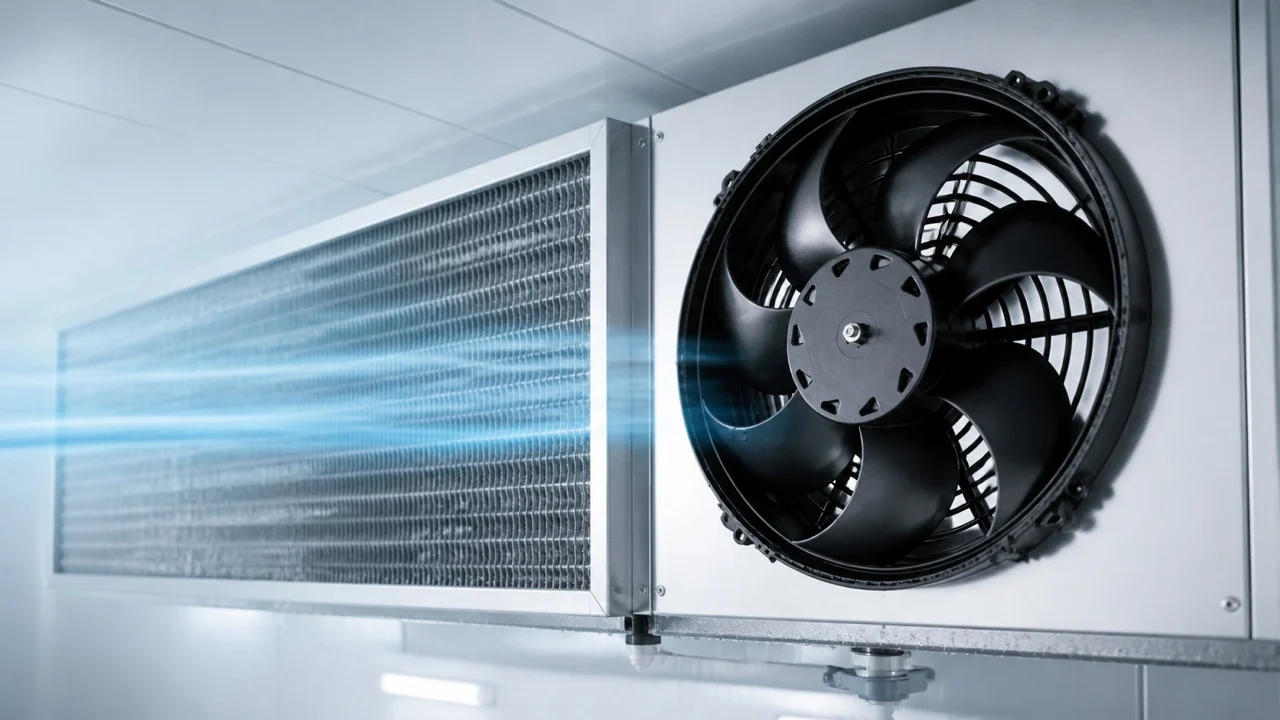
A condenser fan motor drives the propeller in the outdoor unit. It pulls air across the coil so the refrigerant can dump its heat. When it stops, head pressure climbs fast and the compressor suffers.
Swapping one is a common repair. Getting the spec right, though, matters more than the spanner work.
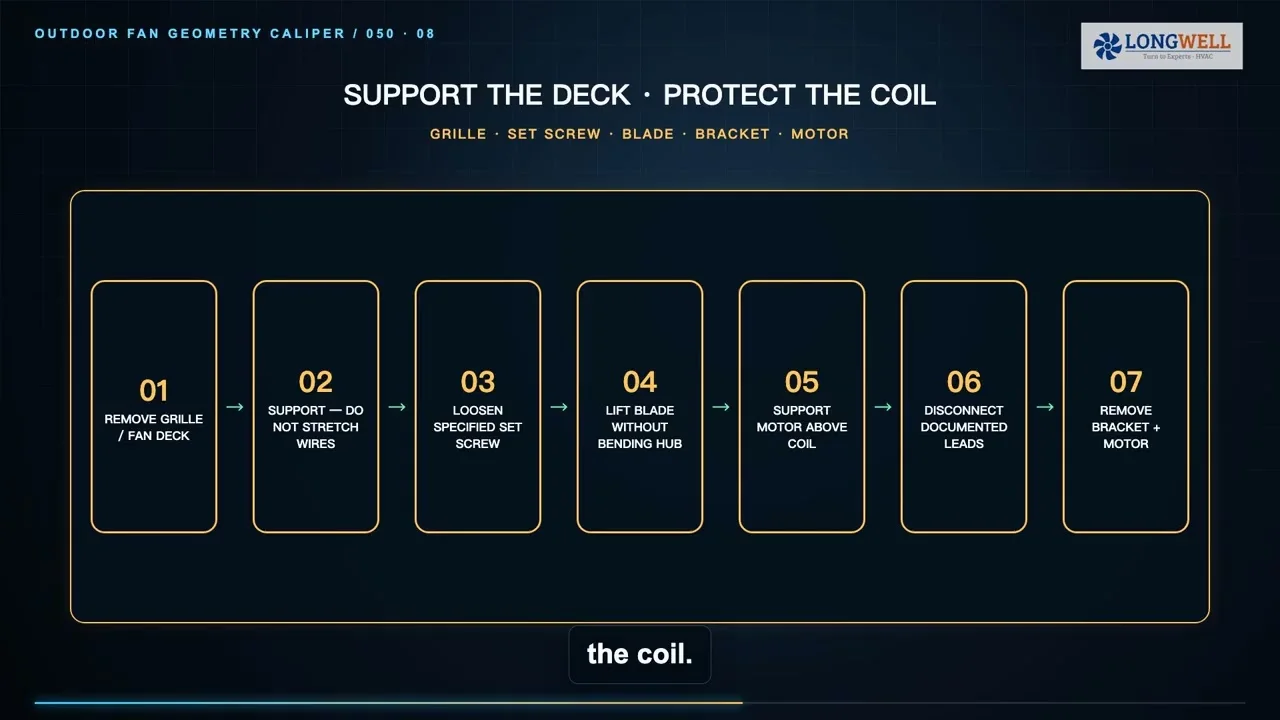
Match the new condenser fan motor on power, voltage, speed, rotation, frame, shaft size and capacitor value. Isolate the unit and discharge the capacitor before you touch anything. Move the blade across, set its height in the orifice to the original figure, then check running current and head pressure before you finish.
Confirm the motor is the fault
Several faults look identical from the outside, so spend five minutes before ordering.
- Fan not turning but compressor running: check the capacitor first, since it is the usual culprit.
- Hums and will not start: capacitor or a seized bearing.
- Runs slowly: worn bearings, a weak capacitor or a failing winding.
- Cycles on and off: internal thermal protection tripping on heat.
- Nothing runs at all: check the contactor, the breaker and the control voltage.
- Finally, check the blade turns freely by hand with the power isolated.
A dual run capacitor serves both the compressor and the fan on many units, so a failed fan section can leave the compressor running normally.
Match the specification carefully
| Parameter | Why it matters |
|---|---|
| Horsepower or watts | Undersizing overheats, oversizing overloads the blade |
| Voltage and frequency | Must match the supply exactly |
| Speed | Blade pitch is matched to rpm |
| Rotation | Stated from the shaft end; wrong way moves almost no air |
| Frame and mounting | Bracket pattern varies between makers |
| Shaft diameter and length | Blade hub fit and height in the orifice |
| Capacitor value | Wrong microfarads shortens motor life |
Universal condenser fan motors work well when matched properly, although rotation and capacitor value need setting rather than assuming.
Isolate and work safely
- Switch off at the outdoor disconnect and at the breaker.
- Prove the circuit dead with a tester you have checked on a known source.
- Discharge the run capacitor through an appropriate resistor.
- Remove the top panel carefully, supporting it since the motor hangs from it.
- Photograph the wiring, the blade position and the capacitor connections.
- Finally, keep the refrigerant circuit undisturbed, since it needs no attention for this job.
Outdoor units sit in weather, so expect corroded fasteners and take penetrating oil with you.
Transferring the blade and setting its height
This step decides whether the repair works, and it is the one most often rushed.
Measure the gap from the blade to the orifice or the top panel before you remove anything. Then copy that figure exactly onto the new motor, because blade height in the venturi drives airflow.
Never straighten a bent propeller blade. Pitch and balance are set at manufacture, so a corrected blade runs out of balance and can crack. Replace the blade instead, and always replace it if the motor seized suddenly.
Wiring and capacitor
Follow the wiring diagram that came with the new motor rather than copying the old one.
Universal motors carry several lead options for rotation and speed, so insulate every unused lead on its own. Meanwhile fit the right capacitor value. A gap of two microfarads shifts current and running heat more than people expect.
Our run capacitor guide covers testing and replacement, and our condenser cooling fan range shows typical specifications.
Commission on numbers
- Confirm rotation and that air discharges upward on top-discharge units.
- Measure running current and compare with the nameplate.
- Check head pressure and the temperature split across the coil.
- Listen for blade contact and check for vibration.
- Clean the condenser coil while access is easy.
- Finally, record the readings for the next service visit.
A clean coil does as much for head pressure as the new motor does. For seasonal maintenance guidance, the US Department of Energy covers the basics.
Condenser fan motor FAQ
Can I use a higher horsepower motor?
It is not recommended. The blade is matched to the original motor speed and power, so a larger motor can overload the blade and raise noise without improving cooling.
Why did my condenser fan motor fail again?
Check the capacitor value, the blade height and coil cleanliness. A dirty coil raises head pressure and air temperature around the motor, which shortens winding life.
Does rotation direction really matter?
Completely. A propeller running backwards moves a small fraction of its rated air, so the unit will trip on high pressure within minutes on a warm day.
Should I replace the blade too?
Yes if it is bent, cracked or if the motor seized. Otherwise a clean, undamaged blade can be reused, provided the hub fit is still tight.
Match the specification, set the blade height to the original dimension, fit the correct capacitor and clean the coil. A condenser fan motor replacement done that way lasts as long as the original.
Choose the right condenser cooling fan
Longwell manufactures 17 condenser cooling fans in-house. Send airflow, static pressure and voltage — an engineer replies with a matching model, performance curve and price within one working day.