Walk into any air handling unit built in the last decade and you will probably find an EC plug fan. Sometimes several of them.
That dominance is not marketing. It comes from three separate advantages arriving in the same package.
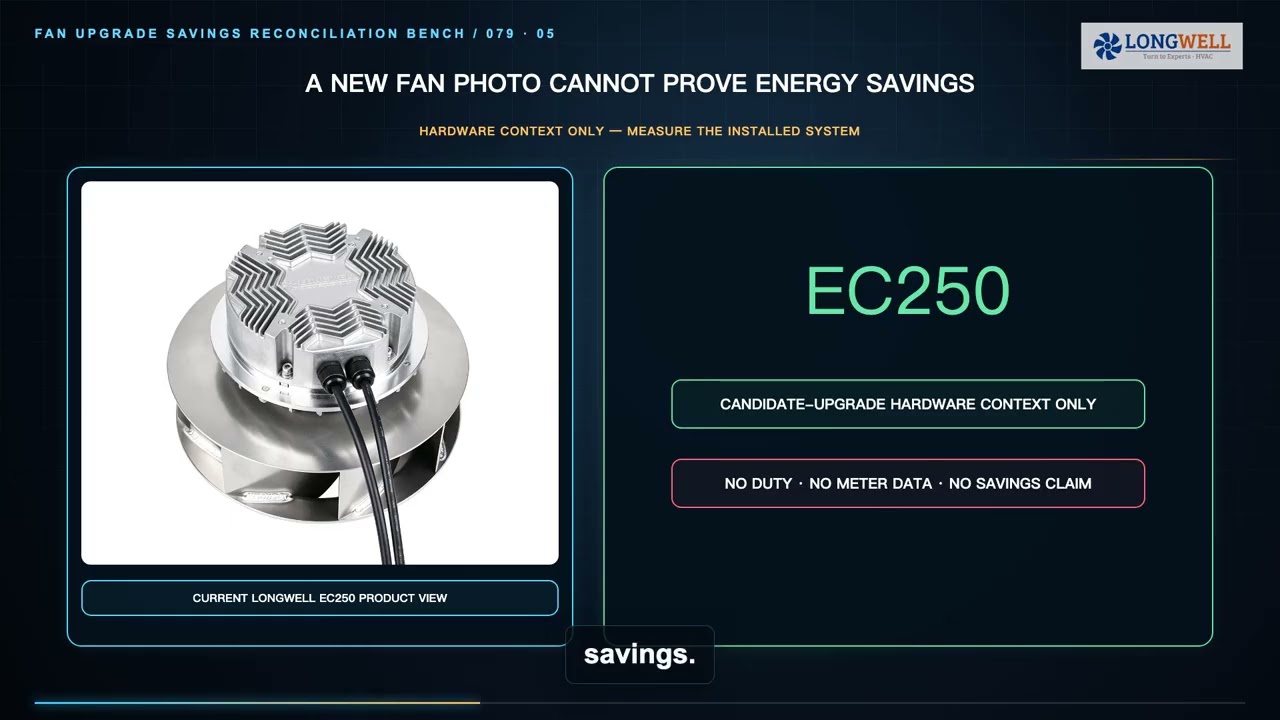
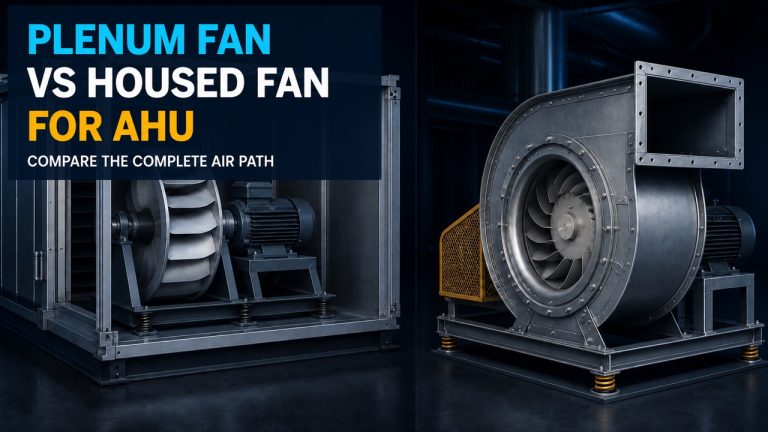
An EC plug fan combines a backward-curved impeller, an external rotor EC motor and no scroll housing. The wheel gives 75 to 84 percent static efficiency with a non-overloading power curve, the motor gives high part-load efficiency and built-in speed control, and dropping the scroll saves 400 to 700 mm of cabinet length while allowing arrays.
Three advantages in one unit
Each part solves a different problem. Together they cover most of what an air handling unit needs.
| Element | What it solves |
|---|---|
| Backward-curved wheel | High efficiency, non-overloading power curve |
| External rotor EC motor | Part-load efficiency, integrated control, compact depth |
| No scroll housing | Cabinet length, free discharge direction, arrays |
| Direct drive | No belts, no transmission loss, less maintenance |
| Integrated electronics | Status feedback and simple wiring |
Take away any one of them and the case gets much weaker.
Why the wheel is backward-curved
Blades leaning away from rotation leave less speed for the housing to recover. That is exactly what a plug layout needs.
A plug fan has no scroll, so there is very little recovery on offer. A wheel that leans on recovery, such as a forward-curved one, does badly here.
Meanwhile the power curve peaks and falls, so an open system cannot overload the motor. That matters on the day somebody pulls the filters out to clean them. Our wheel comparison covers the difference in detail.
Why the motor is external rotor
In an external rotor motor the rotor sits on the outside, and the wheel bolts straight onto it.
- The wheel and rotor become one short assembly, saving axial depth.
- Airflow over the motor provides good cooling.
- There is no shaft coupling or overhang to manage.
- Balance is simpler, since fewer parts contribute to it.
- Bearings sit close together, which improves rotor dynamics.
- Finally, the whole unit fits a shallow cabinet without compromise.
Our external rotor comparison explains how it differs from an internal rotor arrangement.
What you give up
Honesty helps here, since the EC plug fan does not suit every job.
You give up 5 to 10 percent of pressure recovery against a housed fan. You cannot join it straight to a duct without a plenum. Repairs mean a new unit rather than a rewind. Meanwhile duties above roughly 2,500 Pa still suit a housed fan better.
Ducted industrial applications, greasy airstreams and roof-mounted units generally keep their scroll. The plug fan won in air handling units specifically, not everywhere.
Selection points that still matter
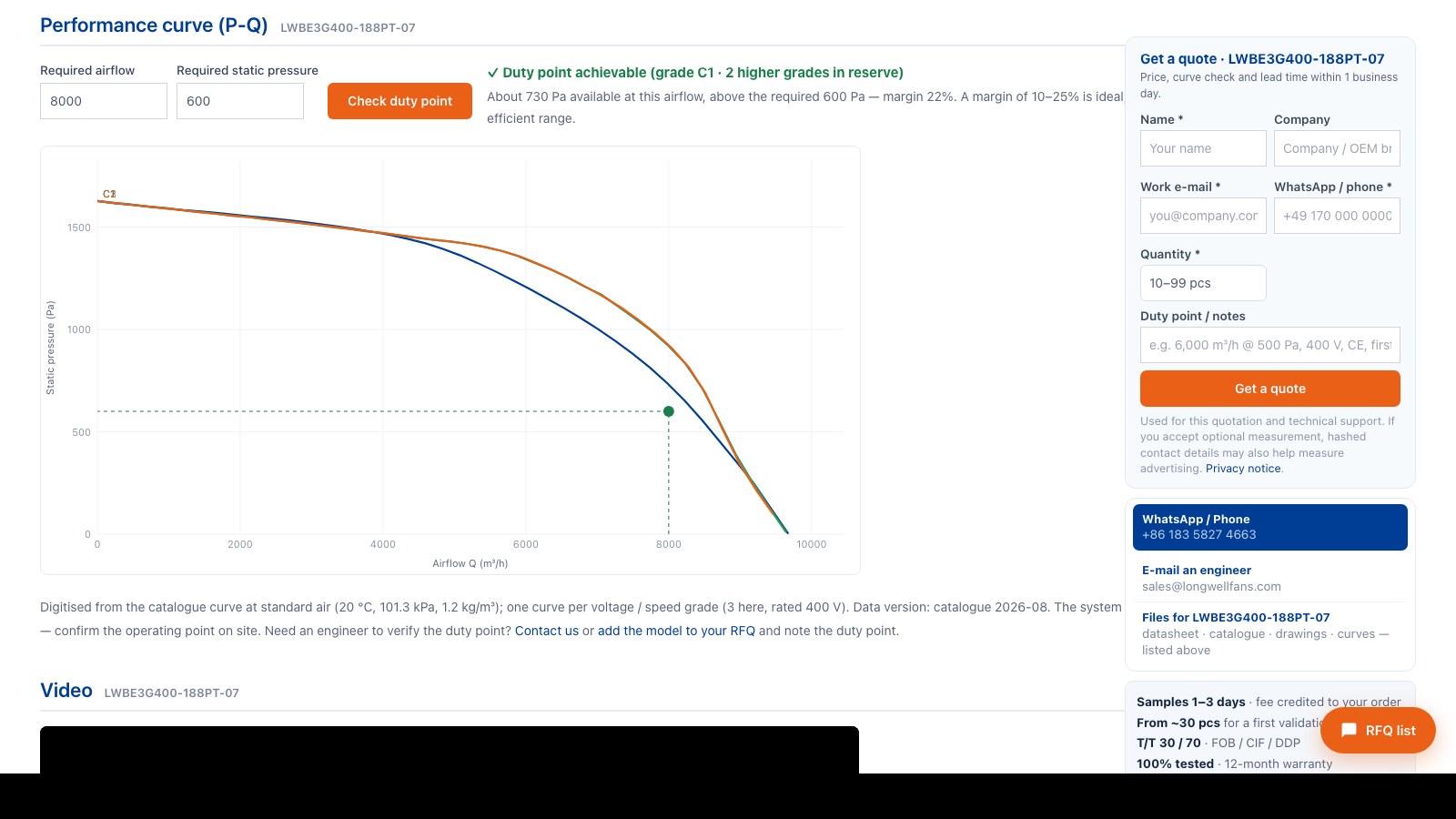
- Duty point on the tested curve, near peak efficiency rather than at the extreme.
- Wheel diameter against available cabinet depth and plenum size.
- Inlet clearance, since a nearby wall or coil costs real pressure.
- Control interface the building system can actually provide.
- Ambient temperature at the electronics, not at the impeller.
- Finally, leakage current when several units share one protective device.
Our EC plug fan range spans 250 to 800 mm wheels, which covers most air handling and array applications.
Arrays are the natural extension
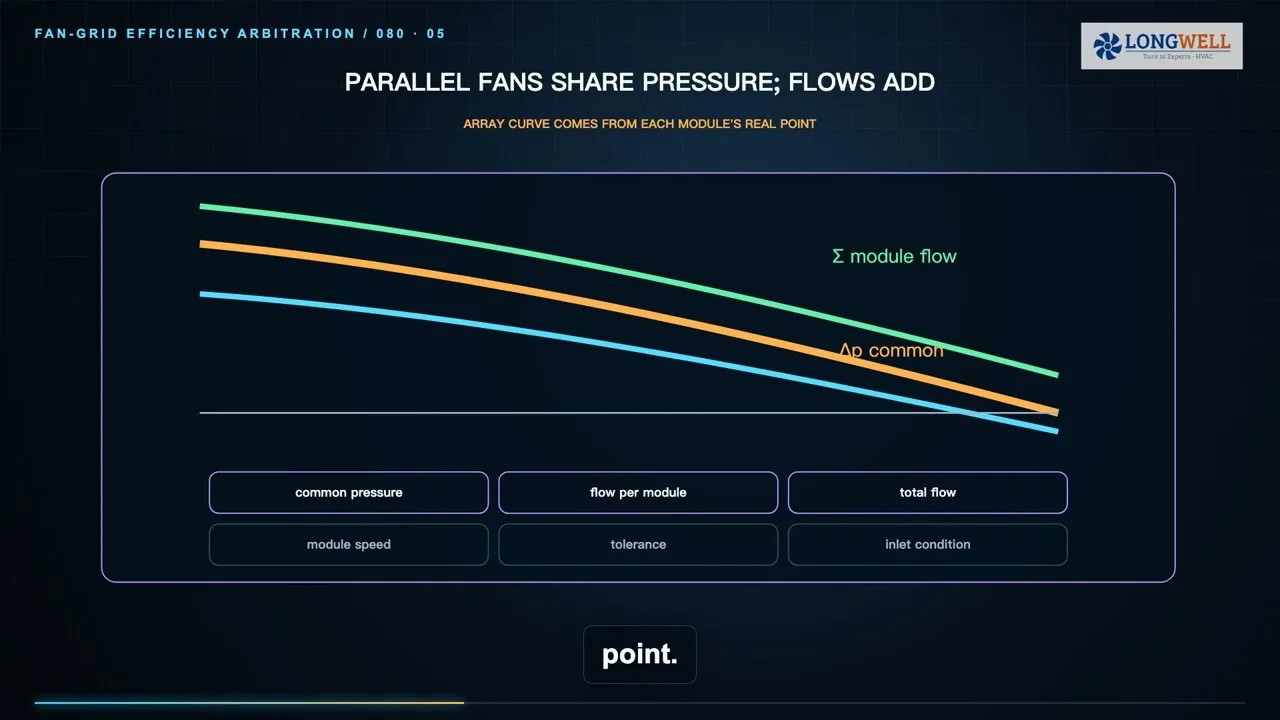
Because a plug fan blows into a plenum, several of them can share one without fighting each other.
That is what makes fan walls work, and it brings backup a single fan cannot. Meanwhile each unit is light enough to carry through a plant room door, which changes the sums on any refurbishment.
For plenum arrangement and inlet spacing guidance, ASHRAE material on air handling unit design is the usual reference.
One planning note is worth remembering on new units. Decide early whether the cabinet will hold one fan or an array, because the bulkhead, the door width and the electrical supply all follow from that choice rather than the other way round.
EC plug fan FAQ
Can an EC plug fan connect straight to a duct?
Not directly. It needs a plenum to discharge into, since there is no scroll to collect the flow. Where a duct connection is essential, a housed fan is the right choice.
What efficiency should I expect?
A good backward-curved wheel reaches 75 to 84 percent static efficiency at its best point. The installed figure depends on how close your duty point sits to that peak.
How long do they last?
Bearing life typically governs, often 40,000 hours or more at moderate temperature. Keep the electronics cool, since board temperature usually decides the rest.
Are they suitable for dirty air?
Only moderately. Backward-curved wheels tolerate light dust, although grease and fibrous material load them quickly. For those duties a radial wheel in a housing is better.
The EC plug fan became standard because it solved efficiency, packaging and control together. Select it on duty point and inlet clearance, and it will do exactly what the catalogue promises.
Choose the right ec plug fan
Longwell manufactures 82 ec plug fans in-house. Send airflow, static pressure and voltage — an engineer replies with a matching model, performance curve and price within one working day.