Industrial fan maintenance is mostly about two things: keeping bearings lubricated correctly, and catching small changes before they become failures.
Neither takes long. Both get skipped, though, because a fan that runs looks like a fan that is fine.
Grease bearings on schedule with the specified grease and quantity, since over-greasing causes as many failures as under-greasing. Inspect belts, mountings, wheel cleanliness and vibration quarterly on continuous plant. Record readings each time, because trends matter far more than single values. After a long shutdown, always rotate the shaft and check clearances before restarting.
Lubrication done properly
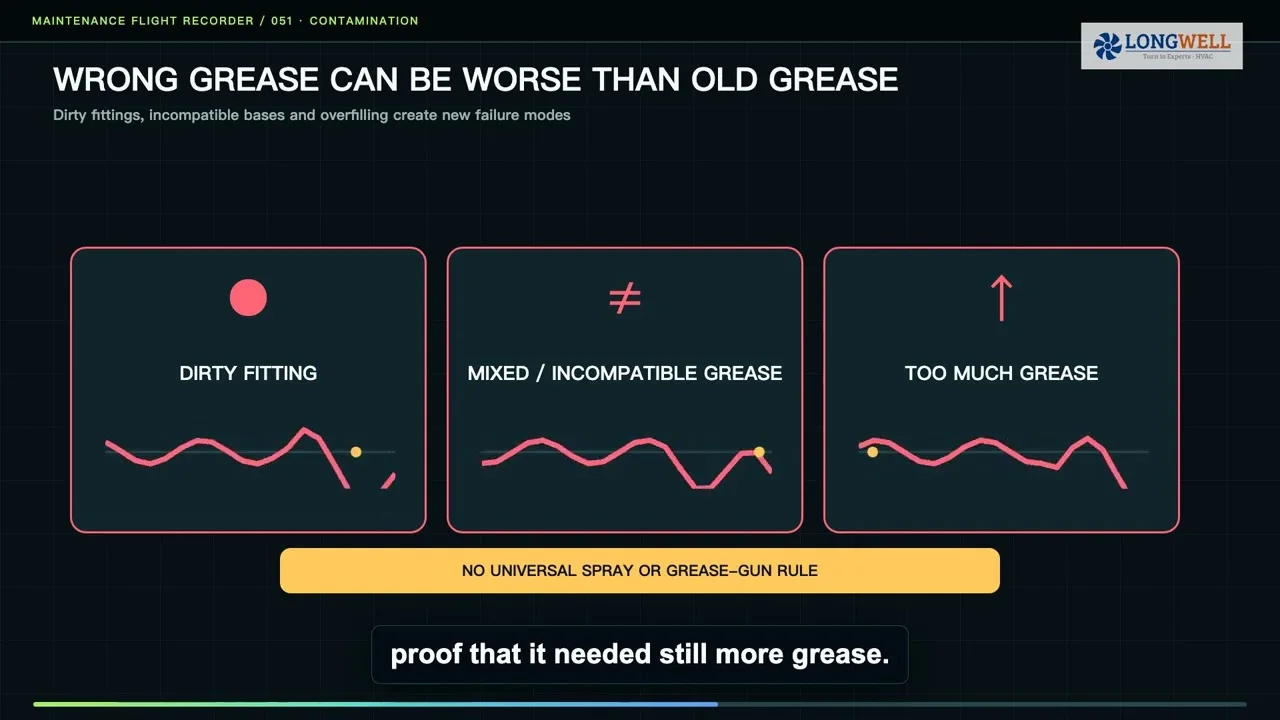
More bearings die from too much grease than from too little. Excess grease churns, heats up and then breaks down. So industrial fan maintenance starts with restraint.
- Use the grease specified by the manufacturer, since mixing types can cause separation.
- Apply the stated quantity, not until grease appears, unless instructions say so.
- Grease with the shaft turning where it is safe to do so.
- Clean the fitting before applying, because dirt injected into a bearing is fatal.
- Open the relief plug when specified, otherwise pressure pushes grease past the seal.
- Finally, log every application with the date, quantity and grease type.
Sealed bearings need nothing at all. Trying to grease them just spoils what is already inside.
Intervals that make sense
| Condition | Regreasing interval | Note |
|---|---|---|
| Under 1,500 rpm, clean, cool | 6–12 months | Follow bearing size chart |
| 1,500–3,000 rpm | 3–6 months | Higher speed shortens grease life |
| Hot air, above 60 °C | 1–3 months | Grease life halves per 10 K |
| Dusty or wet | 1–3 months | Purging keeps contaminants out |
| Vertical shaft | Shorten by half | Grease migrates downward |
| Sealed for life | None | Replace the bearing instead |
Notice how strongly heat features. Our bearing selection guide covers expected life for each type.
The quarterly inspection
- Measure vibration at each bearing and compare with the previous reading.
- Check belt tension with a gauge and inspect for glazing or cracking.
- Inspect the wheel for build-up, erosion and cracked welds.
- Confirm mounting bolts and isolator condition, since looseness mimics unbalance.
- Check the flexible connector for splits and the guard for security.
- Finally, record motor current and compare it against the baseline.
Current is an underrated clue. A slow rise usually means the wheel is filling with dirt, or a bearing has started to drag.
Cleaning the wheel
Deposits change the blade profile and unbalance the rotor, so cleaning is part of industrial fan maintenance rather than an occasional extra.
Clean with the fan isolated and locked off. Use a brush and an appropriate cleaner, never a wire brush or a chisel, and never bend a blade back into shape. Meanwhile leave every balance weight exactly where it is.
Recheck vibration once the fan is running again. A wheel that was balanced dirty will read differently clean, and heavily eroded wheels sometimes need rebalancing after cleaning.
Vibration limits worth knowing
ISO 14694 sets fan vibration limits by category and by how the fan is mounted.
As a working guide, under 2.8 mm/s RMS is good for a rigidly mounted commercial fan. At 4.5 mm/s you should look into it. At 7.1 mm/s, plan a shutdown. Flexibly mounted fans may run a little higher.
Trends beat absolute numbers, though. A fan that has doubled from 1.5 to 3.0 mm/s is telling you something even though both readings look acceptable. See ISO 14694 for the formal table.
Restarting after a long shutdown
Kit that has stood idle needs different care from kit in daily service, so industrial fan maintenance after a shutdown has its own list.
- Rotate the shaft by hand and feel for roughness or flat spots.
- Regrease bearings before the first start, since grease settles and separates.
- Check for corrosion on the wheel, especially in humid environments.
- Confirm belt condition, as belts take a set while stationary.
- Inspect for nesting, which is more common than anyone expects.
- Finally, start briefly and listen before running up to full duty.
Our industrial centrifugal fan range and industrial axial fans ship with manufacturer intervals in the manual, and following them is the cheapest reliability measure available.
Fan maintenance FAQ
How do I know if I over-greased a bearing?
Look for grease escaping past the seals and a bearing running hotter than its neighbour. Over-greasing raises churning losses, so temperature is often the first clue.
Can I mix grease types?
Generally no. Different thickeners can be incompatible, and the mixture may separate or harden. If the grease type must change, purge the bearing thoroughly first.
How often should I check vibration?
Quarterly on continuous plant, and monthly on critical or high-speed fans. Consistency of measurement position matters as much as frequency.
Is industrial fan maintenance worth outsourcing?
It depends on the number of units. A structured in-house routine with recorded readings usually beats an annual visit, since trends only appear with regular data.
Grease correctly, inspect regularly and record everything. Industrial fan maintenance is unglamorous work that quietly prevents the failures nobody budgets for.
Choose the right industrial fan
Longwell manufactures 38 industrial fans in-house. Send airflow, static pressure and voltage — an engineer replies with a matching model, performance curve and price within one working day.