For an EC fan installation, treat protective earth, the control reference and cable screening as three questions with different evidence. The correct connection is the one shown for the complete fan and controller, in the current revision of its instructions. A family name or an example circuit is not enough to choose terminals, a residual-current device or a screen termination for a project.
Start with the complete fan and controller identity
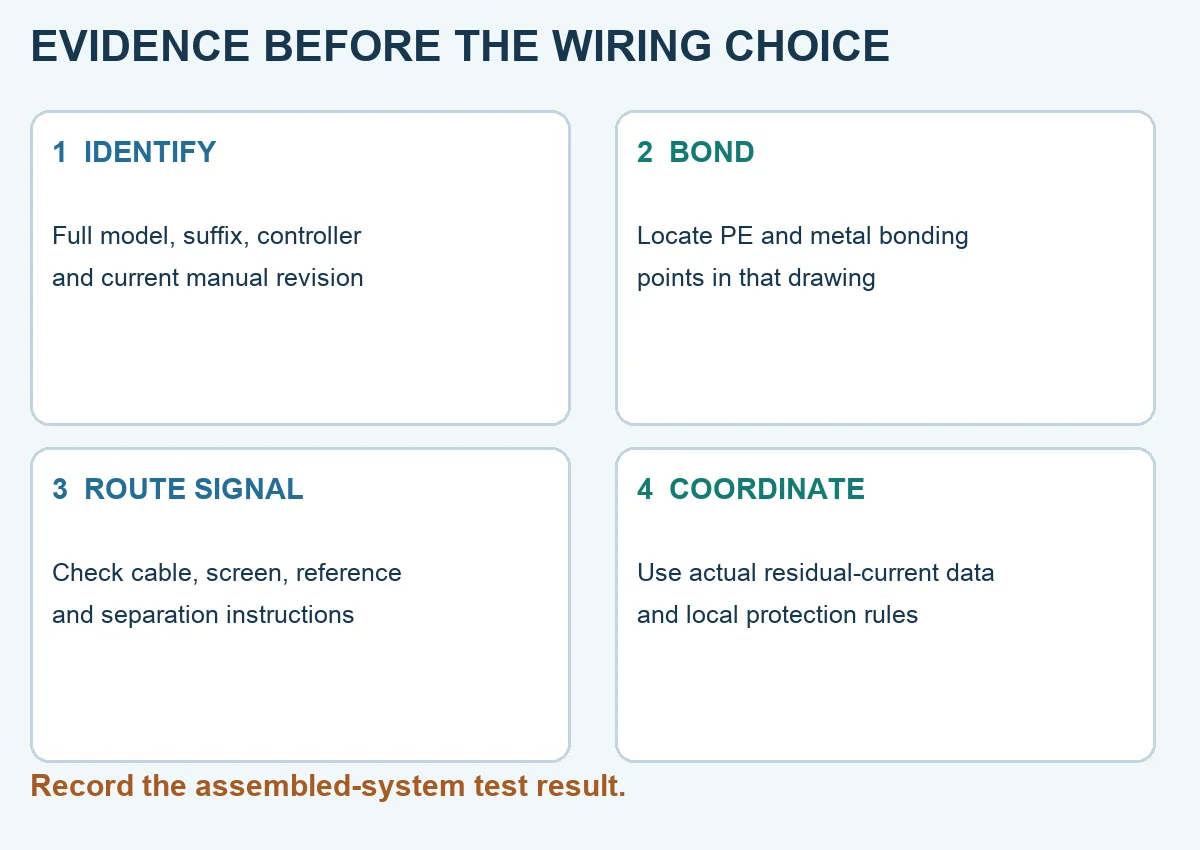
Record the full model and suffix, supply rating, controller or interface version, and the wiring-instruction revision. Then identify whether the installation is one fan, an array, or a fan inside a larger machine. The cable route, upstream protection and nearby electronics are part of that assembled system. Ask the equipment designer or qualified electrician to check the applicable local requirements before work starts. Isolate the supply and use the site’s safe electrical-work procedure for inspection or modification.
LONGWELL’s EC axial fan family and backward-curved centrifugal fan family help narrow a product search. These are family paths, not an approval to copy one model’s terminal map, leakage value or EMC test result to another suffix. Request the exact current connection drawing when choosing a candidate.
Protective earth has a safety job
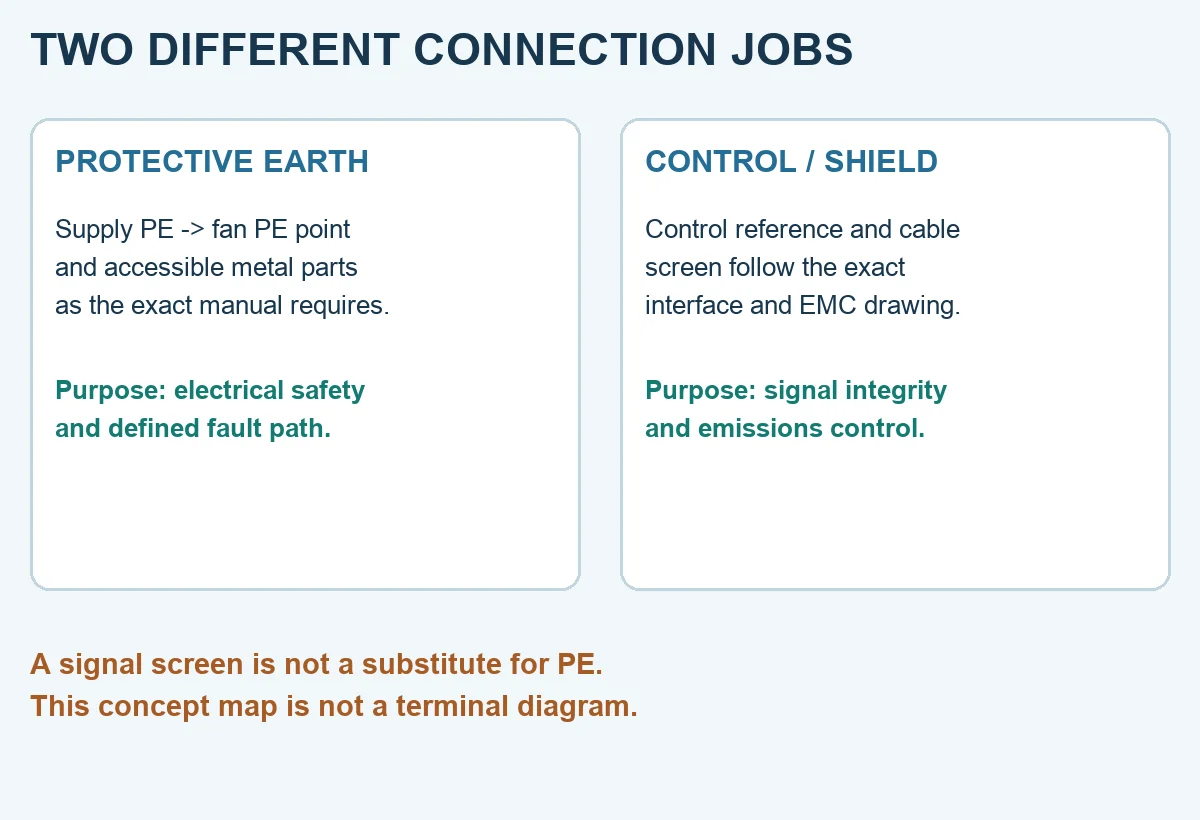
Protective earth (PE) provides the connection specified for accessible conductive parts and a defined fault path. It is not the same conductor or design decision as a low-voltage signal common. Nor can a cable screen be treated as a substitute for the protective conductor. The exact PE terminal, bonding points and conductor requirements belong to the model’s instructions and the system design.
An EC drive switches electrical current, so cable layout and filtering also matter to electromagnetic compatibility (EMC). The input filter and the installation can influence currents in the protective path, but neither the presence of a filter nor the word “EC” establishes a universal leakage value. Do not turn an illustration of an earth symbol into an installation instruction.
Control cable screening depends on the interface
An analogue speed input, a PWM input and a digital bus are different interfaces. Check the actual controller’s signal reference, cable type, maximum run, routing and screen-termination instructions. Keep control wiring away from noisy power paths where the approved design calls for separation, and record unavoidable crossings and the resulting test. A rule such as “earth the screen at one end only” is too broad: the appropriate termination depends on the interface, cable, bonding arrangement and manufacturer’s EMC design.
For an RS-485 or Modbus network, read the fan/controller instructions for topology, termination, common reference and isolation before connecting multiple units. Do not assume that PE and a bus common are interchangeable. A reliable single-fan signal does not prove that the final multi-fan bus will work. The related EC control-signal guide introduces common interface terms, but the exact fan drawing remains authoritative for wiring.
Choose residual-current protection from actual data
Residual-current protection must be coordinated with the supply system, product instructions, connected equipment and local electrical rules. Collect the specified residual-current characteristics for the exact fan or drive, the number of units, any filters and the assembled machine. Have the responsible electrical designer select the device type, sensitivity and circuit arrangement. Multiplying a guessed “milliamps per fan” figure is not a design method.
A published EC fan manual from another manufacturer may warn that power electronics and filter charging affect the choice of residual-current device. That is a useful reminder to seek model-specific data, not a value or device type to transfer to a LONGWELL installation. If an RCD trips, document when it trips, the connected loads and the measured or manufacturer-specified values before changing protection. Do not simply increase the trip threshold or remove a protective device to silence a nuisance trip.
Verify the assembled installation
A product-family description, catalogue picture or EMC report for a named test sample does not verify a different machine layout. Review the final cable routing, protective bonding, control behavior and applicable EMC checks with the completed equipment. Record the supply and control configuration, document revisions and test conditions so a later service visit can reproduce the assessment. If a new cable, filter or controller is substituted, revisit the affected checks.
Symptoms such as unstable control, communication errors or unexpected trips are reasons to investigate, not proof of one root cause. Start with safe visual inspection and the documented settings, then use appropriate measurements under the site procedure. If a conductive housing appears energized or anyone feels a shock, stop use and have a qualified person investigate the protective connection. Avoid diagnosing a particular product from a symptom list alone.
Watch the grounding and EMC explanation
The video shows the separate decisions around grounding, cable routing and interference. Use it to frame the questions for an exact-model wiring review; do not use an animation as a terminal drawing.
Choose the right backward curved centrifugal fan
Longwell manufactures 587 backward curved centrifugal fans in-house. Send airflow, static pressure and voltage — an engineer replies with a matching model, performance curve and price within one working day.