An OEM fan project becomes easier to review when every sample answers a specific question. The useful starting point is the equipment requirement, not a promise about how quickly a custom wheel can be made. This guide follows the path from a measurable brief to a sample that can be judged against agreed evidence.
LONGWELL presents product design, prototyping, testing and manufacturing as parts of its OEM service. The exact route, price, delivery schedule and approval documents still depend on the selected fan, the requested change and the project agreement. The sequence below is a decision framework, not a commitment for a particular order.
Start with the duty and the installation boundary
State the airflow and pressure at the operating points the equipment must cover. Add the expected air path, including filters, coils, grilles and nearby walls. A free-air number alone does not describe the pressure the fan will face inside a cabinet. If several operating modes matter, list each mode rather than reducing the request to one headline point.
Provide a dimensioned envelope, mounting locations, inlet and discharge clearances, supply voltage, frequency or DC range, control command and feedback requirements. Add the ambient and exposure conditions that could change the material or protection decision. For sound, agree where and how the result will be assessed; a bare decibel target without distance, duty and measurement method is difficult to compare.
LONGWELL’s OEM partner overview describes the scope of its design and testing support. A project brief should still request the specific drawing, curve and documents applicable to the proposed model and suffix.
Choose the smallest change that resolves the gap
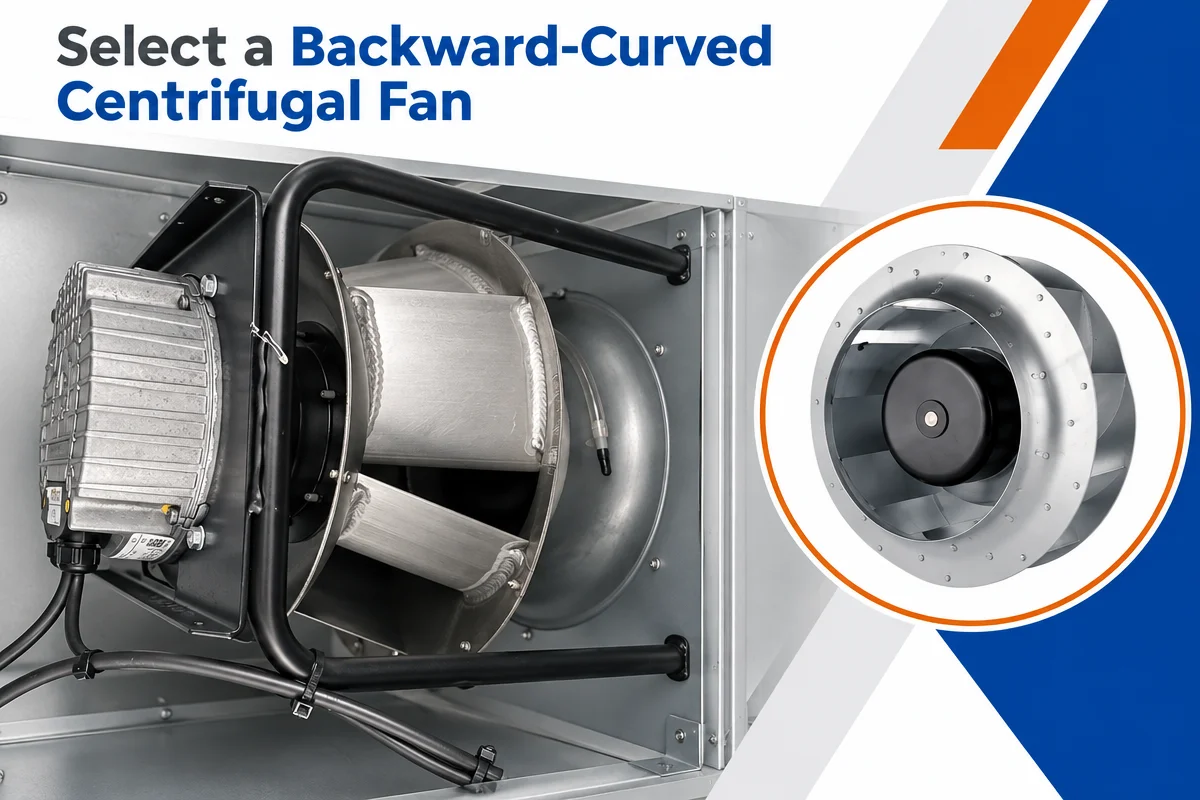
Screen an existing platform before asking for a new design. An EC axial fan family or EC backward-curved centrifugal family can be a discovery starting point, depending on the equipment air path. These family pages identify options; they do not prove that any listed fan meets this project’s duty, fit or compliance needs.
There are three practical routes. Use a standard fan when the exact item passes the application checks. Configure an existing platform when an approved connector, cable, mounting option or control setting removes the obstacle. Commission an engineered variant when a controlled product characteristic must change. A wheel, inlet or speed change may affect the duty curve and other measured characteristics, so carry forward only the evidence that still applies.
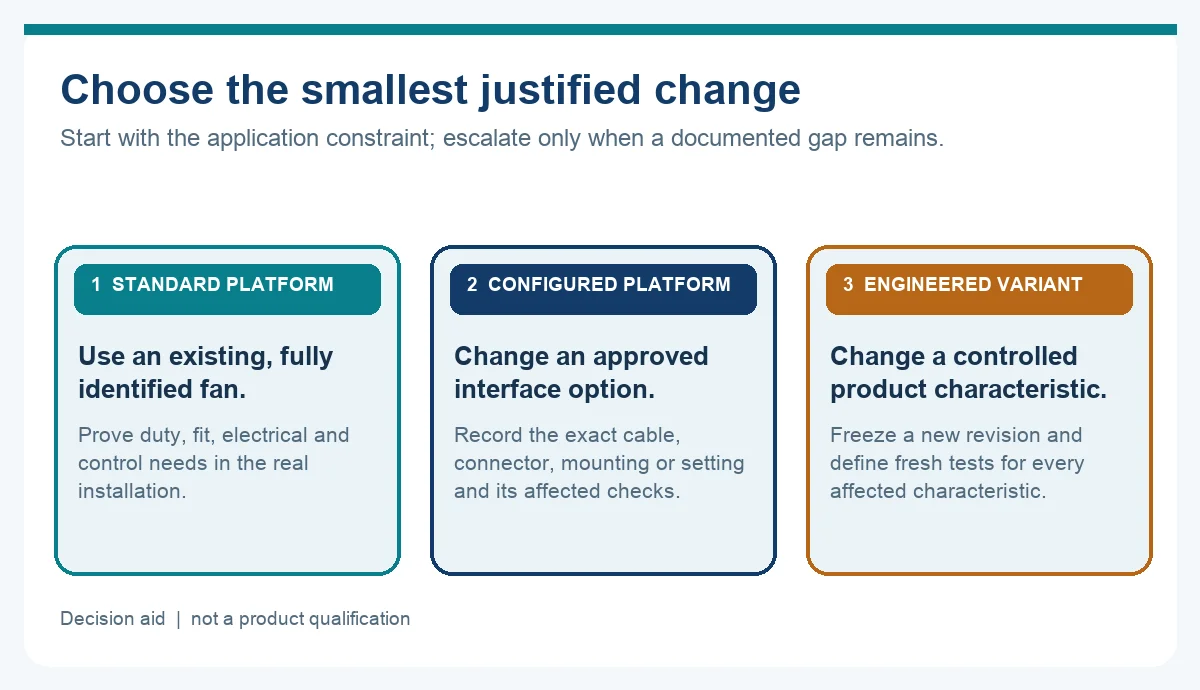
The standard-versus-custom decision guide gives a fuller screen. Ask the supplier to name the precise part and revision for each proposed route, identify what changes, and list the checks that need repeating. No universal annual-volume threshold or tooling payback can be inferred without the actual programme costs and expected life.
Define the sample’s purpose before it is built
A fit sample can answer whether mounting holes, space and service access work. It may not represent final aerodynamic or acoustic performance. An engineering sample can test a stated build at stated conditions, but its findings belong to that configuration. A production-representative build is needed before the final release evidence can be assembled. The sample label should travel with the drawing revision, bill of materials and test conditions.
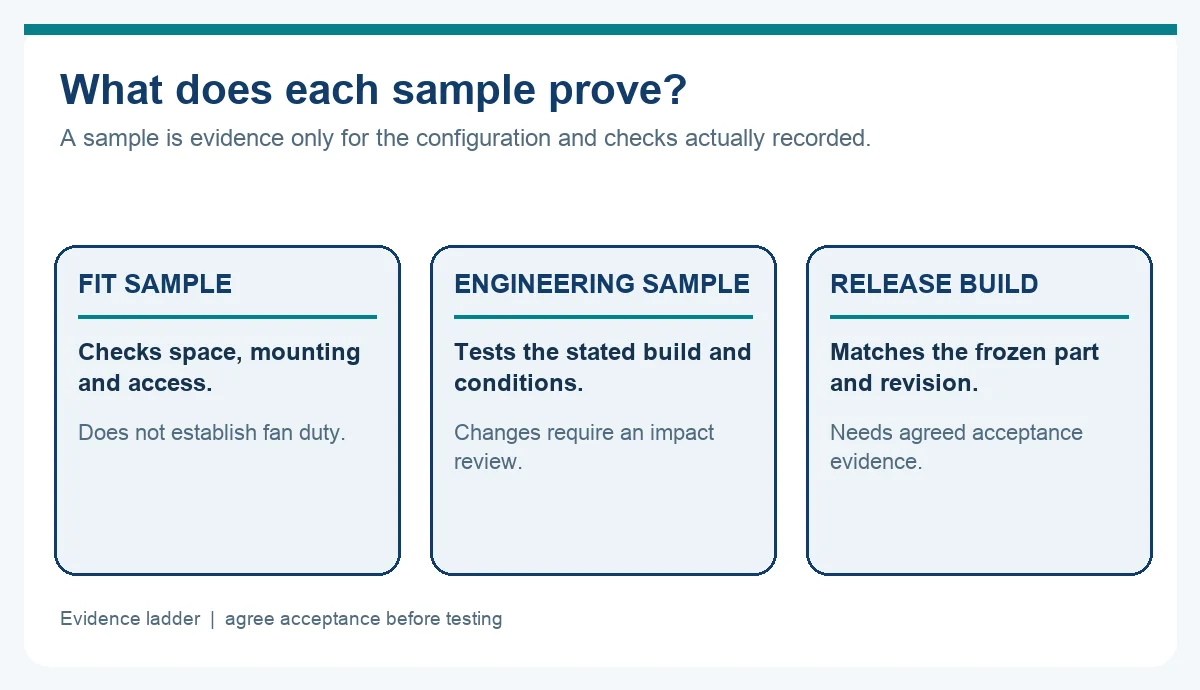
Agree the question for each sample in writing: what will be measured, where it will be measured, which limits apply and who accepts the result. If a prototype uses a different material, surface finish, connector or motor setting, record that difference rather than treating all samples as interchangeable. Changes after a test need an impact review before the old result is reused.
Test the fan and the equipment separately
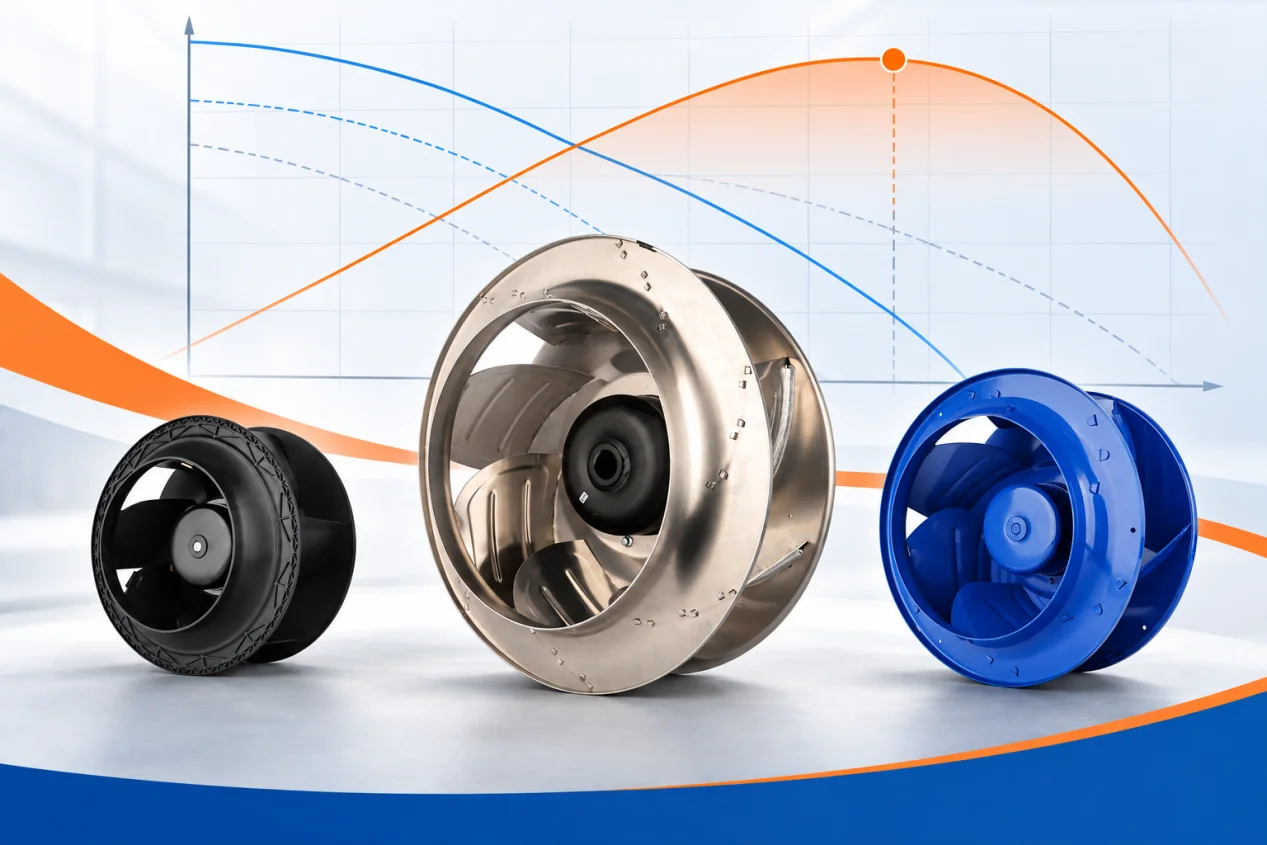
Bench fan measurements and installed-equipment behaviour answer related but different questions. Request a fan curve tied to the exact model, suffix and test configuration. Check the duty point against system resistance, then test the candidate in the actual equipment air path. Inlet restrictions, discharge fittings and nearby surfaces can shift what the assembly delivers.
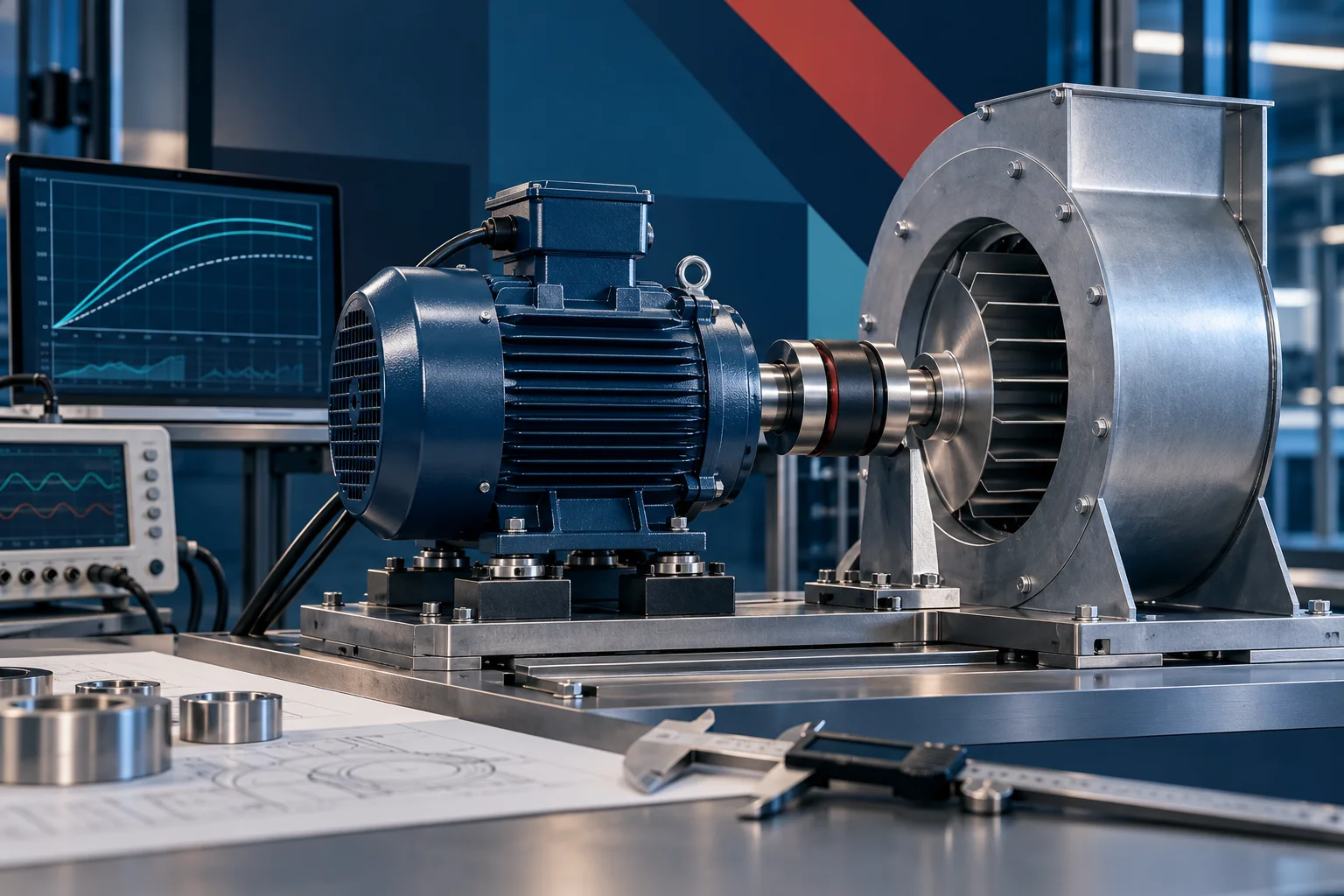
Electrical, thermal, acoustic, vibration and environmental checks should follow the risks in the brief. Name the test method and acceptance limit before testing. A standard’s method, a test report and a certification are not the same document. Ask for the current report or declaration that covers the exact part and intended market; do not assume a company-level statement covers every variant.
Freeze what was approved for release
A passing sample alone does not define a repeatable production item. Release the exact part number and suffix, drawing revision, electrical interface, approved materials, test conditions and acceptance criteria. Agree how substitutions and revisions are notified. Keep the equipment-level result alongside the fan-level result so later buyers can see which assembly was actually checked.
A limited pilot can reveal assembly or inspection issues before wider production, but its quantity and timing should be set for the project rather than copied from a generic example. Define the inspection record and the response to a nonconforming unit before the pilot starts. The company overview shows the publicly described manufacturing and testing context; project-specific acceptance still requires the relevant controlled records.
Send a brief that can be reviewed
Send the duty map, system-resistance information if available, dimensioned envelope, electrical and control interface, operating environment, sound boundary, target market, expected volume range and desired sample decision. Flag which inputs are estimates. Ask the supplier to return a proposed product identity, the route from standard to configured or engineered, missing inputs, required tests, revision controls and an agreed schedule. That response is more useful than a fixed lead-time claim detached from the design.
The practical goal is simple: one named configuration, one set of agreed checks and a clear statement of what the first sample can prove. If the brief changes, update the sample and evidence plan before interpreting the result.
Discuss your OEM fan requirement: send the duty, drawing and electrical interface to sales@longwellfans.com.