What the OEM specified
A European OEM building premium fan coil units and air curtains asked us for a custom cross-flow impeller in three sizes.
All three share a 660mm length, while the diameters differ: 110mm, 120mm and 150mm. Their products need a wide, even sheet of air and very little noise. That is exactly what cross-flow geometry does well.
The constraint that arrived late
Their first documents called for a 25mm steel shaft. Then, partway through, a new compact motor housing changed that to 20mm, plus or minus 0.3mm.
Five millimetres does not sound like much. However, it lands squarely on the hub-to-shaft interface, so the drawings had to be reworked rather than annotated.
- Shaft diameter of 8mm to an h7 fit, meaning -0.005 to -0.010mm, for a press-fit bearing.
- Aluminum alloy, chosen for low weight and corrosion resistance.
- Residual unbalance under 300mg measured at 1500 RPM.
- A common 660mm length across all three diameters.
That balance figure governs everything else. Below 300mg at 1500 RPM, a cross-flow impeller of this span will not hum in a quiet room.
Building the cross-flow impeller family
We ran this as light development. In other words the work sat in updating proven designs, not in inventing one.
Why cross-flow was already decided
The customer had settled the fan type before contacting us, and rightly so. A cross-flow impeller produces a wide, linear air sheet at low static pressure. Meanwhile neither an axial nor a centrifugal fan gives that profile inside the same slim envelope.
The material question
Aluminum was specified. Even so, we checked the choice rather than assumed it.
Plastic costs less. However, over a 660mm span it lacks the stiffness to hold a sub-300mg balance at 1500 RPM. As a result the part would flex, and the balance would drift.
Steel holds shape well, yet its weight and inertia push the motor selection up a size and slow every start. Consequently aluminum was the right call, and we said so.
What we actually delivered
Here the team updated the CAD models, redrew three sets of manufacturing drawings, and reviewed the hub interface against the shorter shaft. Meanwhile production programmed the balancing machines for the new part numbers.
Three cross-flow impeller models came out of it: LWMI-110*660-01, LWMI-120*660-01 and LWMI-150*660-01. Each ships balanced and ready to drop onto the customer assembly line.
Technical Specifications
Three diameters, one length, one shaft. Here the tolerance columns matter more than the headline numbers.
| Parameter | LWMI-110*660-01 | LWMI-120*660-01 | LWMI-150*660-01 |
|---|---|---|---|
| Model Number | LWMI-110*660-01 | LWMI-120*660-01 | LWMI-150*660-01 |
| Impeller Diameter | 110 +0.5/0 mm | 120 +0.5/0 mm | 150 +0.5/0 mm |
| Impeller Length | 660 ±2 mm | 660 ±2 mm | 660 ±2 mm |
| Shaft Diameter | Ø8 mm (-0.005/-0.010) | Ø8 mm (-0.005/-0.010) | Ø8 mm (-0.005/-0.010) |
| Shaft Length | 20 ±0.3 mm | 20 ±0.3 mm | 20 ±0.3 mm |
| Blade Count (Z) | 45 | 48 | 50 |
| Material | Aluminum Alloy | Aluminum Alloy | Aluminum Alloy |
| Dynamic Balance | <300mg Residual Unbalance @ 1500 RPM | ||
| Shaft End Runout | ≤ 0.10 mm | ||
| Rotation | CCW | ||
Technical Documentation
The following documents were generated and approved as part of this light development project. The drawings provide all dimensional and tolerance data required by an OEM’s quality assurance and integration teams.
LWMI-φ110×660-01.pdf: This manufacturing drawing provides all critical dimensions, materials, and tolerance specifications for the LWMI-110*660-01 impeller, essential for quality control and incoming inspection teams.
LWMI-φ120×660-01.pdf: This manufacturing drawing provides all critical dimensions, materials, and tolerance specifications for the LWMI-120*660-01 impeller, essential for quality control and incoming inspection teams.
LWMI-φ150×660-01.pdf: This manufacturing drawing provides all critical dimensions, materials, and tolerance specifications for the LWMI-150*660-01 impeller, essential for quality control and incoming inspection teams.
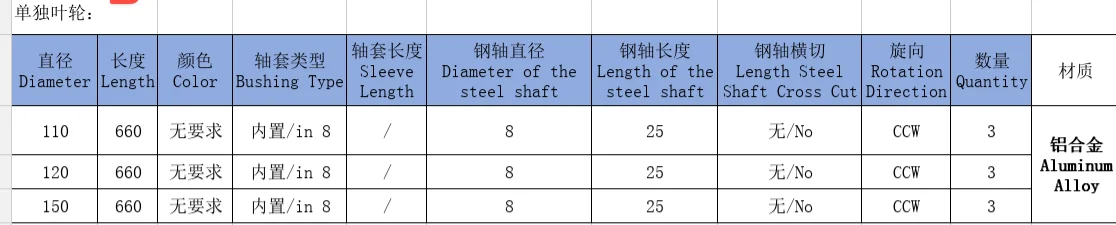
Meanwhile the image above shows the customer’s initial specification table, highlighting the original 25mm shaft length requirement that was later modified to 20mm during the engineering review.
Why the OEM came to us for a component
This was a component order rather than a fan order, and that distinction is the point.
- Late changes without schedule damage. A 5mm shaft change went through our light development route, so drawings and part numbers were released in days. Consequently the OEM kept a late design decision without moving their production date.
- We make the impellers ourselves. Buying the cross-flow impeller directly from the maker removes a tier from the supply chain. It also means the engineer who can answer a tolerance question actually works on the part.
- Balance is a test, not a target. The sub-300mg figure is checked on every unit on automatic equipment, under ISO 9001 processes. So the OEM gets the same vibration behavior on unit 5,000 as on the sample.
- Component cost. The tolerances and verified balance grades here match what top European brands deliver, at a materially lower component price. That lands straight on the bill of materials.
Browse the cross flow fan range, or the cross flow impeller section. Balance grades come from ISO 21940.
Questions about custom impellers
How quickly can custom impeller samples be made?
For a light development change like a shaft length, engineering drawings come back in 3 to 5 working days. Physical samples follow within 2 to 3 weeks of drawing approval. A ground-up new design is different: that runs our full 90-day NPI process from spec lock to first samples.
Can a 660mm impeller be made in something other than aluminum?
Yes. We build the same cross-flow impeller in galvanized steel and in reinforced plastics. However, at 660mm and 1500 RPM we push customers towards aluminum or steel, since plastic will not hold a tight balance over that span. Plastic still works well on shorter or slower parts.
Can the balance tolerance be tightened below 300mg?
Usually yes, though it is worth asking what the tighter figure buys you. Below a certain point the gain is invisible in the finished appliance while the reject rate climbs. Send us the vibration limit at the product level and we will work backwards to the impeller figure.
Do you supply the impeller alone or the complete fan?
Either. This customer had their own motor and housing, so they wanted the cross-flow impeller alone. Other OEMs prefer a matched impeller and motor assembly. Both routes are normal for us.
Technical Documentation & Resources
Need the same thing for your own unit?
Give us the numbers and the envelope, and you get a shortlist rather than a catalog. Meanwhile custom spec sheets and samples run to 90 days. Since 1990 Longwell has supplied EC fans and blowers to OEMs in HVAC, cold chain, data center and industrial markets.
Browse Related Products:
🏆 ISO 9001 / ISO 14001 / ISO 45001 | CE (TÜV) | UL/ETL | ATEX Zone 21/22 | AMCA 210/211 / ISO 5801 tested
Choose the right cross flow impeller
Longwell manufactures 17 cross flow impellers in-house. Send airflow, static pressure and voltage — an engineer replies with a matching model, performance curve and price within one working day.