What the OEM asked for
An OEM approached us for a dual-speed inline duct fan to sit inside their own ventilation product line.
Their brief was short: send the specification sheet. That told us plenty. Clearly they were not after a new design. Instead they wanted a proven, documented standard product they could qualify quickly.
The hard numbers
- First, it had to fit standard 125mm circular duct, inside a 295mm by 178mm envelope.
- Second, power was European domestic supply: 220V at 50Hz.
- High speed had to give 319 m3/h against 185 Pa, while low speed gave 205 m3/h at 135 Pa.
- Noise could not exceed 32 dB(A), since the fan goes into homes and small commercial spaces.
- Finally, the ambient range ran from -20C to +50C.
For market access they needed CE marking, RoHS compliance and conformity to EN 60335-1. Furthermore, they wanted the performance data verified to ISO 5801 rather than simply stated.
Choosing the inline duct fan
This was specification matching rather than design work. Even so, two decisions deserved care.
We considered EC and rejected it
An EC version came up early, since EC motors are more efficient. Moreover they give smooth variable speed from a 0-10V or PWM signal.
However, the customer asked for two fixed speeds. Not a range. Two.
Paying for infinitely variable control and then wiring it to two settings makes no sense. A SmartEC motor would have pushed the bill of materials up sharply and put the end product price out of reach. So we said no to our own more expensive option.
How two speeds were delivered instead
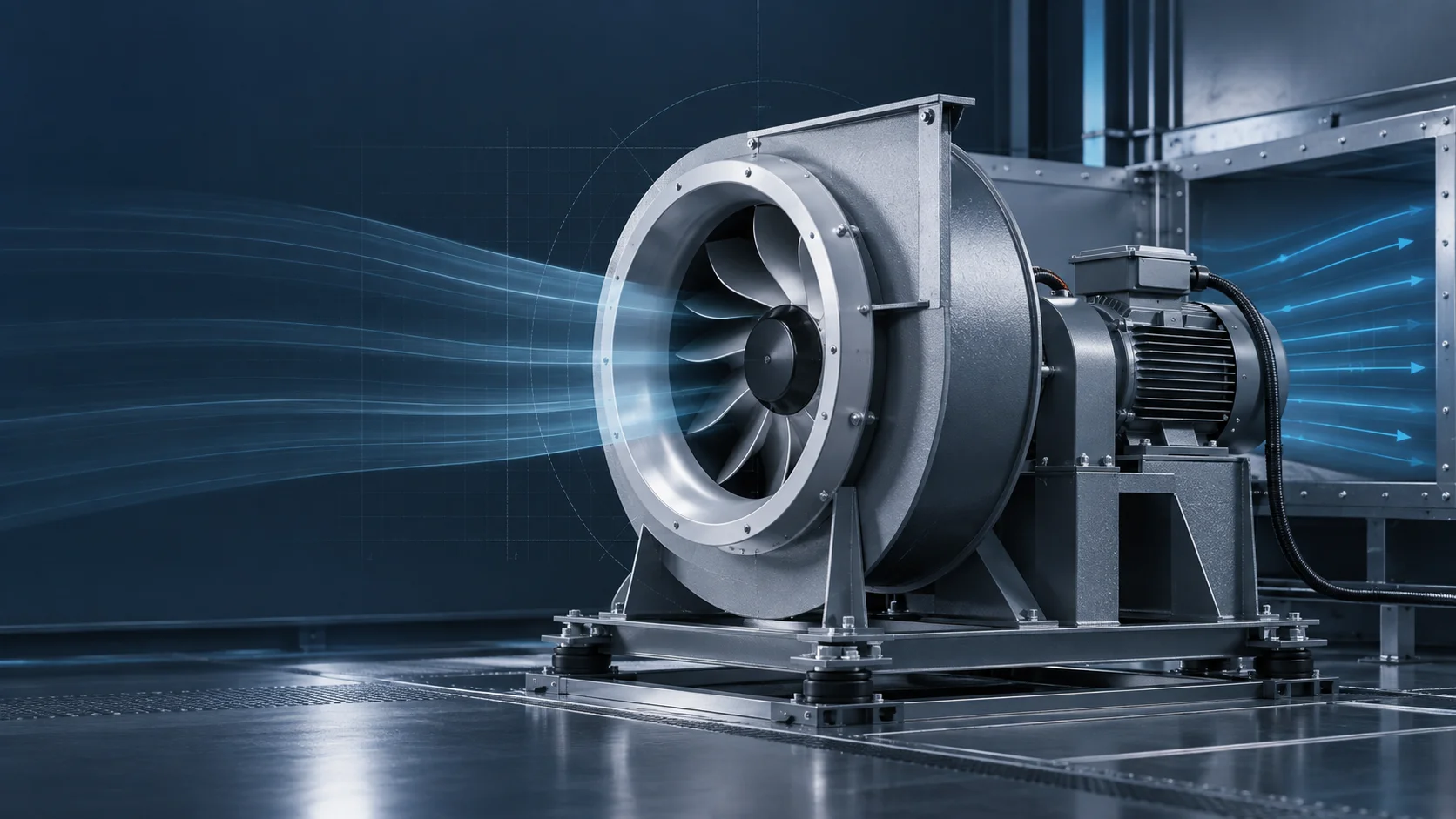
The chosen inline duct fan uses an AC external rotor motor with an extra tap on the windings. High or low is selected by which terminal the live wire lands on, with no controller involved anywhere.
In practice that suits the real use case, which is usually a day and night setting.
Impeller and housing
Inside the tube sits a backward-curved centrifugal impeller rather than an axial rotor. An axial fan simply cannot build 185 Pa in this diameter. Meanwhile resistance from the ducting and filters demanded exactly that.
Here the housing is plastic instead of sheet metal. That cut cost and weight together. Furthermore plastic damps noise, which helped reach the 32 dB(A) figure.
The approved inline duct fan was the LWDA-125(5″)S-PBN-002S, rated for 50,000 hours L10 life.
Technical Specifications
Both speeds appear below. Note how little power the low setting draws for two thirds of the airflow.
| Parameter | Value |
|---|---|
| Model Number | LWDA-125(5″)S-PBN-002S |
| Voltage | 220 V |
| Frequency | 50 Hz |
| Speed (High/Low) | 2600 / 2200 RPM |
| Rated Input Power (High/Low) | 40 / 32 W |
| Airflow (High/Low) | 319 / 205 m³/h |
| CFM (High/Low) | 187 / 121 CFM |
| Max Static Pressure (High/Low) | 185 / 135 Pa |
| Noise Level (LpA) | 32 dB(A) |
| Protection Type | IP44 |
| Insulation Class | F |
| Ambient Temperature Range | -20°C to +50°C |
| Life Expectancy (L10) | 50,000 Hours at 25°C |
| Housing Material | Plastic |
| Dimensions (Duct Diameter x Length) | 125 mm x 295 mm |
| Certifications | CE, RoHS, FCC |
Technical Documentation

Meanwhile the product image provides a visual reference of the fan’s external construction, inlet/outlet configuration, and integrated mounting bracket. Procurement managers use this for initial identification.
LWDA-125(5″)S-PBN-002S Datasheet (PDF)
This is the final specification sheet, containing all mechanical drawings, P-Q performance curves, electrical data, and certification details. Design engineers and quality teams rely on this document for product integration and qualification.
Why the OEM chose us
For an OEM, choosing an inline duct fan is really a decision about documentation, price and risk.
- Cost structure. As a vertically integrated manufacturer we make the motor, the impeller and the casing of this inline duct fan ourselves. That is what let the customer hit their own product price without asking us to remove anything from the specification.
- Documentation on the first pass. The request was a spec sheet, so that is what came back, complete with performance and certification data. Consequently their engineers could start system integration immediately instead of chasing missing figures.
- Numbers that hold up. The 319 m3/h and 185 Pa figures come from our own labs testing to AMCA 210/211 and ISO 5801 methods. They are repeatable measurements rather than catalog optimism, which matters when a redesign costs months.
- Fewer warranty claims. The 50,000-hour L10 rating rests on maintenance-free deep groove ball bearings and on making motors here since 1990. Field failures on a ventilation product are expensive, so reliability is a commercial argument as much as a technical one.
See the inline duct fan range, or the wider duct fan section. Appliance safety sits under IEC 60335-1.
Questions about this fan
What is the difference between the -002 and the -002S?
The -002 runs at one speed only, 2600 RPM. Meanwhile the S suffix marks the dual-speed build, which adds a winding tap so the motor also runs at 2200 RPM. Everything else about the two fans is identical.
How is the speed selected?
By wiring, not by a controller. The datasheet wiring diagram gives separate terminals for each setting. The installer takes the incoming live to the LA terminal for high speed, or to LD for low speed. Consequently there is nothing to fail electronically and nothing to configure.
What are the lead time and minimum order quantity?
Here the inline duct fan is a standard model, so it is often in stock. In-stock orders up to 200 units ship in 1 to 5 working days. Meanwhile make-to-order quantities of 100 to 500 units run 15 to 25 working days from purchase order confirmation.
Would an EC version ever be worth the extra cost here?
Yes, in two cases. If the system needs demand-controlled ventilation driven by a sensor, or if the fan runs long hours where the energy saving repays the price difference. For a two-setting product running intermittently, the AC version is the better commercial answer.
Technical Documentation & Resources
Have a fan requirement like this one?
Send the datasheet you are working against, or simply the duty point. Then our engineers tell you what fits and what does not. Meanwhile custom spec sheets and samples take up to 90 days. Since 1990 we have been building fans for OEMs worldwide.
Browse Related Products:
🏆 ISO 9001 / ISO 14001 / ISO 45001 | CE (TÜV) | UL/ETL | ATEX Zone 21/22 | AMCA 210/211 / ISO 5801 tested
Choose the right duct fan
Longwell manufactures 254 duct fans in-house. Send airflow, static pressure and voltage — an engineer replies with a matching model, performance curve and price within one working day.