Designing a Wide Voltage DC Fan for Window Venting
A customer asked us to engineer a wide voltage dc fan for home window ventilation. First, the application required a unit to mount directly into residential glass panes. The customer needed a massive 110-270V input range at 60Hz. Therefore, the wide voltage dc fan had to survive highly unstable power grids.
Sudden voltage drops destroy normal motors. Next, the project carried strict physical space limits. The wide voltage dc fan needed an outer frame of exactly 210 mm. It also required a strict depth limit of 38 mm to avoid hitting window blinds.
Furthermore, the wide voltage dc fan required a manual pull-cord shutter mechanism to block outside air. However, the main binding constraint was an extremely tight unit cost target. The client ordered 20,000 units of the 150 mm version. They also ordered 10,000 units of a larger 200 mm version at the same time.
Consequently, they explicitly permitted us to use lower-grade housing materials. This choice helped them hit their strict financial goals for retail sales. Meanwhile, the equipment still had to deliver reliable mechanical airflow. It also needed to comply with basic household appliance safety rules.
By contrast, premium engineering plastics would price the product out of its market. So, our team balanced a costly motor against a cheaper plastic chassis.
Evaluating Motor Designs and Financial Limits
Our engineers evaluated multiple motor designs for this high-volume project. First, a standard AC shaded-pole motor looked attractive for budget reasons. Shaded-pole motors cost very little to manufacture. However, an AC motor operates strictly on a narrow voltage band. It cannot span a broad 110-270V range safely. If grid voltage drops, the wide voltage dc fan stalls and overheats. If voltage spikes, the coils burn out. Therefore, we rejected the AC option. Next, we looked at a basic DC motor with a bulky external power adapter. Even so, the 38 mm depth limit made an external brick impossible.
Instead, we selected a brushless DC motor containing a built-in voltage conversion circuit. This setup allows the wide voltage dc fan to accept fluctuating AC mains power safely. It then feeds perfectly stable DC power to the wide voltage dc fan coils. Consequently, the fan spins at a steady 2000 RPM regardless of grid behavior.
Circuit Design and Cost Impacts
This electrical upgrade introduced a materially higher cost to the internal components. The internal conversion circuit requires heavy-duty capacitors and rectifiers that basic residential fans lack. Consequently, we had to extract equivalent financial savings from the mechanical structure. We looked closely at the plastic injection parts. The customer had already agreed to lower-quality plastics for the housing to save money. So, we replaced high-grade virgin ABS with a much more economical polymer blend. We used this cheaper plastic for both the 210 mm outer ring and the clear rear flap.
Material Selection Trade-offs
This specific material decision cost the design some physical impact resistance. Specifically, the cheaper polymer is slightly more brittle during the factory assembly phase. Furthermore, assembly workers must handle the frames carefully to avoid cracking the mounting tabs. However, window exhaust fans remain entirely static once installed in a wall. Post-installation physical impact risks are practically zero. Therefore, the cheaper material works perfectly for the actual application. In short, the lower impact strength does not harm the end user at all.
Final Mechanical Features
Finally, we integrated a manual pull-cord mechanism to operate the backdraft shutter. A simple manual cord avoids the heavy cost of adding electronic actuator motors. Next, we finalized model LWED150(6″)JP-404. It delivers a 150 mm impeller diameter and a slim 38 mm profile. Furthermore, we attached a dedicated British plug on a 300 mm wire to speed up final installation. Thus, the final product met the strict budget without sacrificing electrical safety.
Technical Specifications
| Parameter | Value |
|---|---|
| Model Number | LWED150(6″)JP-404 |
| Impeller Size | 150 mm (6 inch) |
| Outer Frame Diameter | 210 mm |
| Maximum Depth Limit | 38 mm |
| Input Voltage Range | 110-270V |
| Input Frequency | 60 Hz |
| Rated Speed | 2000 RPM |
| Order Volume | 20,000 units (150 mm) |
| Secondary Volume | 10,000 units (200 mm) |
| Power Connection | British plug, 300 mm wire |
The massive 110-270V voltage range dictates the entire engineering approach for this model. Consequently, the unit operates safely even when municipal power grids fluctuate wildly. Furthermore, the 38 mm depth measurement confirms it fits flush against thin window glass. Finally, the 2000 RPM speed ensures adequate air exchange for residential rooms.
Reference: AMCA 210 covers the test method behind these figures.
Technical Documentation
LWED150(6″)JP-404 Specification Drawing
This PDF drawing clearly details the 210 mm outer dimensions and the strict 38 mm depth constraint. Next, systems engineers need this exact file to confirm clearance for glass window mounting.
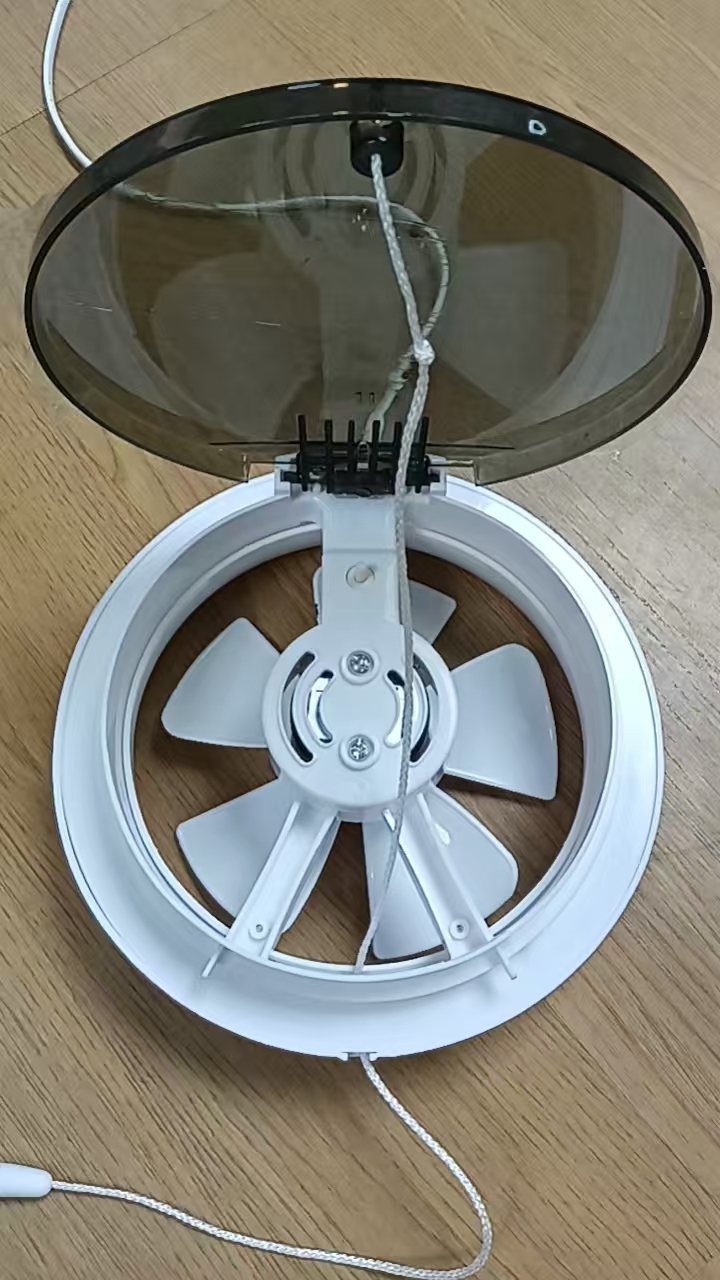
An open flap view directly displays the manual pull-cord mechanism and the clear backdraft shutter.
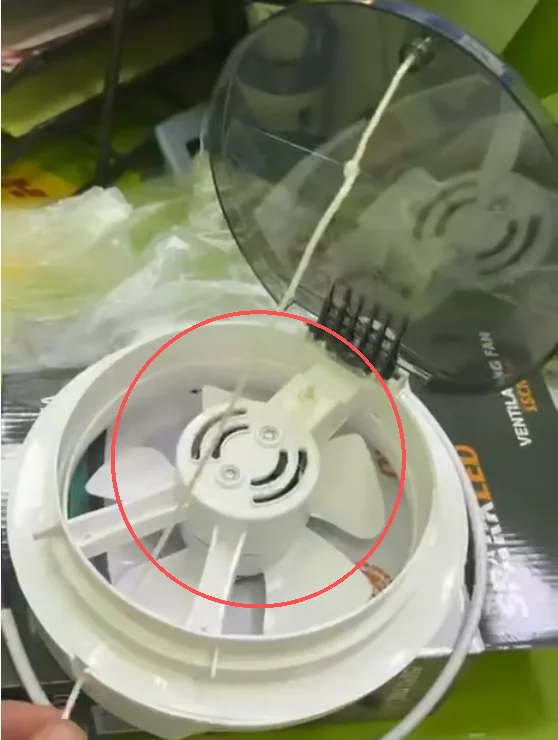
Our assembly engineers enclosed the sensitive voltage conversion circuit safely behind the five-blade impeller assembly.
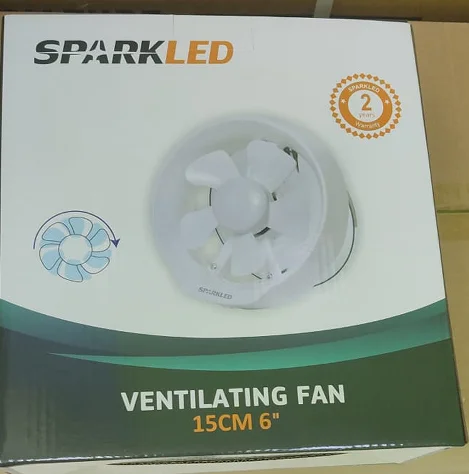
Retail packaging visibly highlights the final 15 cm sizing and formally confirms the two-year warranty offering.
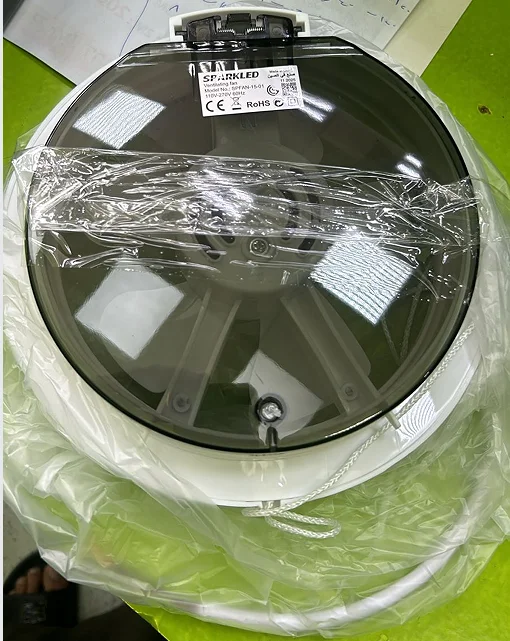
Finally, the completed production unit wears a factory rating plate confirming the critical 110-270V input capability.
Specifying High-Volume Window Exhaust Fans
Engineers facing similar extreme budget constraints should consider the following practical design steps carefully.
- First, identify your non-negotiable electrical requirements early. Specifying a broad input range prevents motor failure in regions with poor grid stability. Consequently, you save money on warranty claims later.
- Furthermore, document all auxiliary components in the initial project brief. Specifying a 300 mm wire with a regional British plug early prevents expensive rework on the final assembly line.
- Finally, high-volume orders easily justify custom factory modifications. Our standard NPI process allows us to adjust plastic injection molds if alternative blended polymers exhibit different cooling shrinkage rates.
Related: Exhaust Fans.
Frequently Asked Questions
Technical Documentation & Resources
Browse our axial fans range, the AC axial fans section, or EC axial fans.
Have a Similar Fan Requirement?
Longwell’s engineering team delivers custom spec sheets and samples within 90 days. Since 1990, we have supplied EC fans and blowers to OEMs across HVAC, cold chain, data center, and industrial applications worldwide.
Browse Related Products:
🏆 ISO 9001 / ISO 14001 / ISO 45001 | CE (TÜV) | UL/ETL | ATEX Zone 21/22 | AMCA 210-16 / ISO 5801 tested
Choose the right dc fan
Longwell manufactures 4 dc fans in-house. Send airflow, static pressure and voltage — an engineer replies with a matching model, performance curve and price within one working day.