What the heat pump OEM asked for
An OEM building a new air-source heat pump range for North America needed a heat pump evaporator fan.
Their duty point was modest: 805 m3/h against 16.7 Pa. That low pressure describes a heat pump evaporator fan pulling air through an outdoor coil with very little in the way.
The stated constraints
- First, a 300mm AC axial fan with a square mounting panel.
- Next, 120V at 60Hz, fixed speed, for North American residential supply.
- Meanwhile IP44, since the unit sits outdoors and gets rained on.
- Finally, power consumption under 25W.
Additionally they wanted 3 to 4 prototypes, with a first production run of 500 units.
Three of those four constraints were routine. The fourth was the problem.
Why this heat pump evaporator fan missed 25W
In short, the duty point and the power target did not belong to the same fan.
Running the numbers
Moving 805 m3/h at 16.7 Pa is roughly 3.7 watts of air power. Hitting that on under 25W of input means the whole chain, motor and impeller together, has to run near 15% wire-to-air efficiency.
That is achievable, though only with an optimized brushless EC motor and a matched impeller. Consequently no 300mm AC axial fan reaches it.
The contradiction in the brief
The same brief asked for a basic fixed-speed motor and a competitive price for a new product line. Those two requirements point away from EC, while the 25W figure points straight at it.
So we said that plainly rather than quoting something that would disappoint. An EC fan meets 25W and costs considerably more. An AC fan meets the price and does not.
What we recommended
We treated airflow, pressure, voltage and dimensions as the binding constraints, and the power figure as a target rather than a requirement.
Here the proposed heat pump evaporator fan is a 300mm axial with a five-blade aluminum-magnesium impeller on a 430mm square panel, driven by a 115V/60Hz external rotor AC motor. Maximum airflow is 1803 m3/h, so the 805 m3/h duty point sits well within range.
What it cost
Power, and we did not hide it. Nominal input is 115W against the 25W they hoped for.
That is the real trade, and it is theirs to make rather than ours. If the fan runs most of the year, the energy difference over a decade may well justify the EC premium. If the unit sells on price into a competitive market, it may not. Either way, the decision belongs to whoever owns the product economics.
Technical Specifications
Note the airflow figure below is maximum, at free delivery. The customer duty point sits far to the left of it.
| Model Number | LWAA4E300S-5MGB-36-00 |
| Nominal Voltage | 115 VAC |
| Frequency | 60 Hz |
| Voltage Range | 92–138 VAC |
| Speed | 1600 RPM |
| Input Power | 115 W |
| Current | 1.1 A |
| Max Airflow | 1803 m³/h / 1060 CFM |
| Noise Level | 55 dB(A) |
| Protection Class | IP44 |
| Insulation Class | Class F |
| Operating Temperature | -30°C to +60°C |
| Life Expectancy (L10) | 30,000 Hours at 40°C |
| Bearing Type | Maintenance-free deep groove ball bearing |
| Impeller Material | Aluminum and magnesium alloys |
| Impeller Diameter | 300 mm |
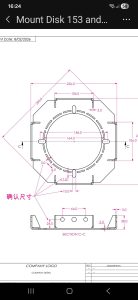
| Panel Dimensions | 430 mm x 430 mm |
| Duty Cycle | S1 (Continuous) |
| Certification | CE |
Technical Documentation
The following documents were approved and archived as the final deliverables for this project.
LWAA4E300S-5MGB-36-00.pdf
The PDF datasheet contains all electrical and mechanical specifications, performance curves (P-Q), dimensional drawings, and wiring diagrams an HVAC engineer needs for system integration.
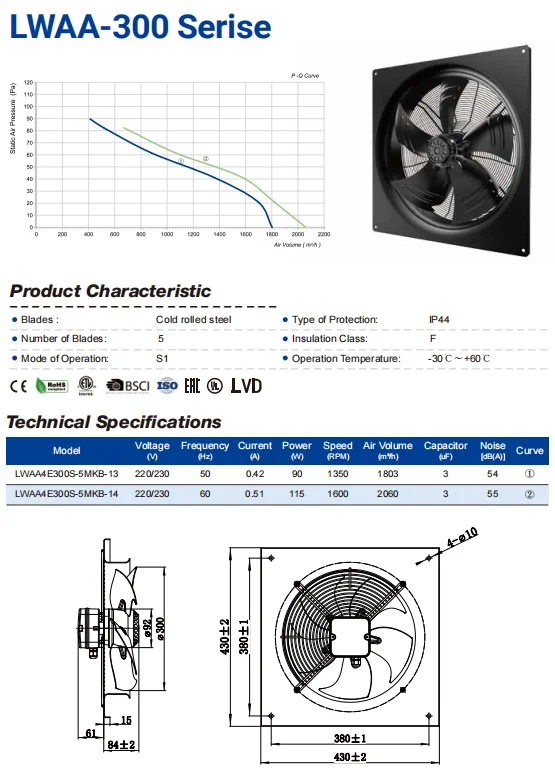
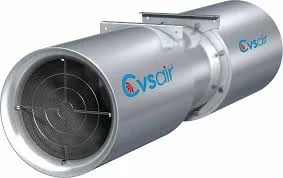
Here the product image shows the general arrangement of the LWAA-300 series fan, which a procurement manager can use for visual verification and preliminary assessment.
How to set a power target that survives
Power targets for a heat pump evaporator fan go wrong in a predictable way. If you are writing one into a specification, these help.
- Work out the air power first. Multiply your airflow in m3/s by your pressure in Pa. That gives watts of useful output. Divide by a realistic efficiency and you have the input power a fan can actually achieve. An AC axial fan of this size lands near 3 to 6%; a good EC fan reaches 15 to 25%.
- Decide whether the target is a requirement or a wish. Both are legitimate, but they lead to different fans and different prices. Saying which it is lets a supplier answer the real question instead of guessing.
- Quote your duty point, not your maximum. Airflow at free delivery tells you nothing about performance against a coil. Give airflow at a stated static pressure, and give the pressure honestly, with the coil dirty rather than clean.
- Check the efficiency case over the product life. On equipment that runs seasonally for years, the EC premium is often recovered. On something that runs occasionally, it is not. Run the arithmetic before assuming either.
Browse our axial fan range, or the condenser and evaporator fan section. Efficiency requirements come from ASHRAE 90.1.
Questions about this selection
Could an EC fan really have hit 25W here?
Yes, at this duty point it is within reach. An optimized EC motor with a matched impeller reaches the efficiency needed to move 805 m3/h against 16.7 Pa on roughly that input. However, it costs considerably more per unit, which is why the answer depends on the product economics rather than the physics.
Why quote a fan rated 1803 m3/h for an 805 m3/h duty?
Because the 1803 figure is at free delivery, with no resistance at all. Against a real coil the same fan lands near the required point. Always compare your duty against the fan curve at your static pressure, never against the headline airflow number.
Is IP44 sufficient for an outdoor heat pump?
For the fan itself, generally yes. IP44 covers solids over 1mm and splashing water from any direction, which suits a heat pump evaporator fan behind a guard. However, if the site sees driven snow, coastal salt or pressure washing, ask about IP54 or higher before committing.
What actually limits axial fan efficiency at this size?
Mostly tip clearance and motor losses. Any axial fan leaks air around the blade tips, and the effect is proportionally larger on small diameters. Meanwhile a small AC induction motor is simply less efficient than an EC one at part load. Neither is a defect. Both are why the arithmetic above matters before a target is set.
Technical Documentation & Resources
Have a fan requirement like this one?
Send the datasheet you are working against, or simply the duty point. Then our engineers tell you what fits and what does not. Meanwhile custom spec sheets and samples take up to 90 days. Since 1990 we have been building fans for OEMs worldwide.
Browse Related Products:
🏆 ISO 9001 / ISO 14001 / ISO 45001 | CE (TÜV) | UL/ETL | ATEX Zone 21/22 | AMCA 210/211 / ISO 5801 tested