What the OEM needed
A European OEM designing commercial air curtains needed 429 m3/h at 40C ambient. What settled the selection was fan supply voltage.
Their 3D model showed 440mm of installation length available. Meanwhile their launch schedule left under four months.
The constraints
- First, integration with their existing 24 VDC power architecture.
- Next, 0-10V speed control for the building control system.
- Meanwhile 50 dB(A) maximum at full speed, since these go in storefronts and reception areas.
- An aluminum impeller, for low rotational inertia and corrosion resistance.
- Finally, CE marking for the EU market.
They had been using AC shaded-pole motors previously, and had run into the limits of that: coarse control and more noise than their next-generation product could carry.
Choosing the fan supply voltage
A brushless DC motor was the obvious direction. However, our series offers two fan supply voltage options, and the comparison is instructive.
The two options
A 12V model reaches the target 429 m3/h. So does the 24V model, at the same 42 Pa of static pressure.
The difference is current. A 12V version draws 1.9A, whereas the 24V version draws 0.8A for identical output.
Why that matters more than it looks
Power is roughly the same either way, since voltage and current trade against each other. What changes is everything downstream of the current figure.
Cable losses scale with the square of current, so more than halving the current cuts wiring loss by roughly a factor of five. Consequently the cable can be thinner, connectors run cooler, and less waste heat ends up inside a sealed housing.
Furthermore the power supply sees a lighter load, which matters when several fans share one rail.
Which is why the fan supply voltage was settled quickly
Here the customer already ran a 24V architecture, so the choice matched their system. Even without that, the current comparison would have argued for it.
The rest of the build
The 368mm impeller had to be matched to the motor so velocity stays uniform across the whole outlet. An uneven outlet leaves gaps in the air barrier, which is the one thing an air curtain cannot have.
Meanwhile the steel and aluminum housing provides rigidity across 437mm of length, which is what keeps vibration out. The control input accepts their 0-10V signal directly, and the -25C to +60C rating comfortably clears their 40C requirement.
What it cost
Nothing on this project, since 24V suited them. Even so, a higher fan supply voltage is not automatically better.
Above roughly 60V you cross into different safety rules. Meanwhile very low-power fans on a high rail need pricier controller parts. So the sensible range here is 24V or 48V, and the right answer follows whatever your system already uses.
Technical Specifications
Note the current row below. That is the figure this whole selection turned on.
| Parameter | Value |
|---|---|
| Model | LWCD-65360MN-07 |
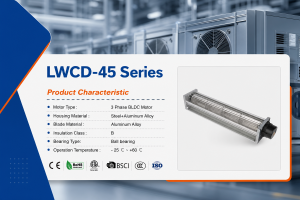
| Motor Type | 3 Phase BLDC Motor |
| Voltage | 24 VDC |
| Current | 0.8 A |
| Speed | 1800 RPM |
| Air Flow | 429 m³/h (252.5 CFM) |
| Static Pressure | 42 Pa |
| Noise Level | 50 dB(A) |
| Speed Control | 0-10V / PWM |
| Signal Output | FG (Frequency Generator) |
| Overall Length (A) | 437 mm |
| Housing Length (B) | 382 mm |
| Impeller Length (C) | 368 mm |
| Housing Material | Steel + Aluminum Alloy |
| Blade Material | Aluminum Alloy |
| Bearing Type | Ball Bearing |
| Insulation Class | Class B |
| Operation Temperature | -25°C to +60°C |
| Certifications | CE, RoHS, ISO 9001 |
Technical Documentation

The product datasheet provides the full performance specifications and mechanical dimensions for the LWCD-65 series, which an HVAC engineer needs for initial component selection.
LWCD-65360MN-07-00.stp
This 3D CAD model in STEP format allows system integrators to drop the fan directly into their master assembly for fitment checks and clash detection before ordering physical samples.
If you are choosing a DC rail
Choosing a DC rail is usually decided by the rest of the system. Where you do have a choice, these apply.
- Compare current, not just power. Two fans with the same wattage can differ by a factor of two in current. That figure sets your cable gauge, your connector rating and your fuse, so it is the number that actually shapes the harness.
- Count the fans on the rail. One fan at 1.9A is unremarkable. Six of them is 11.4A, which changes the power supply, the wiring and the heat inside the enclosure. Add them up before fixing the fan supply voltage.
- Match the rail to what you already have. A native fan removes a converter from every unit. Introducing a second voltage to suit one component rarely pays.
- Ask about the tolerance window, not the nominal. A 24V rail that sags under inrush or rises on a charged battery is common. The fan controller has to hold speed across that range rather than following it.
See our cross flow fan range, the DC cross flow fan section, or fan accessories. Safety limits follow IEC 60335-1.
Questions about voltage and current
If power is the same, why does current matter?
Because everything between the supply and the fan is sized on current. Cable cross-section, connector rating, fuse and switchgear all follow it, and resistive loss in the cable rises with the square of it. Halving current cuts that loss to roughly a quarter, which shows up as cooler wiring and less waste heat.
Should I move to 48V for even lower current?
Sometimes. It halves current again, and it suits telecom and battery systems already running 48V. However, adding a fan supply voltage your system does not otherwise use means a converter somewhere, which puts the loss back. So match the fan to your architecture rather than the reverse.
Does a higher voltage fan cost more?
Usually slightly, since the controller components carry higher voltage ratings. That difference is small and is normally repaid in thinner cable and a smaller power supply. Compare the installed cost rather than the fan price alone.
Why does uniform outlet velocity matter for an air curtain?
Because the curtain works by forming a continuous barrier between two air masses. Any section with lower velocity is where warm and cold air mix, and one weak strip undermines the whole barrier. That is why impeller and motor matching matters more here than raw airflow.
Working on something similar?
Send us the duty point, the envelope and the supply, and our engineers come back with a shortlist rather than a catalog. Meanwhile custom spec sheets and samples run to 90 days. Since 1990 we have built fans for HVAC, cold chain, data center and industrial OEMs.
Browse Related Products:
🏆 ISO 9001 / ISO 14001 / ISO 45001 | CE (TÜV) | UL/ETL | ATEX Zone 21/22 | AMCA 210/211 / ISO 5801 tested