What the OEM needed
An OEM developing commercial HVAC equipment needed a cross-flow fan for a range covering air curtains, air purifiers and general ventilation.
Their target was 429 m3/h at 42 Pa. Notably, the pressure figure is low, which tells you the air is not being pushed through anything restrictive.
The constraints
- First, an overall length no greater than 437mm, set by their chassis.
- Next, a 24 VDC rail, which is standard in modern building control.
- Meanwhile 0-10V speed control, so their main controller can modulate airflow from sensor feedback.
- Standard steel and aluminum construction, with no exotic alloys.
- Finally, a maximum ambient of +40C.
Noise was never stated as a number, though it was clearly a requirement. These products sit above doorways in occupied commercial spaces, so anything above about 50 dB(A) becomes a complaint.
Selecting the cross-flow fan
Ultimately the fan type follows the shape of air the product needs, not the volume.
Why cross-flow at all
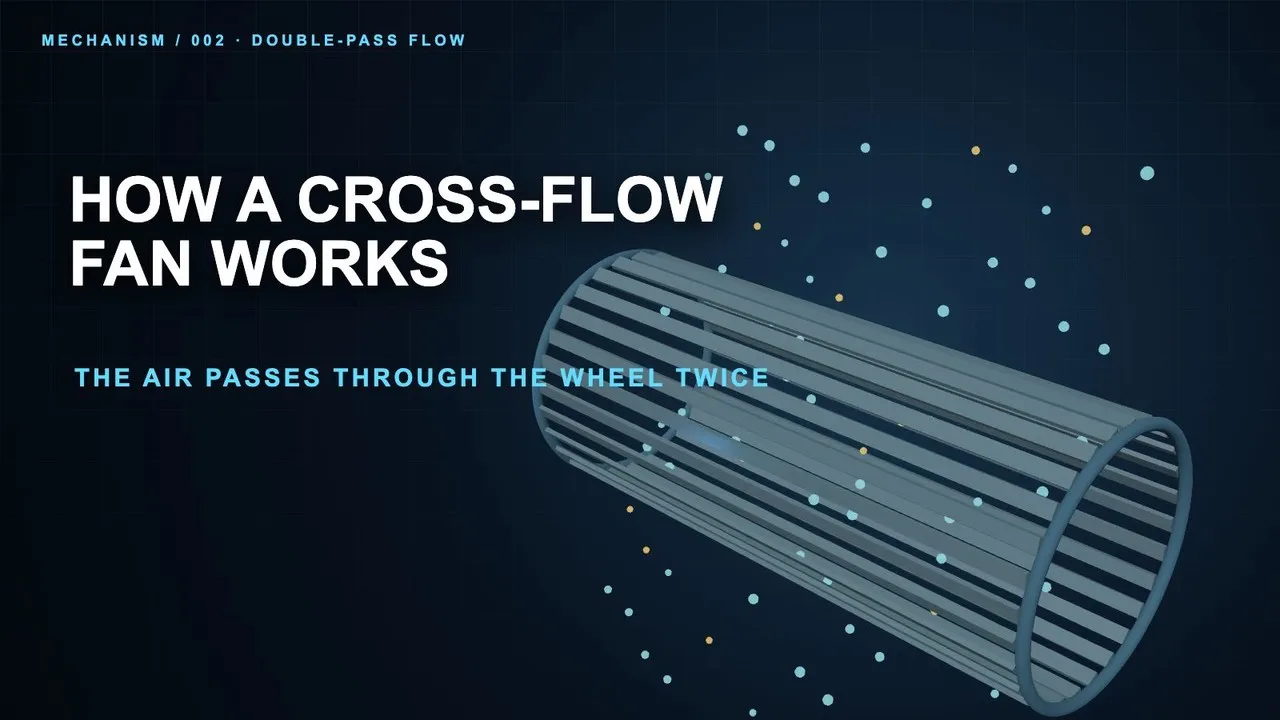
An air curtain has to produce a flat, even sheet of air across a whole doorway. A cross-flow impeller does exactly that, because the air enters and leaves along the full length of the rotor.
By contrast, a centrifugal blower concentrates flow through a small outlet. You could use one and then spread the air out again with a plenum, but that costs depth, cost and pressure. Meanwhile an axial fan produces a cone, which is the wrong shape entirely.
So the customer had already reached the right conclusion. Our task was picking the model.
Why EC over AC
An AC version was considered and dropped.
Their system runs on 24 VDC. Consequently an AC motor would need an inverter ahead of it, adding cost, heat and a component that can fail inside a sealed unit mounted above a door.
The chosen fan uses a three-phase brushless DC motor that runs straight off the 24V supply. Furthermore the SmartEC control accepts the 0-10V signal natively, so no external controller is needed at all.
What the numbers mean
In service the fan turns at 1800 RPM, drawing 19.2W to deliver 429 m3/h at 42 Pa, measuring 50 dB(A).
Nineteen watts is worth pausing on. That is what an EC motor at a sensible duty point costs to run, and on a product that operates whenever a shop door is open, it adds up over a year.
What it cost
Pressure capability, and it is inherent to the fan type. Specifically, at 42 Pa this fan cannot push air through a filter or any length of duct.
That is fine for an air curtain, which discharges straight into a room. It is not fine if someone later decides to add filtration to the same chassis, and that conversation is worth having before the product ships rather than after.
Technical Specifications
Note the length against the impeller diameter below. That ratio is what produces the air sheet.
| Parameter | Value |
|---|---|
| Model | LWCD-65360MN-07 |
| Motor Type | 3 Phase BLDC Motor (EC) |
| Voltage | 24 VDC |
| Current | 0.8 A |
| Input Power | 19.2 W |
| Speed | 1800 RPM |
| Static Pressure | 42 Pa |
| Air Flow | 429 m³/h |
| Noise | 50 dB(A) |
| Dimensions (Overall L x W x H) | 437 mm x 100 mm x 112 mm |
| Housing Material | Steel + Aluminum Alloy |
| Blade Material | Aluminum Alloy |
| Bearing Type | Ball Bearing |
| Insulation Class | Class B |
| Speed Control | 0-10V / PWM |
| Signal Output | FG (Tachometer) |
| Operating Temperature | -25°C to +60°C |
Technical Documentation

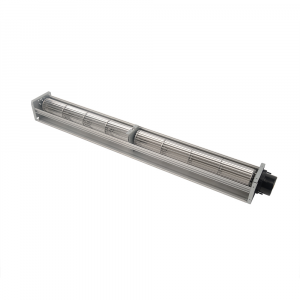
Here the LWCD-65360MN-07, shown here, features a steel and aluminum alloy housing for structural rigidity and a lightweight aluminum impeller for efficient operation.
Download the LWCD-65360MN document
Download the complete technical specification sheet, including dimensional drawings, performance curves, and wiring diagrams, for review by mechanical and electrical system integrators.
If you are designing an air curtain
Certainly air curtain design has constraints that are easy to miss until prototypes exist.
- Specify the air sheet, not just the airflow. Discharge velocity and evenness across the length determine whether the curtain actually separates two air masses. A volume figure alone can be met by a fan that produces the wrong shape entirely.
- Match impeller length to door width. A cross-flow rotor produces air along its whole length, so gaps at the ends are where warm and cold air mix. Size the rotor to the opening rather than to a convenient standard length.
- Keep the pressure budget honest. These fans work at tens of pascals, not hundreds. Adding a filter, a grille with high free-area loss, or any ducting will collapse the performance. Decide early whether filtration is in scope.
- Use variable speed for the acoustics. A curtain over a shop door does not need full output all day. Running slower when traffic is light cuts noise sharply, and the 0-10V input makes that trivial to implement.
See our cross flow fan range, the EC cross flow fan section, or fan accessories. Ventilation guidance comes from ASHRAE 62.1.
Questions about cross-flow fans
Why not use a centrifugal blower and a plenum?
You can, and some products do. However, it costs depth behind the outlet, adds cost, and wastes pressure spreading air that a cross-flow fan delivers already spread. It makes sense only when the same chassis must also handle filtration, where the extra pressure capability earns its place.
Can a cross-flow fan handle a filter?
Not really, at these pressures. Maximum static pressure here is 42 Pa, and most filters consume more than that on their own. If your product needs filtration, plan for a centrifugal fan from the start rather than discovering the limit during testing.
What does the 0-10V input let the product do?
Modulate airflow from a sensor or a controller rather than switching between fixed speeds. On an air curtain that means running gently when the door is mostly closed and stepping up when traffic increases, which saves energy and keeps the unit quieter for most of the day.
Why is impeller length so much greater than diameter?
Because the air path runs across the rotor rather than along it. A cross-flow impeller draws air in on one side of its length and discharges on the other, so making it longer widens the air sheet without changing the pressure or velocity. That is exactly what a doorway needs.
Technical Documentation & Resources
Need the same thing for your own unit?
Give us the numbers and the envelope, and you get a shortlist rather than a catalog. Meanwhile custom spec sheets and samples run to 90 days. Since 1990 Longwell has supplied EC fans and blowers to OEMs in HVAC, cold chain, data center and industrial markets.
Browse Related Products:
🏆 ISO 9001 / ISO 14001 / ISO 45001 | CE (TÜV) | UL/ETL | ATEX Zone 21/22 | AMCA 210/211 / ISO 5801 tested
Choose the right cross flow fan
Longwell manufactures 495 cross flow fans in-house. Send airflow, static pressure and voltage — an engineer replies with a matching model, performance curve and price within one working day.