What the integrator needed
A system integrator needed a 250mm DC axial fan for an outdoor enclosure, most likely battery storage or a 5G telecom cabinet. Its fan protection features matter more than usual there.
Meanwhile their brief named two modifications: add a protective guard, and reach at least IP54.
The constraints
- First, a nominal 24 VDC rail tolerating 16 to 28 VDC.
- Next, a 280 by 280 mm frame with depth around 80mm.
- Meanwhile enough pressure to push through filters and heat sinks, not merely enough airflow.
- Variable speed over 0-10V or PWM from their system controller.
- Finally, CE certification and data verifiable to ISO 5801.
The wide voltage tolerance is worth noticing. A field supply sags under load, rises on a charged battery, and dips during inrush. Sixteen to twenty-eight volts is what surviving that looks like.
The fan protection features that matter
Here the platform matched the dimensions directly. Furthermore the 24 VDC rail settled the motor type, since an AC motor would need an inverter, adding cost, loss and a failure point.
So the interesting part is not the selection. It is what the fan does when conditions go wrong.
Why fan protection features matter more here
Nobody visits a roadside cabinet to look at a fan. It runs unattended for years, and the first sign of trouble is usually a thermal alarm from something else.
Consequently the fan protection features are worth more than a slightly better airflow figure. They decide what happens on the day something goes wrong.
Locked rotor protection
If debris jams the impeller, an unprotected motor keeps driving current into a stalled rotor. Consequently windings heat fast, and the failure can be worse than an inoperative fan.
So locked rotor protection cuts drive when the controller sees no rotation. The fan then stops safely rather than cooking itself.
Soft start
Starting a 250mm impeller from rest draws a large surge. Meanwhile, where several fans share a supply, simultaneous starts can pull the rail down far enough to reset other equipment.
Instead soft start ramps the motor up, which protects the supply as much as the fan.
Reverse polarity protection
The one is about installation rather than operation. Normally a DC fan wired backwards is destroyed immediately.
With protection it simply does not run, and an installer can correct the wiring. On a site visit measured in hours of travel, that difference is significant.
What it cost
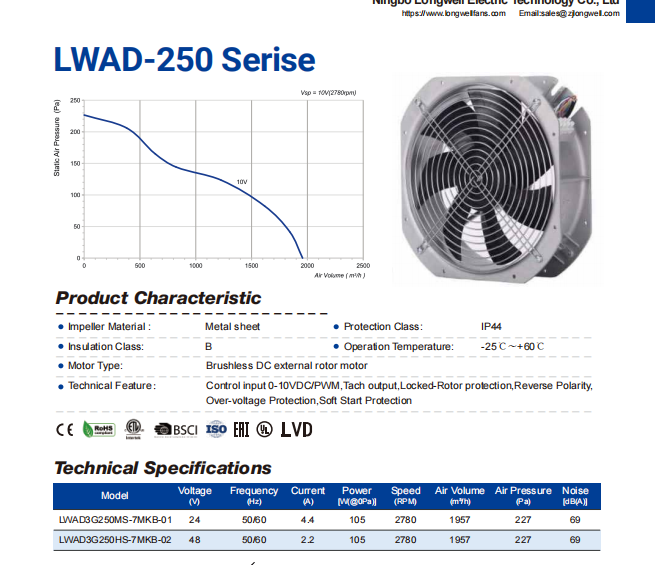
Power draw. At 105W and 4.4A this fan is not economical to run at full speed, and the guard adds a little resistance on top.
That is the price of 1957 m3/h against 227 Pa from a 280mm frame. The speed control is the mitigation, since the cabinet rarely needs full output.
Technical Specifications
Meanwhile the voltage range row below is wide for a reason. In practice field supplies are not the clean 24V a bench provides.
| Parameter | Value |
|---|---|
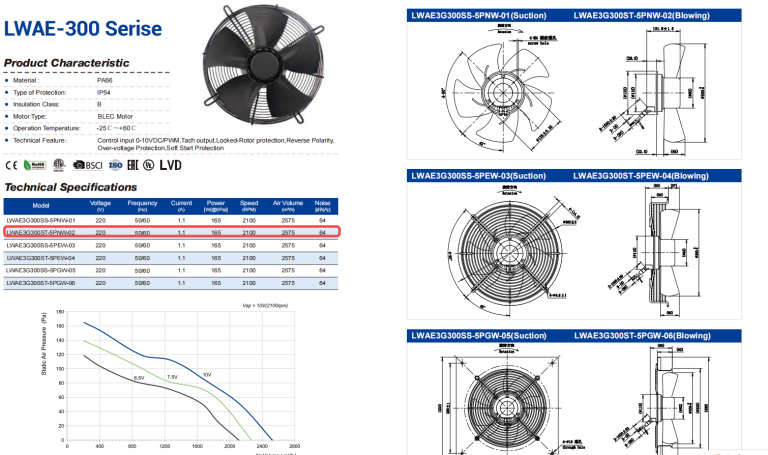
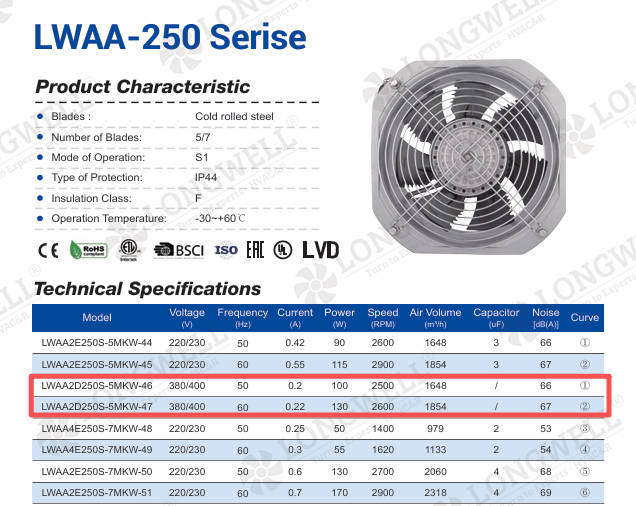
| Model Number | LWAD3G250MS-7MKB-01-47 |
| Nominal Voltage | 24 VDC |
| Voltage Range | 16 – 28 VDC |
| Speed | 2780 RPM |
| Input Power (@ 0 Pa) | 105 W |
| Current (@ 24V, 0 Pa) | 4.4 A |
| Max Airflow | 1957 m³/h / 1151 CFM |
| Max Static Pressure | 227 Pa |
| Noise Level (LpA) | 69 dB(A) |
| Dimensions | 280 x 280 x 80 mm |
| Weight | Approx. 2.5 kg |
| Protection Class | IP55 |
| Insulation Class | Class B |
| Operating Temperature | -25°C to +60°C |
| Life Expectancy (L10) | 40,000 Hours @ 25°C |
| Control | 0-10VDC / PWM |
| Certifications | CE, RoHS, Reach |
Technical Documentation
The final specification sheet contains all performance data, mechanical drawings, and wiring diagrams for system integrators and quality assurance teams.
Download PDF: LWAD3G250MS-7MKB-01-47 Specification Sheet
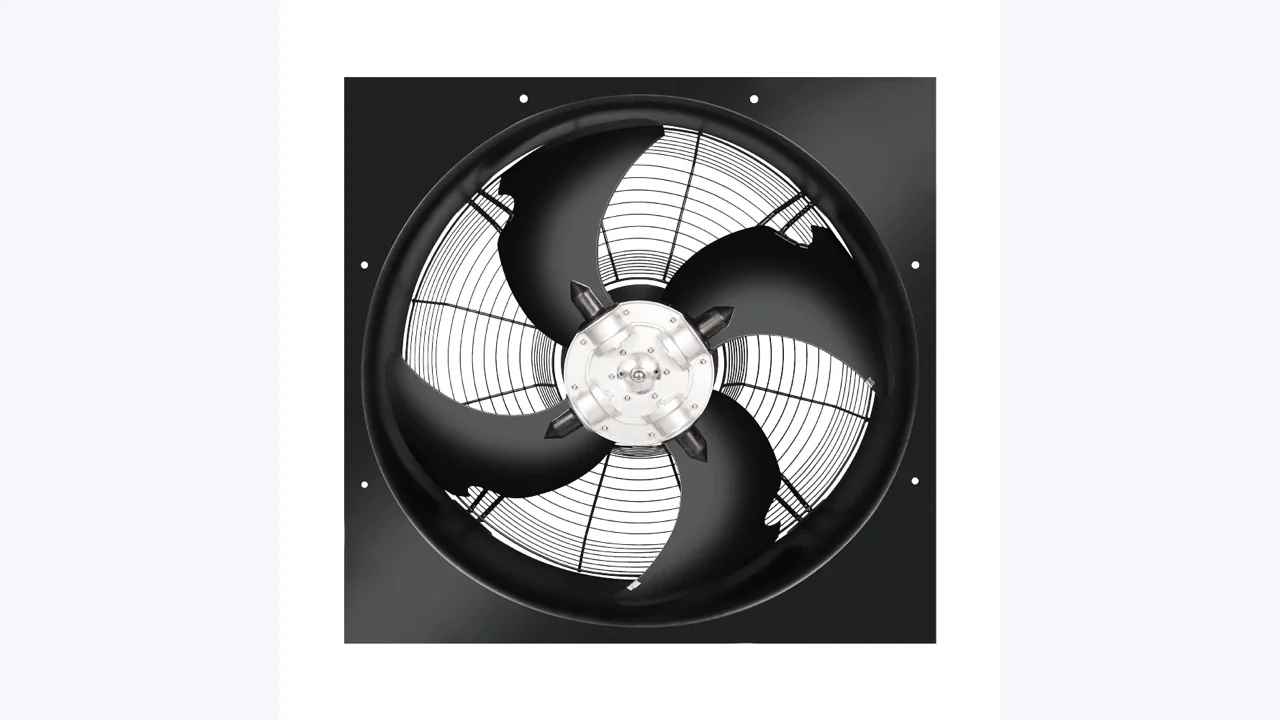
Here the project image shows the assembled LWAD3G250MS-7MKB-01 with its integrated finger guard, ready for installation.
If your fan will never be inspected
Fan protection features matter far more in an unattended enclosure than in a serviceable machine.
- Ask which fan protection features are actually implemented. Locked rotor, soft start and reverse polarity are not universal, and they are not always listed. Ask specifically rather than assuming an EC controller includes them.
- Take the tachometer output and wire it in. Protection stops the fan safely; feedback tells your system it stopped. Without it a protected fan and a failed fan look identical from outside.
- Give the real voltage window, not the nominal. Field supplies sag and surge. A fan rated 16 to 28 VDC keeps commanded speed across that range instead of following the rail, which is what keeps airflow predictable.
- Specify IP against the actual exposure. IP54 suits a cabinet interior behind a louvre. A fan at an open intake facing weather needs more, and the rating should follow where it sits rather than where the cabinet sits.
See our axial fan range, the DC axial fan section, or cabinet cooling fans. Ingress ratings follow IEC 60529.
Questions about this fan
What does locked rotor protection actually do?
It removes drive when the controller detects the rotor is not turning. Without it a stalled motor keeps drawing current and heats quickly, which can damage more than the fan. With it, a jammed impeller becomes a fan that stopped, which your monitoring can report.
Why does soft start matter in a cabinet?
Because inrush current from several fans starting together can pull the supply rail down. In a battery or telecom cabinet sharing a bus with sensitive electronics, that dip can reset other equipment. Ramping the motor up avoids the surge entirely.
Is reverse polarity protection really necessary?
It costs almost nothing and prevents a whole class of installation failure. A DC fan wired backwards without it is destroyed on the spot. With it, nothing happens until the wiring is corrected, which on a remote site saves a second visit.
Is IP55 needed if the cabinet is already sealed?
Usually not for a fan circulating air inside. The enclosure provides the environmental barrier. However, a fan at an intake or exhaust opening sees whatever the louvre lets through, and there the rating should match the exposure rather than the cabinet specification.
Technical Documentation & Resources
Have a fan requirement like this one?
Send the datasheet you are working against, or simply the duty point. Then our engineers tell you what fits and what does not. Meanwhile custom spec sheets and samples take up to 90 days. Since 1990 we have been building fans for OEMs worldwide.
Browse Related Products:
🏆 ISO 9001 / ISO 14001 / ISO 45001 | CE (TÜV) | UL/ETL | ATEX Zone 21/22 | AMCA 210/211 / ISO 5801 tested