Specifying a Radial Ceiling Pipeline Fan for Exhaust
The buyer needed a ceiling pipeline fan for a new duct project. First, they sent photos of the exact aesthetic design they wanted to match. The system needed high static pressure to push air through long pipes. Therefore, the buyer required a radial inner design.
They rejected standard flat axial blades. Next, they asked for a 150 m3/h baseline air volume. The project also needed two mechanical sizes. We had to match 4-inch (100mm) and 6-inch (150mm) round side ports.
Finally, the electrical spec was strictly locked at 220V at 50Hz. Size was the main limit. A ceiling pipeline fan must fit a standard room cutout perfectly. The plans showed a 300x300mm flat panel for the 4-inch model.
So, fitting a high-pressure impeller inside this flat box was hard. Also, engineers must plan for heavy backpressure from rigid ducts. Free-air fans fail here. Instead, this project required enclosed radial hardware.
It must hold airflow against wind and pipe friction. Finally, the final product must meet strict safety standards for household appliances.
Engineering the ceiling pipeline fan radial layout
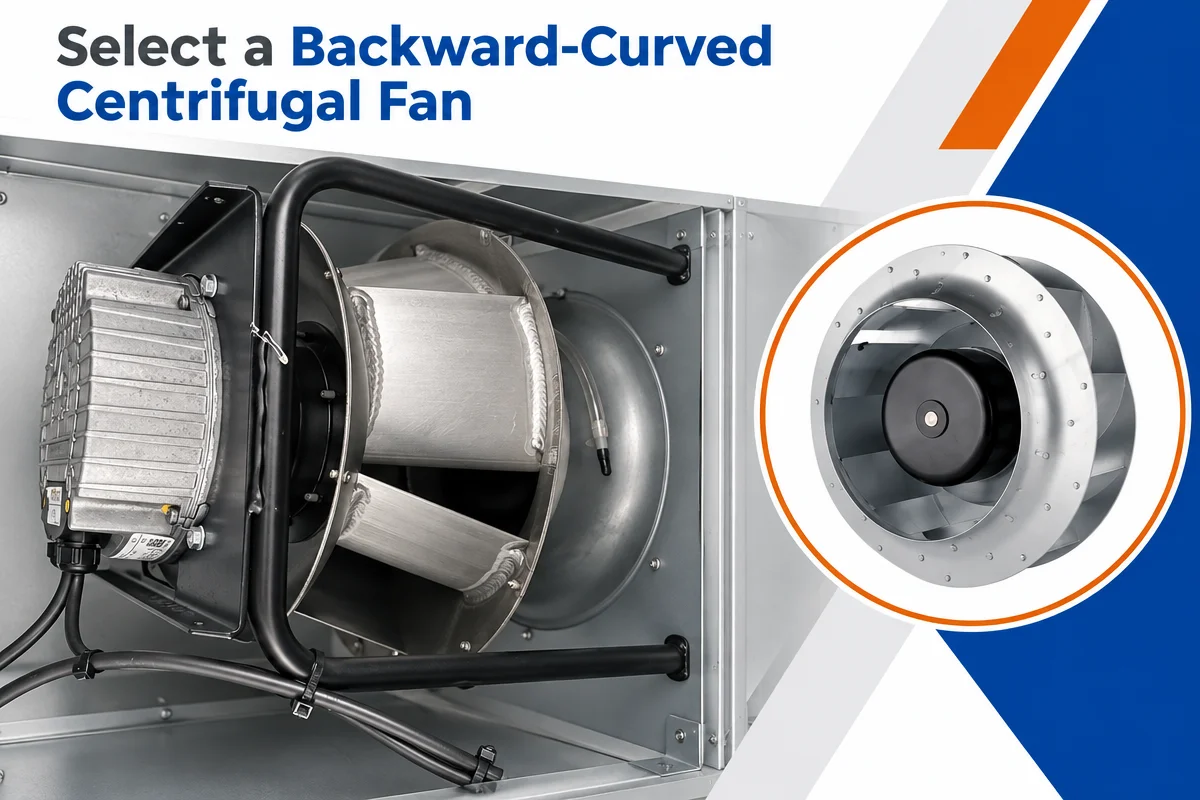
We checked the airflow needs for this layout. First, basic bath exhaust units use flat axial blades. But axial blades fail against duct pressure. Instead, the buyer correctly asked for a radial impeller. It turns spin energy into static pressure very well.
Evaluating Internal Layouts
Next, we looked at two inner layouts. First, we tried putting a standard forward-curved blower in the square box. This standard blower yields great pressure. Even so, placing a round blower in a flat square box blocks the air intake. So, we rejected this idea. The blockage would add turbulence and noise at the visible grille.
Instead, we chose a custom flat radial impeller. We paired it with a perimeter volute housing. This custom part pulls air up and pushes it out the side port. Also, this layout aligns with the 100mm and 150mm duct parts. In short, it provided the needed pressure without adding height.
Trade-offs and Motor Limits
Every design choice has a real cost. The tight radial setup needed a stronger motor winding. The motor must hold speed under a heavy load. Therefore, we picked a 36W motor for the LWEA100(4″)SP-401 model. It hits 1250 RPM safely.
By contrast, a standard 8-inch LWEA200(8″)SP-031 model uses only a 25W motor. It spins at 1300 RPM for the same 150 m3/h free-air flow. The cost of forcing air through a tight 100mm hole is this higher power draw. It also needs a heavier rotor. Finally, we set the specs for the LWEA100 and LWEA150 models. They deliver the radial airflow and match the strict visual rules.
Technical Specifications
| Parameter | LWEA100(4″)SP-401 | LWEA200(8″)SP-031 |
|---|---|---|
| Panel Dimensions (mm) | 300 x 300 | 245 x 245 |
| Housing Depth (mm) | Not Specified | 200 x 200 |
| Air Outlet Size | 100 mm | Not Specified |
| Operating Voltage (V) | 220 | 220 |
| Frequency (Hz) | 50 | 50 |
| Speed (RPM) | 1250 | 1300 |
| Input Power (W) | 36 | 25 |
| Air Volume (m3/h) | Not Specified | 150 |
The table shows the exact specs for the compact radial model and a standard catalog unit. First, pushing air through a narrow 100mm outlet demands more power. So, the smaller duct needs 36W, while the large 8-inch model needs only 25W. Also, the 300x300mm panel requires a wider mounting flange to fit the room.
Reference: AMCA 210 covers the test method behind these figures.
Technical Documentation

This image shows the side port and the internal radial impeller.

This photo shows the flat white panel mandated by the buyer.
LWEA100(4″)SP-401 Engineering Specifications
This file lists the exact sizes and electrical details for the 4-inch model.

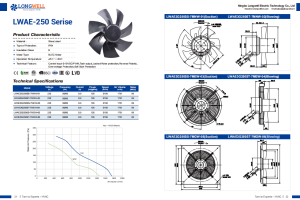
This catalog page shows the standard 8-inch model data for comparison.
How to Specify Ducted Exhaust Fans
Engineers tackling ducted exhaust problems must check their building limits early. Do this before you start sourcing. You must measure a few strict parameters before ordering a ceiling pipeline fan.
- First, measure your ceiling cavity depth. The outer housing height is always the strict binding limit for these projects. It limits how thick your impeller can be.
- Next, find the total pressure drop of your long duct run. Radial impellers handle pressure well. Even so, sharp bends and long pipes still dictate the final motor RPM you need to push air outside.
- Finally, send your supplier the exact flat grille sizes on day one. A factory can build the internal spiral volute much faster if the outer box dimensions are final.
Related: Duct Fans.
Common Engineering Questions
Technical Documentation & Resources
Browse our axial fans range, the AC axial fans section, or EC axial fans.
Have a Similar Fan Requirement?
Longwell’s engineering team delivers custom spec sheets and samples within 90 days. Since 1990, we have supplied EC fans and blowers to OEMs across HVAC, cold chain, data center, and industrial applications worldwide.
Browse Related Products:
🏆 ISO 9001 / ISO 14001 / ISO 45001 | CE (TÜV) | UL/ETL | ATEX Zone 21/22 | AMCA 210-16 / ISO 5801 tested
Choose the right centrifugal fan
Longwell manufactures 1,130 centrifugal fans in-house. Send airflow, static pressure and voltage — an engineer replies with a matching model, performance curve and price within one working day.