What was asked for
A customer named one of our 250mm fans, then asked for three changes, starting with the axial fan blade count.
They wanted five blades instead of the standard seven, a panel-mount configuration, and blowing rather than drawing airflow direction.
The quantity was four units.
Where the conflict was
Here the model number they quoted denotes a seven-blade impeller. So the request contradicted itself: this exact fan, but with a different axial fan blade count.
Four units also tells you what kind of project this is. Nobody orders four fans for production, so this was a prototype build or a specific retrofit, where any tooling cost lands on a handful of parts.
- A 250mm fan on 220-240V at 50Hz.
- Panel-mount, with airflow blowing outward.
- Meanwhile -30C to +60C, typical of cabinet and control panel duty.
- Finally, safety under EN 60335-1 and performance data to ISO 5801.
Why axial fan blade count did not decide this
The obvious route was to build what they asked for. We rejected it immediately.
Why not just make a five-blade version
Creating a five-blade variant of that specific model means new tooling and a full NPI cycle. On a four-unit order the tooling cost alone exceeds the value of the fans by a wide margin, and the lead time would be weeks rather than days.
That is a bad answer even when the customer would pay for it.
Reading past the model number
So we went back to what they actually needed: a 250mm panel-mount fan, 230V at 50Hz, blowing, five blades, performing like the model they had quoted.
Here is the thing worth knowing. Axial fan blade count is only one variable among several. Motor speed, blade pitch and housing geometry all shape the final performance, and a five-blade impeller with a different pitch can match a seven-blade one exactly.
The match already existed
A cross-reference through our catalog found a standard model with an axial fan blade count of five that performs identically to the seven-blade unit.
Both run at 1400 RPM. Both deliver 886 m3/h maximum airflow on 50W input at 53 dB(A). The suffix in the part number confirms panel mounting, and the drawing confirms blowing direction.
Consequently the whole request was met from stock. No tooling, no NPI, no development cost on four fans.
What it cost
Nothing on this project, which is unusual and worth saying. The customer got a stocked part instead of a custom one.
Meanwhile the general caution is that this only works when the underlying requirement is performance rather than geometry. If they had needed five blades for a physical reason, such as clearance around a hub or a specific acoustic signature, the answer would have been different and more expensive.
Technical Specifications
These are the figures for the five-blade model. They match the seven-blade unit the customer originally named.
| Parameter | Value |
|---|---|
| Model Number | LWAA4E250B-5MKB-42-00 |
| Nominal Voltage [VAC] | 220 |
| Voltage Range [VAC] | 198~242 |
| Frequency [Hz] | 50 |
| Speed [rpm] | 1400 |
| Input Power [W] | 50 |
| Current [A] | 0.25 |
| Max Airflow [m³/h] | 886 |
| Max Airflow [CFM] | 521 |
| Noise Level [dB(A)] | 53 |
| Capacitor [μF] | 2 |
| Protection Type | IP44 |
| Insulation Class | Class F |
| Operating Temperature [°C] | -30 to +60 |
| Mounting Dimensions [mm] | 320 x 320 (mounting holes), 370 x 370 (overall) |
| Work System | S1 (Continuous Duty) |
Technical Documentation

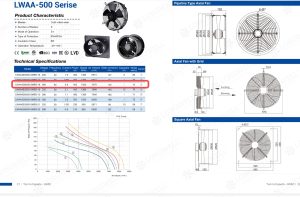
The product series datasheet shows the performance curve and available configurations, useful for initial project evaluation by a design engineer.
Full Technical Specification: LWAA4E250B-5MKB-42-00 (PDF)
Here the detailed PDF specification for the final proposed model contains all nominal data, mechanical drawings, and wiring diagrams needed by an integration engineer or quality control team.
If you are specifying a small batch
Small batches expose specification habits that large orders hide. These are worth carrying into any prototype request.
- Send the requirement, not just a modified part number. A model number with three changes attached forces a supplier to guess which detail is essential. Airflow, pressure, envelope, voltage and direction get you an answer in a day.
- Say the quantity up front, and say if it is a prototype. Four units and four thousand lead to completely different engineering answers. Hiding the quantity to seem more serious usually produces a slower, worse-fitting response.
- Do not treat blade count as a performance specification. It affects noise character and pressure capability, but pitch, diameter and speed matter more. Specify what you need the air to do, and let the supplier reach it.
- Ask whether an existing part already matches. Suppliers with a deep catalog can often find one. It costs a search rather than a tooling program, and the part is usually in stock.
Browse our axial fan range, the AC axial fan section, or compact cooling fans. Appliance safety follows IEC 60335-1.
Questions about blade count
Does blade count change performance at all?
It does, though less than people expect. More blades generally build more static pressure at a given diameter and speed, at the cost of noise and power. However, blade pitch and profile compensate, which is why a five-blade and a seven-blade fan can land on the same duty point. So compare curves rather than axial fan blade count.
Why does blade count affect noise character?
Because each blade passing the housing produces a pressure pulse. The blade passing frequency is speed multiplied by the axial fan blade count. Consequently five blades at 1400 RPM and seven at the same speed produce tones at different frequencies. The overall dB(A) can match while the sound quality differs, which matters near occupied spaces.
What is the minimum order for a custom fan?
For a genuinely custom design requiring tooling, volumes need to justify the tooling investment, which typically means hundreds to thousands of units a year. Below that, we look for an existing part first. That is not a brush-off; it is usually a better answer for the customer.
Can I get four units of a standard fan?
Yes. Stocked models ship in small quantities, generally within a few days. Make-to-order models have a minimum, though it is far lower than anything requiring new tooling. Ask before assuming a small quantity is impossible.
Technical Documentation & Resources
Need the same thing for your own unit?
Give us the numbers and the envelope, and you get a shortlist rather than a catalog. Meanwhile custom spec sheets and samples run to 90 days. Since 1990 Longwell has supplied EC fans and blowers to OEMs in HVAC, cold chain, data center and industrial markets.
Browse Related Products:
🏆 ISO 9001 / ISO 14001 / ISO 45001 | CE (TÜV) | UL/ETL | ATEX Zone 21/22 | AMCA 210/211 / ISO 5801 tested