What the OEM asked for
A European HVAC OEM needed an 800mm AC axial fan for commercial refrigeration condensers, and they arrived with a condenser fan duty point already fixed.
Their target was roughly 25,000 m3/h against 115 Pa. Typically that pressure means a high-efficiency condenser, where dense fin stacks create real resistance.
The constraints
- First, a 400V three-phase supply at 50Hz.
- Next, suction configuration, pulling air through the coil.
- Meanwhile a simple single-speed motor near 900 RPM, matching their existing controls.
- A protective guard grille for safety compliance.
- Finally, ten units for prototyping, with performance verifiable to ISO 5801.
Reading between the lines, they wanted a form, fit and function alternative to a European-made fan. Consequently dimensional interchangeability mattered as much as the numbers.
Setting an honest condenser fan duty point
The requested condenser fan duty point was itself the problem. So it was worth saying so before quoting anything.
Why 25,000 m3/h at 115 Pa did not work
Moving that much air against that pressure, from an 800mm frame at 900 RPM, pushes the motor towards its service limit.
On a test bench it is not impossible. However, a motor at its limit runs hot continuously, and heat is what ends motor life. So the fan would meet the number on day one and disappoint in year three, outdoors, where nobody checks it.
That failure mode is worse than missing the target, because it arrives after the customer has committed their design.
What we quoted instead
Instead we went back with 21,000 m3/h at the same 115 Pa, taken from a curve verified in independent testing to AMCA 210/211 methods.
At that point the motor sits near its efficiency peak rather than at its limit. Consequently it runs cooler, draws less, and reaches the life the datasheet claims.
That airflow still suits the condenser thermal design. Furthermore we said so explicitly, rather than leaving the customer to work out whether the reduction mattered.
Two alternatives we ruled out
An EC motor would give efficiency and control. However, this product tier was chosen on simplicity and cost, and the customer had existing AC controls.
A faster AC motor would reach the original number. Meanwhile it would raise noise and power draw unacceptably, and noise is a constraint on outdoor refrigeration equipment in most European markets.
The build
A seven-blade plastic impeller balances efficiency, weight and corrosion resistance. Meanwhile Class F insulation and maintenance-free deep groove ball bearings support a 20,000-hour L10 life across -40C to +60C.
What it cost
Here the order, potentially. Telling a customer their condenser fan duty point is unrealistic risks losing to whoever quotes the number they asked for.
We think that is the right trade, though it is a real one. The alternative is winning the order and being the supplier whose fans fail early, which is a worse position to be in three years later.
Technical Specifications
The airflow row below is at free delivery. By contrast the 21,000 figure above is the condenser fan duty point against 115 Pa, which is where it runs.
| Parameter | Value |
|---|---|
| Model Number | LWAA6D800S-7PEB-18-00 |
| Nominal Voltage | 3~380V (compatible with 400V) |
| Frequency | 50 Hz |
| Speed | 920 RPM |
| Power Input | 2200 W |
| Current | 3.8 A |
| Max Airflow | 27,089 m³/h / 15,935 CFM |
| Max Static Pressure | 248 Pa |
| Ambient Temperature Range | -40°C to +60°C |
| Protection Class | IP54 |
| Insulation Class | Class F |
| Life Expectancy (L10) | 20,000 hours at 40°C |
| Balancing | According to JB/T 9101-1999 requirements G6.3 |
| Certifications | CE, RoHS, Reach |
| Work System | S1 (Continuous Duty) |
Technical Documentation
Meanwhile the following documents provide detailed engineering data for system integration and design review.
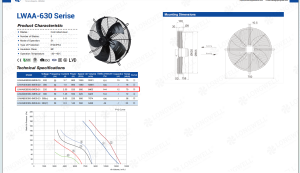
Final Specification Sheet (LWAA6D800S-7PEB-18-00)
The primary specification sheet for the selected model, containing all nominal data, P-Q performance curves, and dimensional drawings for design engineers. Get (PDF).
Alternative Variant Datasheet (LWAA6D800S-7PNB-18-00)
The document shows the specification for the alternative -7PNB variant, provided for engineering comparison. It highlights the selected -7PEB’s superior static pressure capability (248 Pa vs 185 Pa). Download (PDF).
How to sanity-check a duty point
A condenser fan duty point that looks fine on paper can still be unsustainable. So these checks catch it early.
- Ask where on the curve your point sits. A fan can hit many operating points, although only some leave the motor in its efficiency band. So ask the supplier to mark your condenser fan duty point on the curve and show the power draw there, not at free delivery.
- Treat a quote that exactly matches your ask with mild suspicion. Real fans land near your target, not on it. A supplier who confirms every figure without comment may not have checked, and you will find out in service.
- Check whether speed is being used to reach the number. Raising RPM is the easy way to meet a hard duty point, and it costs noise, power and bearing life. If a quoted speed is higher than you expected, ask what it bought.
- Give your thermal requirement, not just an airflow figure. Condenser designers often have margin in the airflow number. Saying what heat you need rejected lets the supplier find a sustainable point rather than chasing a number you could have relaxed.
See our axial fan range, the condenser fan section, or industrial axial fans. Airflow testing follows AMCA 210.
Questions about this fan
Why not just supply the fan they asked for?
Because it would have met the figure while running the motor at its service limit continuously. Heat is what ends motor life, and an outdoor condenser is not somewhere anyone notices a fan running hot. Meeting a number that shortens service life is not a solution, it is a deferred failure.
Is 21,000 m3/h enough for the condenser?
For this design, yes, and we confirmed that rather than assuming it. Condenser airflow targets often carry margin, since designers size for worst-case ambient. Give your heat rejection requirement and the design ambient, and the sustainable airflow can be checked against it directly.
Could a higher speed motor have hit 25,000?
Yes, and we ruled it out deliberately. Raising speed increases airflow, and it increases noise and power draw faster. On outdoor refrigeration equipment in Europe, noise limits usually bind before performance does, so the trade rarely works.
What does the L10 figure mean at 20,000 hours?
That after 20,000 hours at 40C ambient, 90% of a large batch are expected to still be running. It is set mainly by the bearings. Running a motor near its thermal limit does not change the published figure, though it does change what you actually get, which is the point of this whole exercise.
Technical Documentation & Resources

Sizing something comparable?
Share the airflow, pressure, voltage and control interface, and we come back with a tested curve and a drawing. Meanwhile custom work runs to 90 days for spec sheets and samples. Since 1990 Longwell has supplied fans to HVAC and industrial OEMs.
Browse Related Products:
🏆 ISO 9001 / ISO 14001 / ISO 45001 | CE (TÜV) | UL/ETL | ATEX Zone 21/22 | AMCA 210/211 / ISO 5801 tested