Single-phase and three-phase fan motors can both turn an impeller, but the supply available at the installation is only the first part of the choice. Starting method, fan-wheel load, control method and protection must match the exact motor and assembled fan. A phase label alone cannot tell you which motor will use less energy or start a particular wheel reliably.
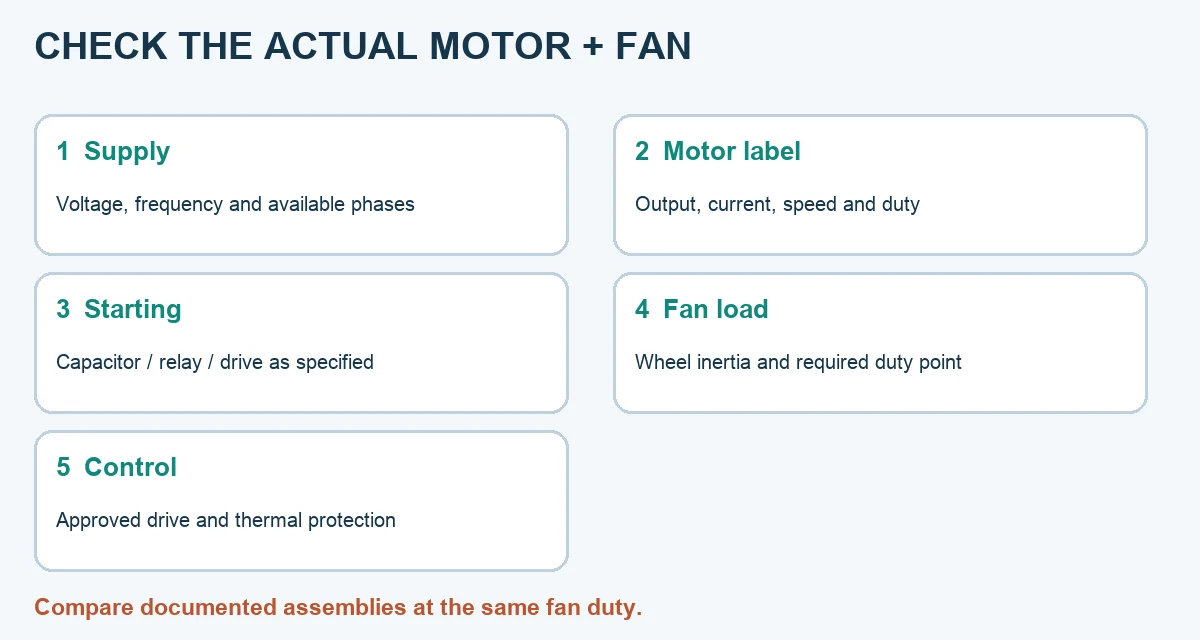
Confirm the available supply, then compare documented motor-and-fan assemblies at the same required duty. Verify the starting circuit, nameplate, approved controller and protection before making a substitution.
What changes in the magnetic field?
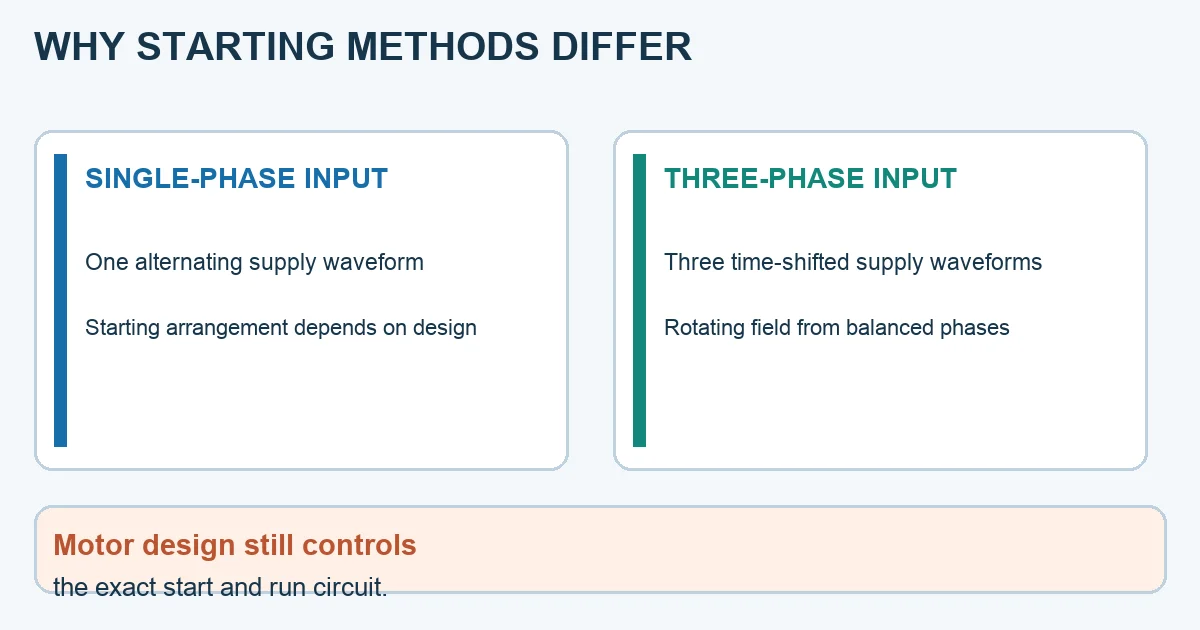
A balanced three-phase supply has three time-shifted currents. In a suitable three-phase induction stator, those currents produce a rotating magnetic field. A single-phase induction motor fed by one alternating waveform needs a design-specific way to establish starting torque. Capacitor-start, capacitor-run and shaded-pole designs do this differently; not every single-phase motor has the same capacitor circuit.
This distinction explains the electrical mechanism, but it does not establish a fixed efficiency gap or starting-torque ranking for every product. Compare the rated data for the proposed motors and the fan assembly. The diagram below shows the supply principle; it is an original explanation, not a test result for a LONGWELL model.
Why there is no universal power crossover
A particular single-phase motor may be a practical choice where only single-phase power is available. A three-phase alternative may offer a different selection of rated outputs and control options where that supply exists. Neither statement creates a universal kilowatt threshold. Motor ranges, regional supplies, starting requirements and approved controls differ, so a fixed “switch to three phase above this size” rule is unreliable.
LONGWELL lists single-phase asynchronous motors and an AC induction motor family. These pages help identify families to discuss, but a family listing does not prove that a pictured motor fits a particular wheel or has a claimed duty-point result. Request the current model, suffix and datasheet for the exact assembly.
Compare energy use at the same fan duty
Old percentage tables often compare unlike motor sizes or ignore the fan operating point. A useful review starts with the airflow and pressure the installed fan must deliver. Then compare the complete motor-and-fan input power under the same conditions, including any drive losses, operating schedule and control settings. The US Department of Energy motor systems guide gives a broader framework for motor selection and operating cost; its example values should not be copied as LONGWELL model results.
The real decision also depends on whether the site can provide the required voltage and phase safely. If it cannot, the design team must evaluate a suitable alternative or properly engineered power conversion. A cable count or wire color cannot substitute for the motor nameplate, connection diagram and local electrical requirements.
Check starting, control and protection together
Fan-wheel inertia, expected start frequency and the required acceleration matter alongside motor starting torque. A capacitor problem is possible only for a design that uses that component; a slow start can also arise from load, voltage, wiring or another motor fault. Diagnosis belongs to qualified personnel using the exact manufacturer’s instructions and safe isolation procedure.
A variable-frequency drive is not automatically approved for every three-phase motor. Likewise, a voltage or triac controller is not automatically acceptable for every single-phase motor. Check the motor’s control documentation, permitted speed range, cooling, thermal protection and the fan’s stable operating range. EC fan input phase does not by itself describe the internal motor topology or prove controller compatibility.
What to send for a replacement review
Record the old motor and fan model and suffix, nameplate voltage, frequency, phase, rated output and speed. Include the connection diagram, capacitor information if present, controller model, wheel size, rotation direction, mounting dimensions, airflow and pressure requirement, and the actual site supply. A photo of the label can prevent a family-level product page from being mistaken for an exact replacement specification.
For a new design, ask the supplier to show the selected motor’s current curve or rating data together with the fan duty point and approved control arrangement. For an existing installation, compare the assembly documentation before changing the supply, controller or motor. The broad LONGWELL AC motor range is a useful starting directory, not a substitute for that exact review.