IP ratings describe how well an enclosure keeps solids and water out, using two digits that mean specific tested things.
They are precise, although they are narrower than most people assume. A rating covers one defined test, not every condition a fan meets outdoors.
The first digit covers solid objects and dust, from 0 to 6. The second covers water, from 0 to 9K. IP54 means dust protected and splash proof. IP55 adds low-pressure jets. IP66 means dust tight and resistant to powerful jets. Higher water digits are not always a superset, so check which test the application actually needs.
What each digit means
| Digit | First: solids | Second: water |
|---|---|---|
| 0 | No protection | No protection |
| 1 | Objects over 50 mm | Dripping water |
| 2 | Objects over 12.5 mm | Dripping when tilted |
| 3 | Objects over 2.5 mm | Spraying water |
| 4 | Objects over 1 mm | Splashing water |
| 5 | Dust protected | Water jets |
| 6 | Dust tight | Powerful water jets |
Note the gap between dust protected and dust tight. IP5X lets a little dust in, provided it does not stop the fan working. IP6X lets none in at all.
Common ratings for fans
- IP44: general indoor equipment protected from splashing.
- IP54: the most common outdoor and industrial fan rating.
- IP55: adds resistance to low-pressure jets, useful for washdown areas.
- IP65 and IP66: dust tight, for exposed outdoor and coastal installations.
- IP68: submersible, rare on fans but used in some pump-fan assemblies.
- Finally, IP69K: high-pressure hot washdown, common in food processing.
Our EC axial fan range and condenser cooling fans publish the rating for each model, since outdoor duties depend on it.
Why higher is not always better
A sealed box keeps water out, although it also keeps heat in.
Motors lose heat through their surface, so a fully sealed one runs hotter than a vented one at the same load. So asking for IP66 where IP55 would do can shorten life rather than extend it.
Water digits are not a simple ladder. A product tested to IP66 has not necessarily been tested for immersion, so IP67 is not automatically implied. Where both matter, look for a dual rating such as IP66 or IP68.
What IP ratings do not cover
- Corrosion, which depends on materials and coating rather than sealing.
- Ultraviolet degradation of plastics and cable sheathing.
- Condensation forming inside a sealed enclosure as it cools.
- Chemical attack from cleaning agents or process vapours.
- Impact resistance, which uses a separate IK rating.
- Finally, long-term seal ageing, since testing is done when new.
Condensation deserves special attention. A sealed outdoor box breathes as it heats and cools, so it draws in humid air that condenses inside. Drain holes and breather elements exist precisely because IP ratings alone do not solve that.
Choosing for common applications
| Application | Typical requirement |
|---|---|
| Indoor plant room | IP44 or IP54 |
| Outdoor rooftop | IP54 to IP55 |
| Coastal or exposed | IP65 or IP66 plus coating |
| Refrigeration and cold store | IP54 minimum, condensation control |
| Food processing washdown | IP66 or IP69K |
| Roadside cabinets | IP54 plus filtration |
Our evaporator fan guide covers the refrigeration case where condensation matters most.
Verifying a claim
Many makers declare IP ratings themselves, so ask what they actually tested.
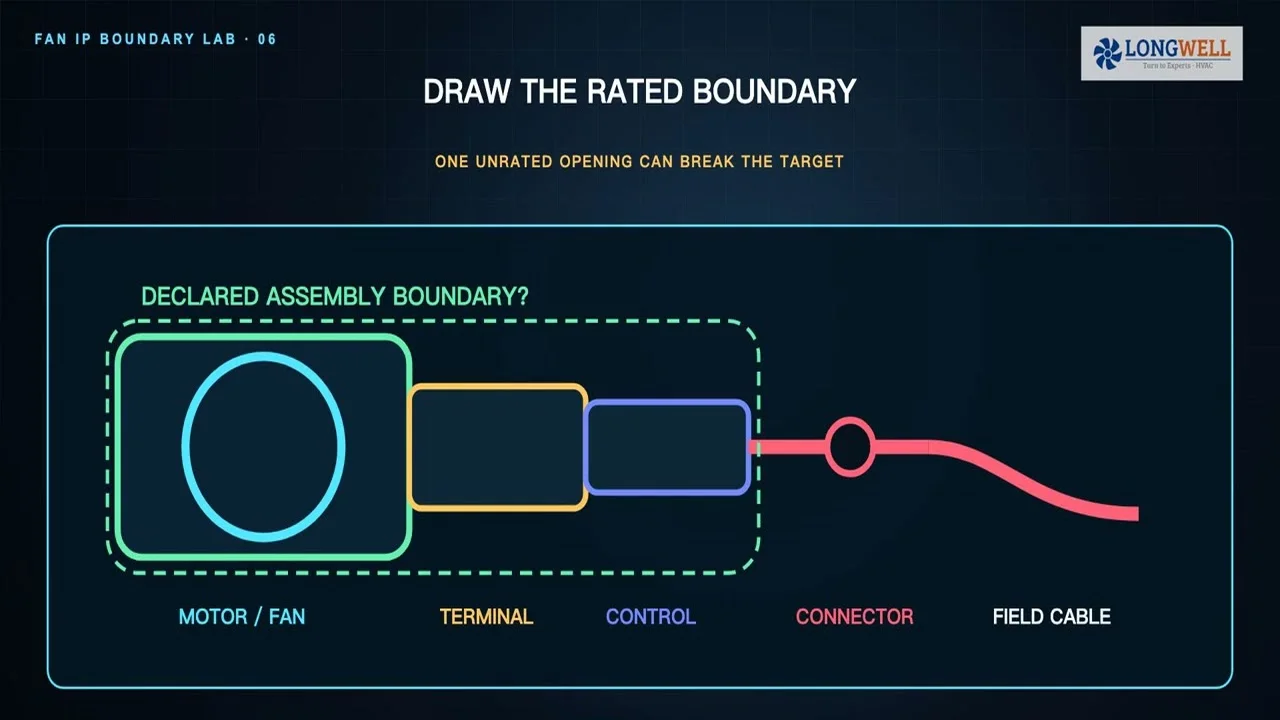
Request the test report, confirm which parts of the assembly it covers, and check whether cable entries and connectors were included. Meanwhile confirm the rating applies to the fan as installed, since a fan tested without its terminal box is a different product.
For the definitions, IEC 60529 is the governing standard.
Finally, write the rating into the order rather than assuming it. Suppliers offer several IP variants of the same fan, and the default is rarely the one an outdoor site needs.
IP rating FAQ
Is IP66 better than IP55 for an outdoor fan?
Not necessarily. IP66 seals better, although it also traps heat and moisture. For a rooftop fan, IP55 with proper drainage often gives longer life than a fully sealed unit.
Does IP rating cover corrosion?
No. Corrosion resistance depends on materials and coating, and it needs specifying separately. A coastal installation needs both a suitable IP rating and a suitable finish.
What does the K in IP69K mean?
It denotes high-pressure, high-temperature washdown testing, originally from a German automotive standard. It matters in food processing and vehicle applications.
Can I improve a fan IP rating on site?
Only marginally, through better glanding and shielding. Changing the fundamental rating means changing the product, since the enclosure design determines it.
IP ratings answer a narrow question precisely. Pair the rating with a corrosion specification and a condensation strategy, and the fan will actually survive outdoors.