What the refrigeration OEM needed
A commercial refrigeration OEM wanted to update its condenser line. The old AC fan was tired and thirsty, and the market had moved on. Rules such as ASHRAE 90.1, plus rising expectations about noise, made an EC axial fan the obvious swap.
The enquiry came in properly prepared, with drawings of the existing condenser and data for the old fan. Consequently it saved everybody a fortnight.
Nearly all the limits came from the chassis, since that was not changing.
- A guard diameter of 760mm at most, plus 210mm of fitting depth.
- At least 13,000 m3/h against roughly 180 Pa of calculated system pressure.
- No more than 75 dBA at peak, because these units sit near people.
- IP54, because the condensers are installed outdoors.
- An operating range from -25C to +60C.
- CE for Europe and ETL for North America, since the OEM sells worldwide.
A retrofit like this is harder than a clean sheet. Someone else has already fixed every dimension. In the end, only one variable is yours to choose.
Sizing the EC axial fan to a fixed chassis
Our LWAE series was the right family. The real question was diameter, since in a fixed chassis that is the only free choice left.
Why not 560mm
A smaller 560mm fan reaches the airflow target, but only by spinning much faster. Noise climbs steeply with tip speed, so it would have blown past the 75 dBA limit. Meanwhile efficiency would have dropped. Two penalties, no gain.
Why not 710mm
A 710mm fan is the opposite case. It would run slower, quieter and cleaner, which is just what you want. However, it does not fit the existing 753mm mounting pattern. So the better fan was simply out of reach.
The 630mm platform, and the motor on it
That leaves 630mm as the only size that meets airflow, noise and geometry at once. The model chosen was the LWAE3G630TS-5PEW-11, with an 887W EC motor.
We checked motor size in both directions. A weaker winding lacked the torque to hold the duty point against 224 Pa of peak pressure. Meanwhile a 1.1 kW option is more than the job needs, and it costs more to buy and to run. The 887W winding sits where it should.
Here the impeller carries five blades in tough PA66 composite. Five blades give the pressure a dense coil demands. Furthermore, the composite holds its shape when hot better than a thin steel pressing of the same weight.
What the built-in drive removes
The built-in SmartEC electronics are arguably the biggest gain. They take 0-10V, PWM and RS485 Modbus directly. So the OEM can trim fan speed to the weather without the external drive its old AC fan needed.
That removes a part, a cabinet, a set of terminations and a source of electrical noise. Meanwhile the -25C to +60C window, standard on our ThermoFlex designs, left plenty of margin for the customer climate range.
Technical Specifications
These figures are for the approved EC axial fan. Compare the overall diameter with guard against the customer 760mm limit, since that one dimension decided the whole selection.
| Parameter | Value |
|---|---|
| Model Number | LWAE3G630TS-5PEW-11 |
| Rated Voltage | 380 V (3-Phase) |
| Voltage Range | 304 ~ 456 V |
| Frequency | 50/60 Hz |
| Rated Speed | 1200 RPM |
| Input Power | 887 W |
| Rated Current | 1.57 A |
| Maximum Airflow | 13670 m³/h / 8137 CFM |
| Maximum Static Pressure | 224 Pa |
| Noise Level | 74 dBA |
| Impeller Diameter | 630 mm |
| Overall Diameter (with Guard) | 753 ± 1 mm |
| Overall Depth | 202 ± 2 mm |
| Protection Class | IP54 |
| Insulation Class | Class F |
| Operating Temperature | -25°C to +60°C |
| Bearing Type | Maintenance-free deep groove ball bearing |
| L10 Service Life | 40,000 hours (@ 40°C) |
| Control Signal | 0-10VDC / PWM / RS485 |
| Certifications | CE, ETL (UL 507 / CSA C22.2#113), RoHS, REACH |
Technical Documentation
LWAE3G630TS-5PEW-11 Specification Sheet
Meanwhile the technical specification sheet provides complete electrical data, performance curves, and mechanical drawings required by design engineers for system integration.
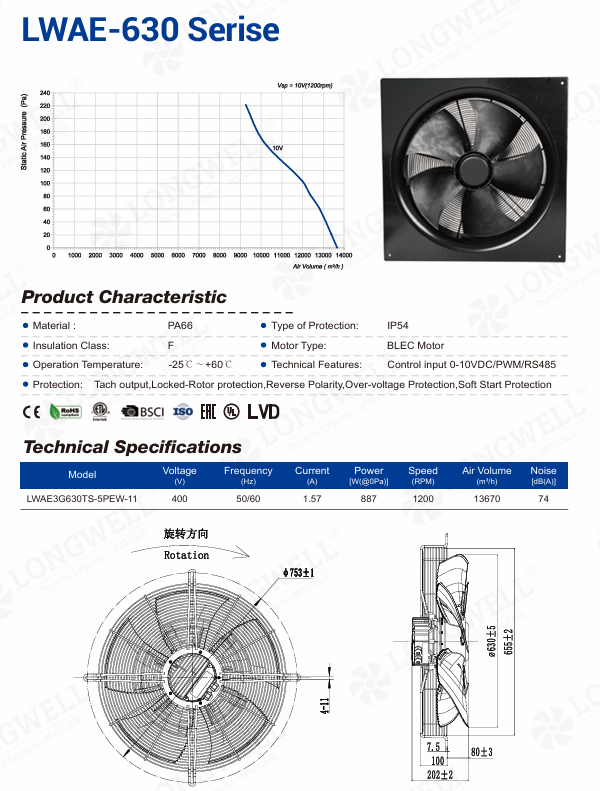
Here the product image and characteristic summary is useful for procurement managers and project teams for quick identification and review.
Why the OEM changed supplier
Beyond the engineering itself, three things carried this project.
- A better price on a key part. Our quote sat well below the matching 630mm EC axial fan from their old European supplier. As a result the OEM bill of materials improved, and nothing was given up on performance.
- Control without a drive cabinet. Since SmartEC lives inside the motor, the customer dropped the VFD entirely. The saving covers the drive, the panel space, the wiring and the setup time around it.
- Airflow data they could trust. Detailed reports came from our own test lab, checked independently to AMCA 210/211 and ISO 5801 methods. Consequently no guesswork entered their system model.
Browse the full EC axial fan range, or the condenser fan series for refrigeration work. Efficiency requirements are set out by ASHRAE in Standard 90.1.
Questions from the integration team
What is the lead time on 500 units?
Standard production runs 15 to 30 days after order confirmation. Our annual output exceeds 30,000 cold chain units, so volumes at this level are routine. For a first mass production order we usually suggest allowing 30 to 45 days so it slots cleanly into your own planning.
Is IP54 enough outdoors?
For most installations, yes, since the fan normally sits behind a housing or cowl. Where it faces heavy rain directly, pressure washing, or coastal salt air, specify IP55 or a custom-coated version instead. It is a cheap decision to make early and an expensive one to revisit.
Can we monitor the fan over Modbus RTU?
Yes. The SmartEC controller supports full control and monitoring over RS485. Once the project is confirmed and an NDA is in place we supply the complete register map, covering speed control, RPM feedback, motor temperature, fault codes and running hours, which is enough for proper BMS integration.
How much energy does the EC change actually save?
It depends on how long the unit runs below full load, which for a condenser is most of the year. An EC axial fan gains most exactly there. Fan power falls with the cube of speed, so a modest reduction in speed produces a large reduction in watts. That part-load behavior usually matters more than the efficiency difference at full speed.
Technical Documentation & Resources
Got a duty point you need matched?
Tell us the airflow, the pressure and the space you have. Then we mark your duty point on a tested curve and send the drawing back. Meanwhile samples and custom spec sheets take up to 90 days. Since 1990 we have supplied OEMs across HVAC, refrigeration and industry.
Browse Related Products:
🏆 ISO 9001 / ISO 14001 / ISO 45001 | CE (TÜV) | UL/ETL | ATEX Zone 21/22 | AMCA 210/211 / ISO 5801 tested
Choose the right axial fan
Longwell manufactures 1,086 axial fans in-house. Send airflow, static pressure and voltage — an engineer replies with a matching model, performance curve and price within one working day.