What the precision cooling OEM needed
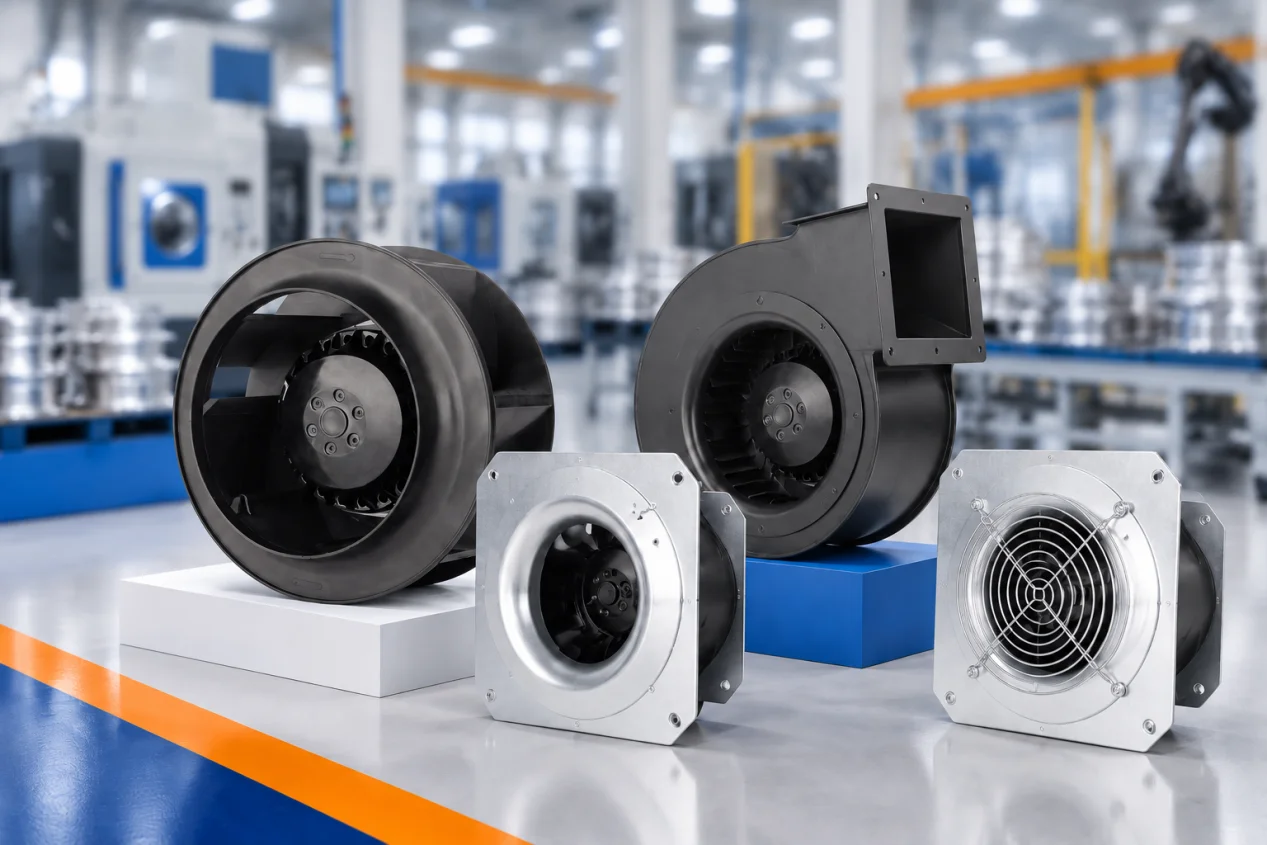
A leading OEM of precision cooling systems needed a DC centrifugal blower for its next generation of computer room air handlers. The headline requirement was 649 Pa of static pressure out of a body only 244mm across.
Those units run on a 310 VDC bus, which is common in data center and telecom kit. Furthermore, the enquiry opened with a request for 3D STEP files, so the design-in had already started.
The constraints were unusually demanding.
- An envelope of 244 by 220 by 96mm, since in-row cooling layouts are dense.
- A standard tier at roughly 494 m3/h, but against a full 649 Pa.
- A high-performance tier at 680 m3/h, from the same mechanical platform.
- No more than 66 dB(A), because data center standards say so.
- Continuous S1 duty, so maintenance-free ball bearings rather than sleeve types.
- Finally, CE and UL compliance, for Europe and North America.
Wanting two tiers from one platform is a buying decision as much as an engineering one. Namely, it keeps the bill of materials short and the assembly line simple across several product models.
Designing the DC centrifugal blower pair
Two constraints did most of the work here. Firstly high pressure, then a DC supply.
Why not axial, and why not AC
At this size, 649 Pa is far beyond anything an axial fan produces. So a DC centrifugal blower was settled immediately.
An AC motor was evaluated and rejected just as quickly. The OEM bus is 310 VDC, so an AC motor would need a DC-to-AC inverter added inside an already crowded cabinet. That is extra cost, extra heat and one more thing to fail in equipment where failure is expensive. A brushless DC motor was the obvious route.
Forward-curved, deliberately
Here the impeller choice is the interesting one. A backward-curved wheel reaches higher peak efficiency. Even so, we chose forward-curved.
The reason is pressure per unit of size. A forward-curved multi-blade impeller gives more pressure from a given diameter, and diameter was capped at the 160mm class. Efficiency matters, though not if the fan never reaches the duty point.
A plastic housing, on purpose
Meanwhile the scroll is injection-molded PA66 rather than stamped steel. Consequently it is lighter, it does not corrode, and it damps vibration far better than sheet metal.
That damping is a direct contributor to staying under 66 dB(A). A steel scroll rings; a filled polymer one does not.
Two tiers, one platform
We proposed the LWFD3G160-072SZ-01 and the faster LWFD3G160-092SZ-01. Both share an identical PA66 housing and mounting footprint. The difference, therefore, comes entirely from motor winding and control parameters.
Consequently the OEM gets a 38% airflow increase available with no mechanical redesign at all. The integrated SmartEC controller handles 0-10V, PWM and RS485, which supplies the variable speed operation that ASHRAE 90.1 efficiency targets rely on.
Technical Specifications
Two models share the housing below. Only the winding and the control parameters differ. In short, that is what lets one DC centrifugal blower design cover both tiers.
| Parameter | LWFD3G160-072SZ-01 | LWFD3G160-092SZ-01 |
|---|---|---|
| Voltage (VDC) | 310 | 310 |
| Input Power (W) | 80 | 220 |
| Current (A) | 0.26 | 0.71 |
| Speed (RPM) | 1800 | 2400 |
| Max Air Flow (m³/h) | 494 | 680 |
| Max Air Flow (CFM) | 291 | 400 |
| Max Air Pressure (Pa) | 649 | 597 |
| Noise (dB(A)) | 61 | 66 |
| Dimensions (mm) | 244 x 220 x 96 | 244 x 220 x 96 |
| IP Class | IP54 | IP54 |
| Insulation Class | B | B |
| Operating Temp (°C) | -30 to +60 | -30 to +60 |
Technical Documentation
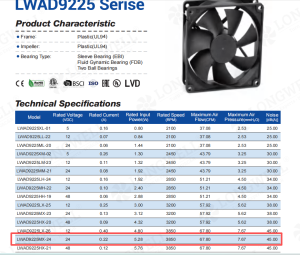
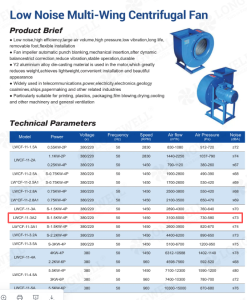
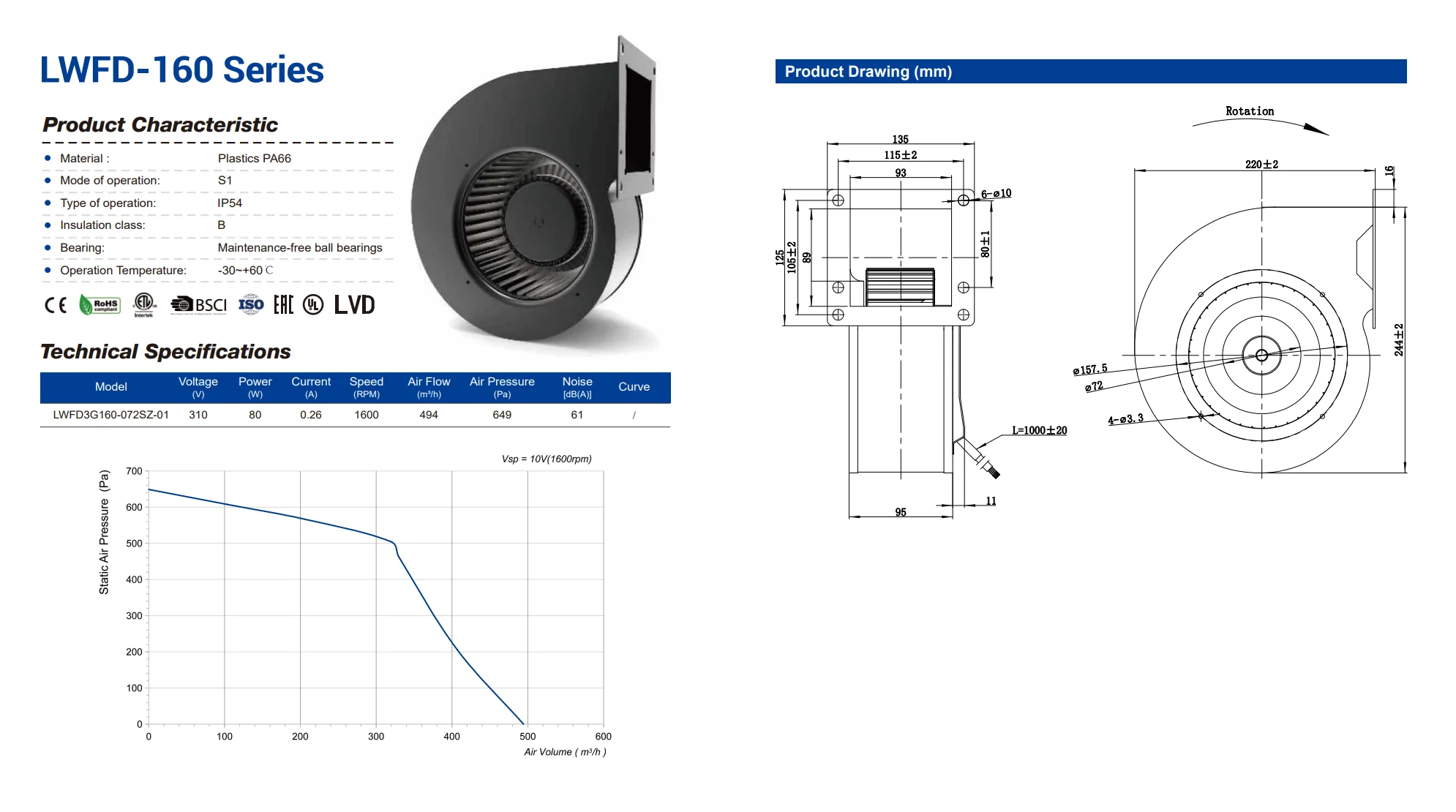
The specification sheet for model LWFD3G160-072SZ-01 provides performance curves, dimensions, and electrical data for system integration.
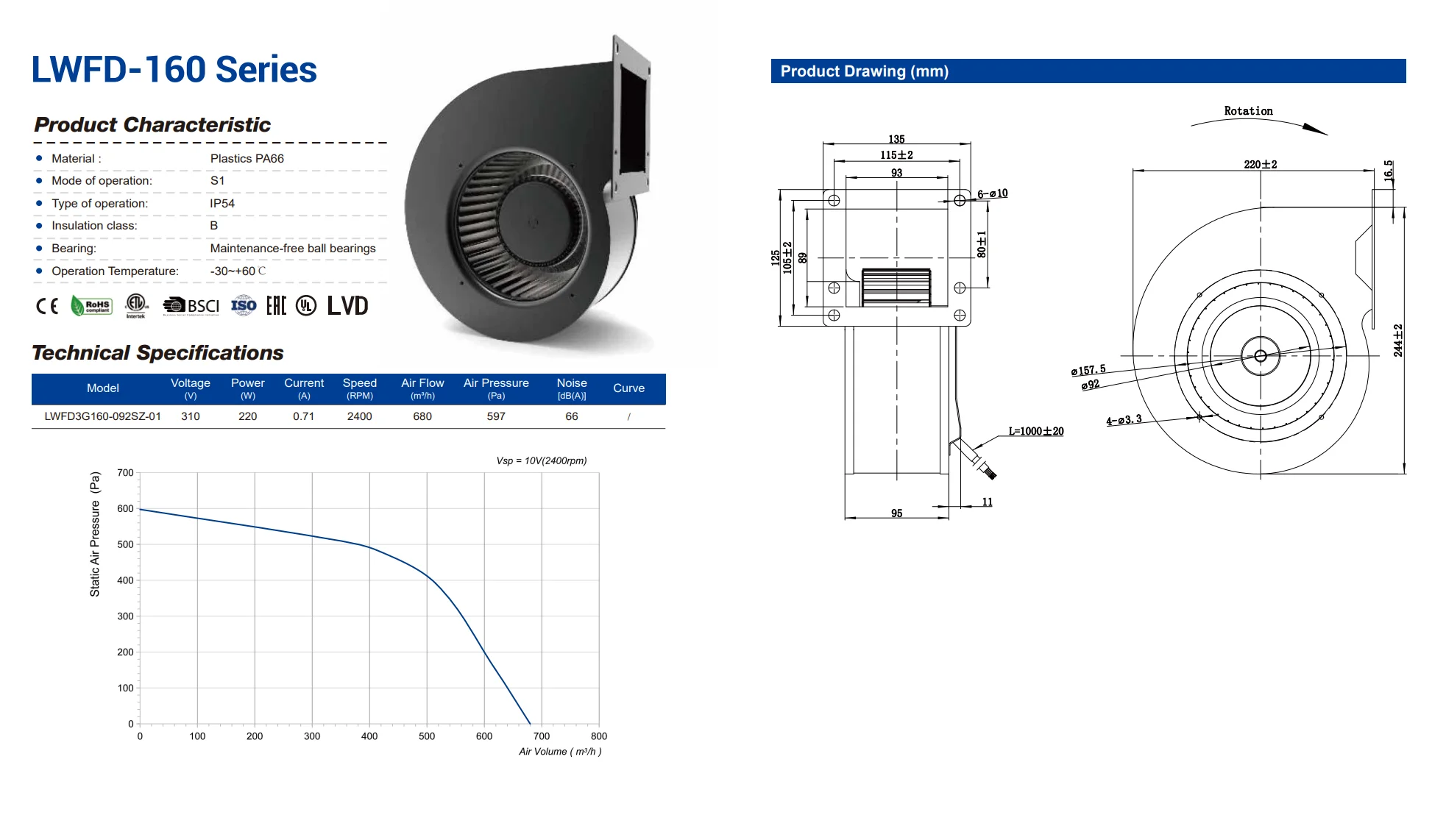
Here the document details the LWFD3G160-092SZ-01, the higher-performance variant, for procurement managers and engineers to compare specifications.
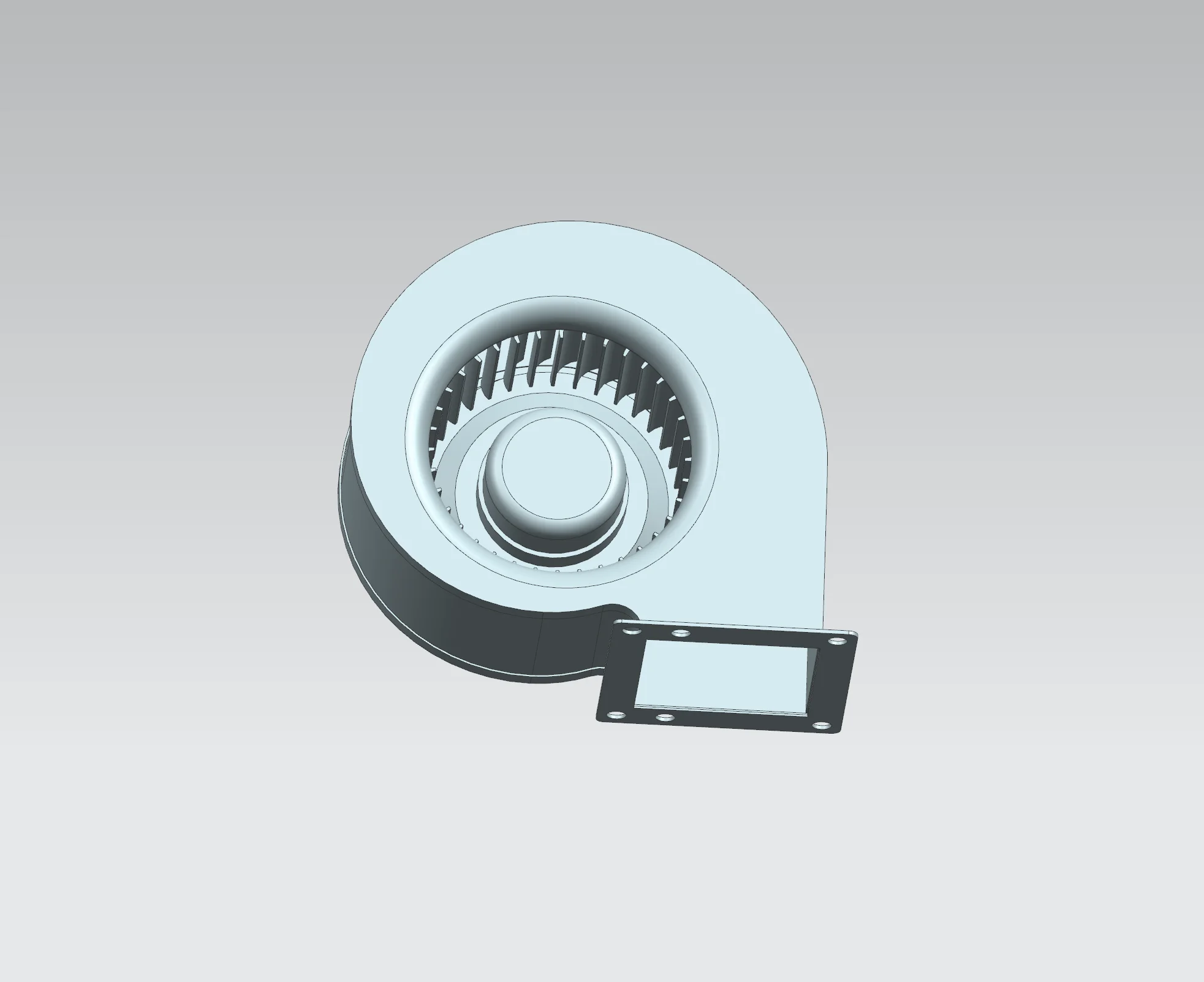
A 3D CAD rendering (isometric view) of the LWFD-160 series blower, used by design engineers for initial spatial fit checks.
Here the alternate 3D view shows the impeller and motor housing, critical for maintenance access and airflow path analysis.

Why the OEM designed us in
Beyond the DC centrifugal blower itself, two things mattered to this customer.
- A design-in inside 90 days. The request for 3D files confirmed a fresh design cycle. Our NPI process runs from specification lock to first production samples inside 90 days, against the 12 to 18 months imported European brands commonly quote. That difference moved their CRAH launch forward by quarters.
- Figures that survive contact with reality. In mission-critical cooling, a stated number must be the real number. The 649 Pa and 494 m3/h figures are verified in our on-site lab, independently audited to AMCA 210/211 and ISO 5801 methods.
Browse our centrifugal blower range, or the data center cooling fan section. Efficiency requirements are published by ASHRAE in Standard 90.1.
Questions from the thermal team
What control interfaces does the LWFD-160 EC motor offer?
The SmartEC controller takes a 0-10V analogue signal, or a PWM signal typically between 1 and 10 kHz. In addition, it can be factory configured for RS485 Modbus RTU. That covers direct integration with most BMS platforms or with an OEM control board, including alarm monitoring as well as speed setting.
Can it run in a hot-aisle containment system?
Meanwhile the standard DC centrifugal blower is rated for continuous running to +60C ambient. Above that we apply our ThermoFlex platform, which means higher-temperature windings, bearings and control board parts specified through a 90-day NPI cycle. That usually lifts the ceiling to +70C or beyond, depending on duty cycle.
How does a PA66 housing compare with a steel scroll?
It damps vibration considerably better, which is a large part of why the noise sits at 61 to 66 dB(A). Moreover it is lighter and immune to corrosion. Importantly, all our published data including the 649 Pa figure is measured with the production PA66 housing, so the catalog number is the one you get.
Why is static pressure the hard part in a CRAH unit?
Because the air path is full of resistance. Namely a deep coil, filters, and often a raised floor or containment beyond that. Airflow quoted at free air is close to meaningless there. What matters is how much air the blower still moves once several hundred pascals stand in the way.
Need the same thing for your own unit?
Give us the numbers and the envelope, and you get a shortlist rather than a catalog. Meanwhile custom spec sheets and samples run to 90 days. Since 1990 Longwell has supplied EC fans and blowers to OEMs in HVAC, cold chain, data center and industrial markets.
Browse Related Products:
🏆 ISO 9001 / ISO 14001 / ISO 45001 | CE (TÜV) | UL/ETL | ATEX Zone 21/22 | AMCA 210/211 / ISO 5801 tested
Choose the right blower
Longwell manufactures 247 blowers in-house. Send airflow, static pressure and voltage — an engineer replies with a matching model, performance curve and price within one working day.