A bearing complaint is a reason to inspect the fan, not a countdown to failure. Ball and sleeve bearings support a rotating shaft in different ways, but bearing type alone cannot tell you how many hours remain. The useful decision is whether the exact fan can continue safely, needs a specified service action, or should be replaced as an assembly.
Start with the exact fan, not a generic lifetime number
Find the fan and motor designation, bearing arrangement, installation position, operating hours and service instructions. A published life figure applies only under its stated test or calculation conditions. Temperature, speed, load, contamination, lubricant and installation can change the outcome. A rolling bearing’s calculated fatigue rating also differs from the service life of its grease, seals and complete motor. This distinction matters when a brochure quotes one number without saying what it measures.
For example, the public LONGWELL LWCA-40290SN-07 product record identifies maintenance-free ball bearings for that particular cross-flow fan. It does not establish a lifetime for another LWCA model or prove that this model fits your duty point. The cross-flow fan family contains different motor and bearing options; use the exact drawing and project conditions to select one.
What changes inside a sleeve or ball bearing?
A sleeve or plain bearing supports the shaft across a sliding surface. Its lubrication arrangement may be an oil film, an impregnated material or another design specified by the motor maker. A ball bearing carries load through rolling elements between raceways and still depends on suitable lubrication and protection. Neither construction makes a motor immune to heat, contamination or incorrect installation. The diagram separates the mechanisms; it is not a section drawing of a LONGWELL product.
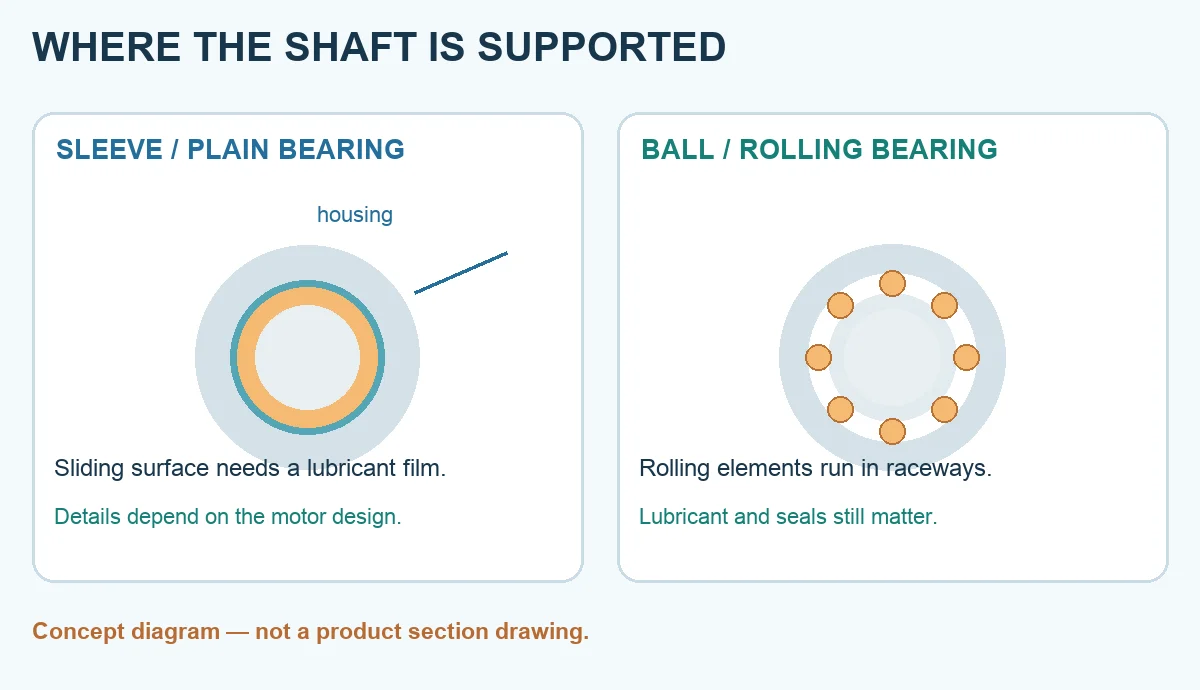
This mechanical difference helps frame the questions to ask, but it is not a simple ranking. The motor’s complete bearing arrangement, shaft orientation, thermal environment and approved service method determine which design can be specified. A ball-bearing option should not be treated as an automatic field conversion for a sleeve-bearing motor.
How should a life claim be read?
Ask whether the stated hours describe the fan, motor, lubricant or an L10 bearing calculation, and request the assumed operating temperature, speed and load. As ebm-papst explains, mechanical bearing fatigue life and grease life are separate questions. SKF’s rating-life guidance also considers lubrication and contamination. A fixed hours-to-replacement rule cannot be carried from one fan or ambient condition to another.
For procurement, compare candidates against the same duty point and installation constraints. If a supplier quotes a bearing-life value without its basis, ask for the model-specific sheet or engineering calculation before using that value in a maintenance plan. The published number is a design input, not a timer that starts when the fan is installed.
What observations justify stopping and inspecting a fan?
A new sound, vibration, heat or current change can point to a bearing problem, but it can also reflect blade rub, contamination, mounting looseness, imbalance or a changed operating point. Record the condition at a comparable speed and duty, and compare it with a known baseline. If the fan is overheating, tripping, rubbing or showing rapidly worsening vibration, follow the site’s isolation and safety procedure before inspection; do not use this article to authorize continued operation.
Noise alone does not identify ball versus sleeve construction, and the sound does not reveal a trustworthy number of weeks or months remaining. A qualified technician can combine inspection with the motor documentation to determine whether the bearing, motor or complete fan assembly is the serviceable unit. Our bearing replacement guide describes the service questions to gather, but the exact product instructions take priority.
A practical replacement decision
The steps below keep diagnosis and purchasing tied to evidence. First establish the model and approved bearing arrangement. Then compare measurements under known conditions. Inspect only after safe isolation and with the right competence. Finally check the correct replacement part or assembly, installation fit and post-service test. This sequence is more useful than choosing a bearing solely because one type is described as quieter or longer lasting.
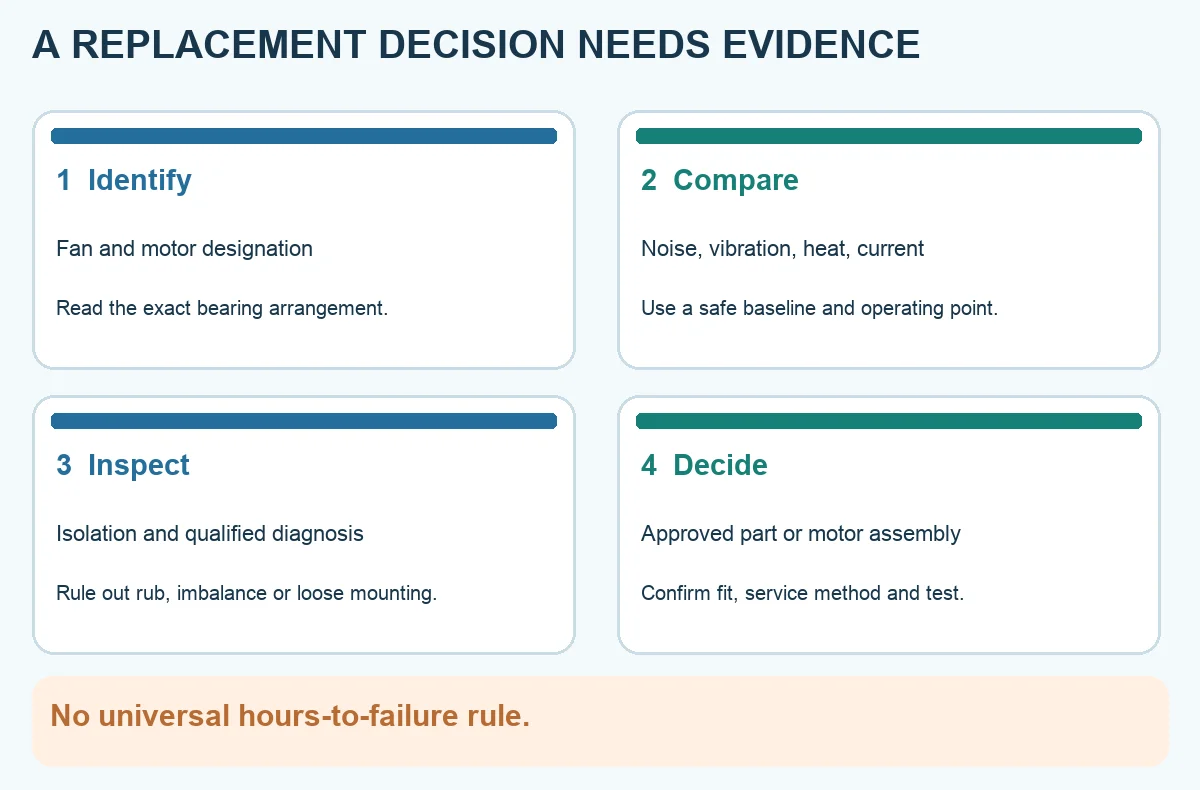
For a new design, give the supplier the mounting orientation, ambient and expected motor temperature, duty hours, speed or control range, contamination exposure and access for maintenance. Request the model-specific bearing type, life basis and service instructions. The answer may be an approved ball-bearing model, a specified sleeve-bearing design or a different motor arrangement. It depends on verified conditions, not on a universal bearing hierarchy.
Watch the bearing comparison
The video introduces the two contact mechanisms and the questions behind a replacement decision. Use it with the exact fan documentation and site measurements rather than treating its diagrams as a parts drawing.
Need to specify or replace a fan? Send the exact model, mounting position, duty conditions and observed symptoms to sales@longwellfans.com for an engineering review.