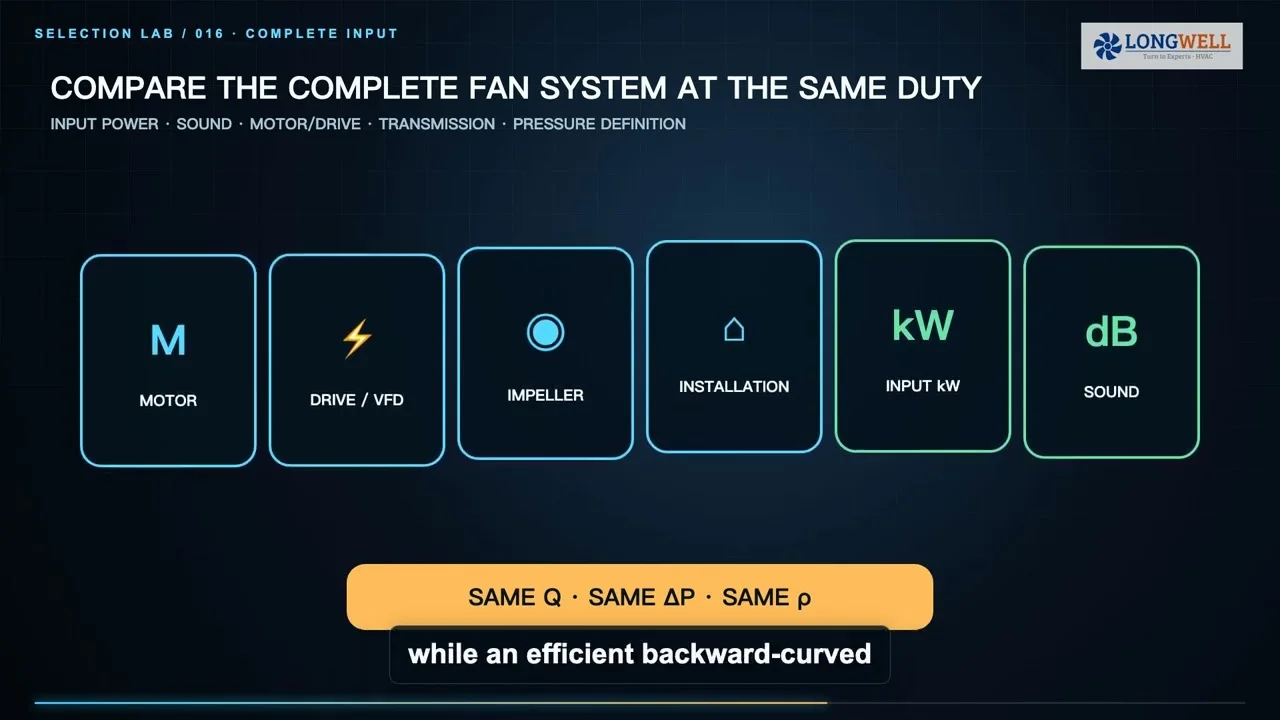
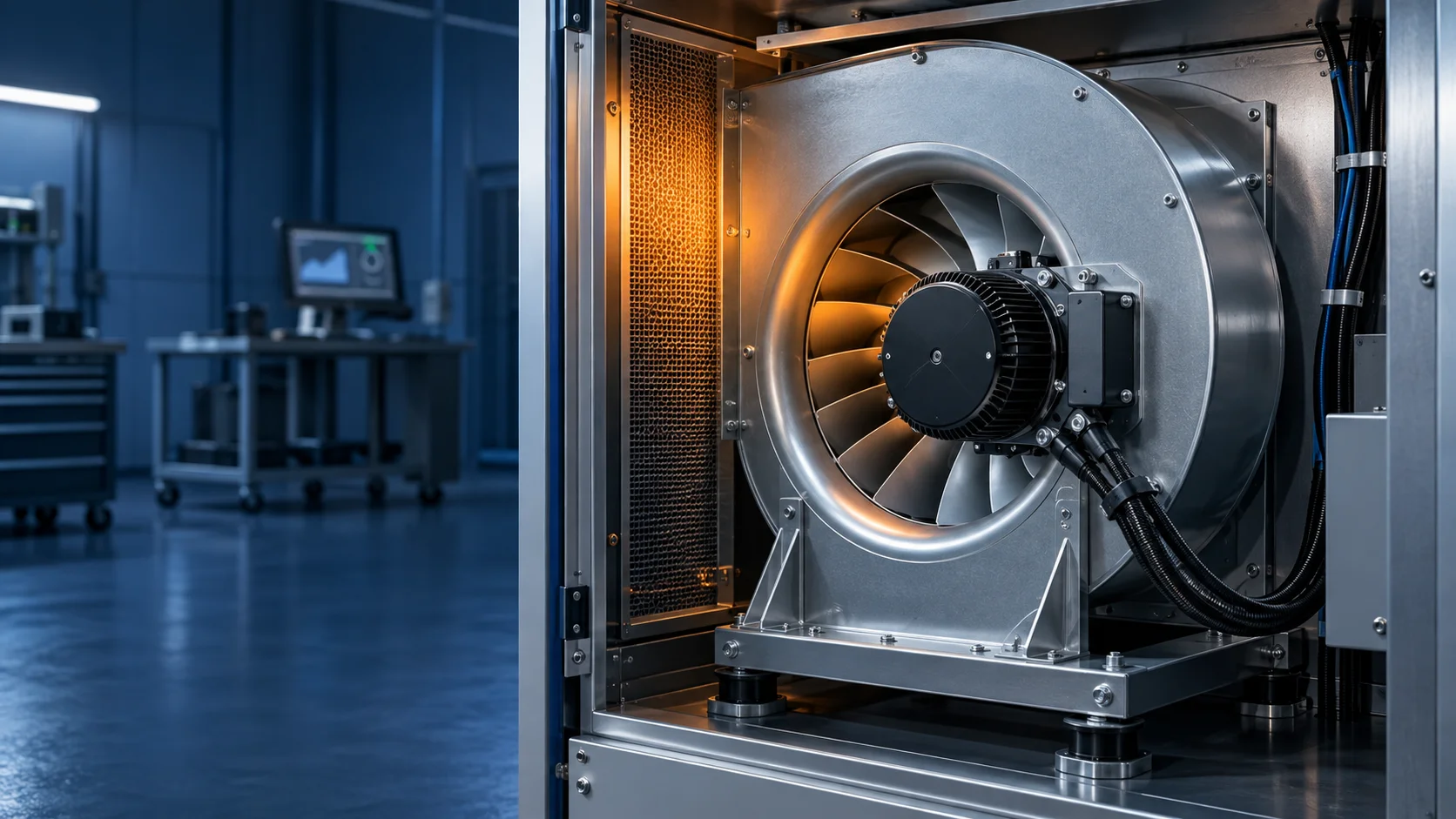
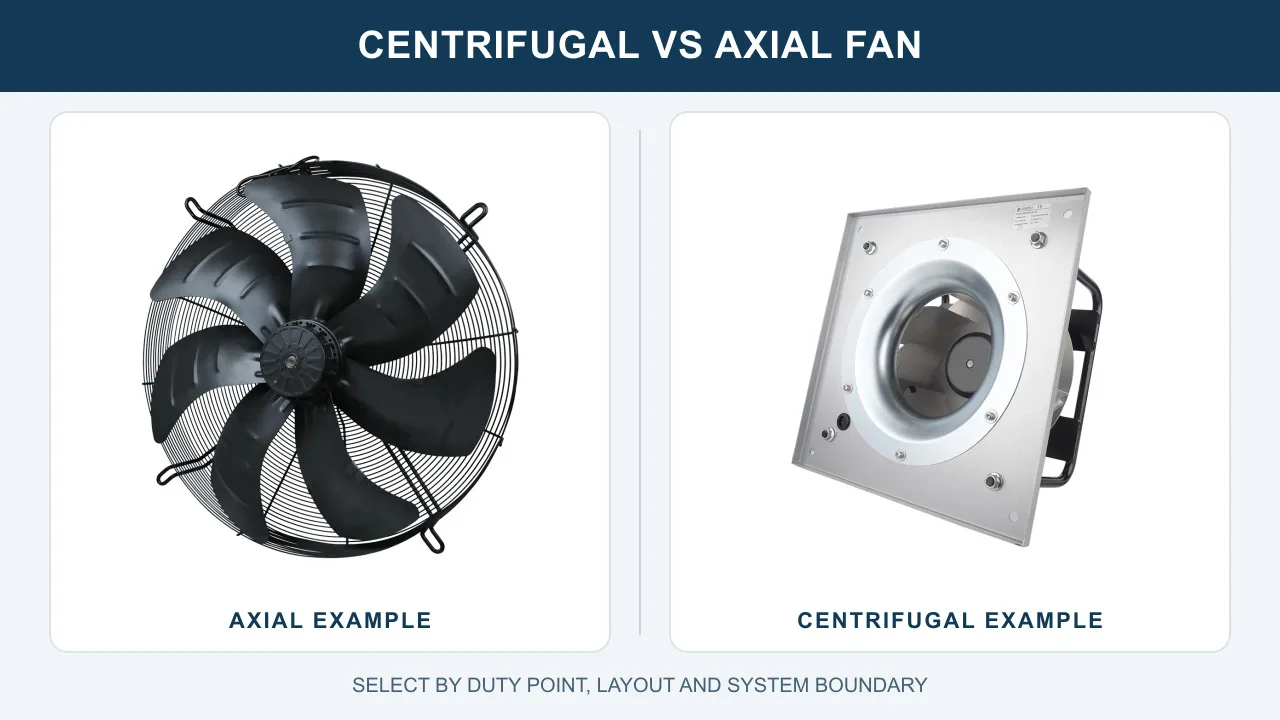
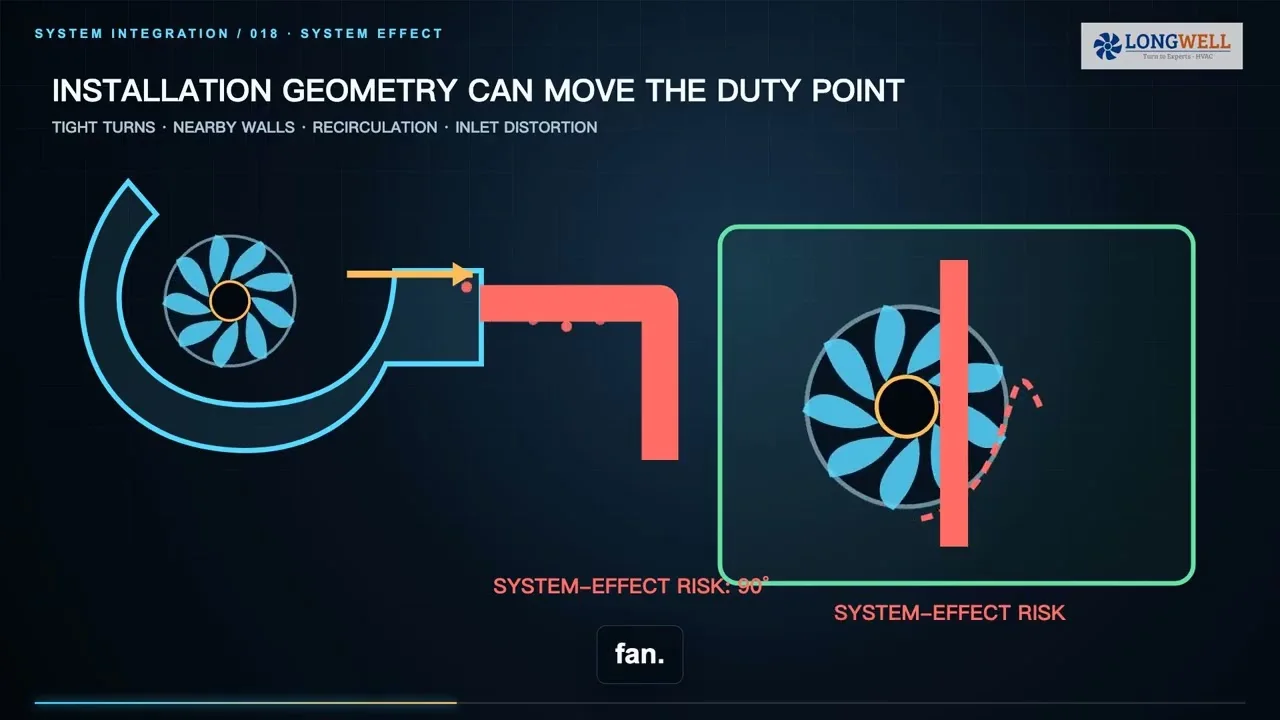
Choosing between a forward-curved and a backward-curved wheel is one of the few fan decisions that genuinely changes the whole machine. Size, motor rating, noise and running cost all move together.
Fortunately the decision follows a short path. Answer four questions and the wheel picks itself.
Pick a forward-curved wheel when space is tight, pressure is under about 400 Pa and run hours are modest. Pick backward-curved when the fan runs long hours, the duty exceeds roughly 400 Pa, or the motor must not be overloadable. Above 2 kW, backward-curved is almost always the right answer.
Question one: how much pressure
Start with the duty point rather than the fan. Below about 400 Pa both wheels work, so other factors decide.
Between 400 and 1,200 Pa the backward-curved wheel pulls ahead, because it reaches the pressure at lower speed and better efficiency. Above 1,200 Pa a forward-curved wheel becomes impractical, since it would have to spin fast enough to shake itself apart.
Be honest about the resistance while you are at it. Designers routinely underestimate filter loading, so a duty that looks like 350 Pa on paper often behaves like 500 Pa after a year. Consequently a forward-curved selection that was marginal at commissioning becomes a problem later.
Question two: how long does it run
Efficiency only matters when the fan actually turns. So count the hours.
| Annual run hours | Typical case | Sensible choice |
|---|---|---|
| Under 1,000 | Standby, smoke extract, seasonal | Forward-curved, cost led |
| 1,000–3,000 | Office hours only | Either, check payback |
| 3,000–6,000 | Extended commercial use | Backward-curved |
| Over 6,000 | Continuous plant | Backward-curved with EC motor |
At 6,000 hours, twenty efficiency points on a 4 kW fan is worth roughly 900 a year. Consequently the bigger wheel pays for itself long before the equipment is retired. Meanwhile the smaller wheel keeps costing that money every single year it stays installed.
Question three: how much room
This is where the forward-curved wheel earns its living. For the same airflow it is noticeably smaller, so fan coil units and packaged heaters use it almost exclusively.
A backward-curved wheel needs a larger diameter and a deeper scroll. If the cabinet cannot take it, the argument ends there. However, a plug fan removes the scroll entirely and often recovers the space you need.
When replacing an old forward-curved fan in a tight cabinet, check a plug fan before assuming there is no room. Losing the scroll frees enough depth for a larger, more efficient wheel surprisingly often.
Question four: how clean is the air
Forward-curved blades sit close together, so lint, grease and dust bridge across them quickly. Once loaded, the wheel loses airflow and then goes out of balance.
- Kitchen and laundry air: avoid forward-curved unless cleaning access is excellent.
- Filtered office supply air: either wheel is fine.
- Woodworking or grain dust: neither, use a radial wheel instead.
- Humid or salt-laden air: backward-curved in coated steel or composite.
- Cleanroom supply: airfoil or backward-curved, since they hold their profile.
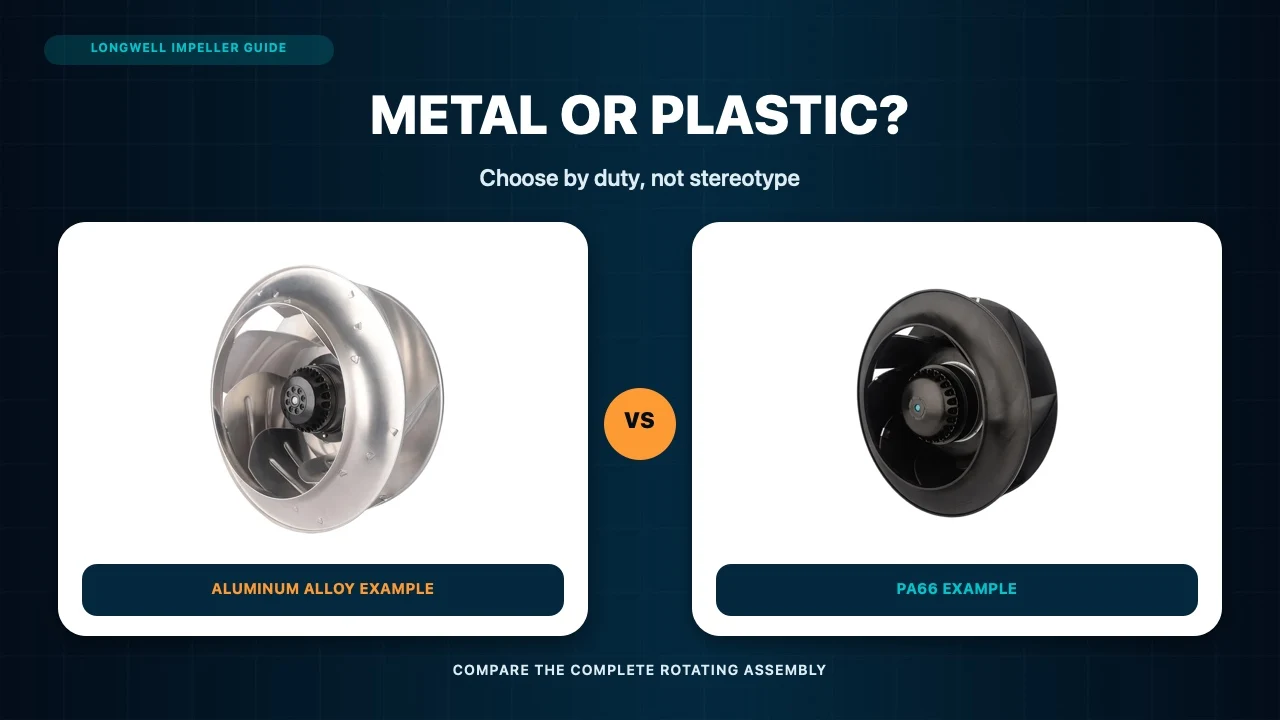
Our forward-curved range and backward-curved range both offer coated versions, and the metal versus plastic impeller guide covers material choice in corrosive air.
The overload trap
One safety point deserves its own section. A forward-curved fan has a rising power curve, so absorbed power keeps climbing as the system opens up.
Remove a filter for cleaning, leave the fan running, and current climbs past nameplate within minutes. Overload trips follow. A backward-curved wheel cannot do this, because its power curve peaks and then falls.
For anything above a couple of kilowatts, that behaviour alone justifies the choice. The AMCA fan application guidance makes the same recommendation for commercial air handling plant.
Wheel selection FAQ
Is a forward-curved fan always cheaper?
The wheel usually is, and so is the housing. Over ten years of operation, though, the energy difference normally exceeds the purchase saving several times over.
Can I fit a backward-curved wheel in a forward-curved housing?
No. Scroll width, cut-off clearance and outlet area are matched to the original wheel, so the swap produces noise and unpredictable performance rather than efficiency.
Which is quieter at the same duty?
Backward-curved, in most cases. It runs closer to peak efficiency and generates less turbulence, although its higher tip speed can produce a different tonal character.
What about EC motors on forward-curved wheels?
They work well and are common in fan coil units. You gain the control and part-load benefits, though the aerodynamic efficiency of the wheel itself does not change. See EC forward-curved fans.
Pressure, hours, space, dirt. Answer those four questions and the forward-curved or backward-curved decision stops being a matter of opinion.
Write the answers into the specification as well. The next engineer to open that cabinet will need to know why the wheel was chosen, and a one-line note saves an expensive rediscovery a decade later.
Choose the right backward curved centrifugal fan
Longwell manufactures 587 backward curved centrifugal fans in-house. Send airflow, static pressure and voltage — an engineer replies with a matching model, performance curve and price within one working day.