What the OEM needed
An HVAC OEM had already qualified our 1000mm cross-flow fan. Then their layout turned it into a request for a mirrored cross-flow fan.
Their air handling unit needed two fans side by side to cover the full width. However, the pair had to mirror: one motor on the right, one on the left.
Why a mirrored pair, not two identical fans
Putting two identical fans next to each other means both motors sit at the same end. That unbalances the weight across the unit, doubles the cable run to one side, and puts both service points in the same place.
A mirrored cross-flow fan pair puts a motor at each outer end instead. Consequently weight is symmetrical, the wiring loom is shorter and simpler, and air intake and exhaust paths behave predictably.
- Airflow of 3100 m3/h at 119 Pa from each unit.
- Next, a 230V EC motor with 0-10V analog speed control.
- Meanwhile roughly 1166mm total length, housing a 1000mm impeller.
- Performance tested to AMCA 210/211, with CE compliance for Europe.
- Finally, four samples: two standard right-hand units and two of the new left-hand build.
The real deliverable was not hardware. They wanted two distinct drawings with separate part numbers, so their bill of materials and quality control could tell the two apart.
Building the mirrored cross-flow fan
Here the task sounds trivial. In practice it is not.
Why you cannot just turn it around
Certainly flipping the standard unit end-for-end puts the motor on the other side. However, it moves everything else too.
The steel housing has mounting points in specific positions. Rotate the fan and those holes no longer line up with the customer chassis. Meanwhile the cable exits from the wrong face, and the service access that was convenient is now against a wall.
So a genuine mirror means redrawing the housing so the mounting pattern, cable egress and access all end up where the customer needs them, with the motor on the opposite end.
What stayed identical
Everything aerodynamic stayed put. Same 150mm impeller, same 1000mm length, same 800 RPM, same 3100 m3/h at 119 Pa, same 72 dB(A).
Furthermore the EC motor and its control interface carried over unchanged, so the customer control strategy applies to both units without modification.
Two part numbers, deliberately
This is the part worth emphasising. Both builds look alike and behave alike, which makes them exactly the sort of parts that get confused in stores.
Separate part numbers and separate drawings mean the wrong one cannot quietly reach an assembly line. That documentation was what the customer actually asked us for.
What it cost
An NPI cycle and a second part to stock. A mirrored cross-flow fan housing is new tooling territory rather than a drawing change, so it ran through our full development process.
Meanwhile the customer also now carries two line items where they had one. That is unavoidable with a true mirror, and it is the price of a symmetrical installation.
Technical Specifications
Two part numbers appear below for what is aerodynamically one fan. That separation is the deliverable.
| Parameter | Value |
|---|---|
| Model Number | LWCE-1501000SN-06 (Right Motor) / LWCE-1501000SN-07 (Left Motor) |
| Airflow | 3100 m³/h |
| Static Pressure | 119 Pa |
| Input Power | 350 W |
| Speed | 800 RPM |
| Voltage | 230 V |
| Frequency | 50/60 Hz |
| Speed Control | 0-10V / PWM / RS485 (SmartEC™) |
| Overall Dimensions (A) | 1166 mm |
| Mounting Length (B) | 1020 mm |
| Impeller Length (C) | 1000 mm |
| Impeller Diameter | 150 mm |
| Noise Level | 72 dB(A) |
| Operating Temperature | -25°C to +60°C |
| Bearing Type | Ball Bearing |
| Housing Material | SGCC (Steel) + Aluminum Alloy |
| Certifications | CE, ISO, BSCI |
Technical Documentation
Technical Drawing: LWCE-1501000SN-07-00
The PDF contains the final approved engineering drawing for the new left-hand motor configuration, which is essential for system integrators planning mechanical integration and service access.
Technical Drawing: LWCE-1501000SN-06-00
Here the document is the engineering drawing for the standard right-hand motor configuration, serving as the baseline for the project.
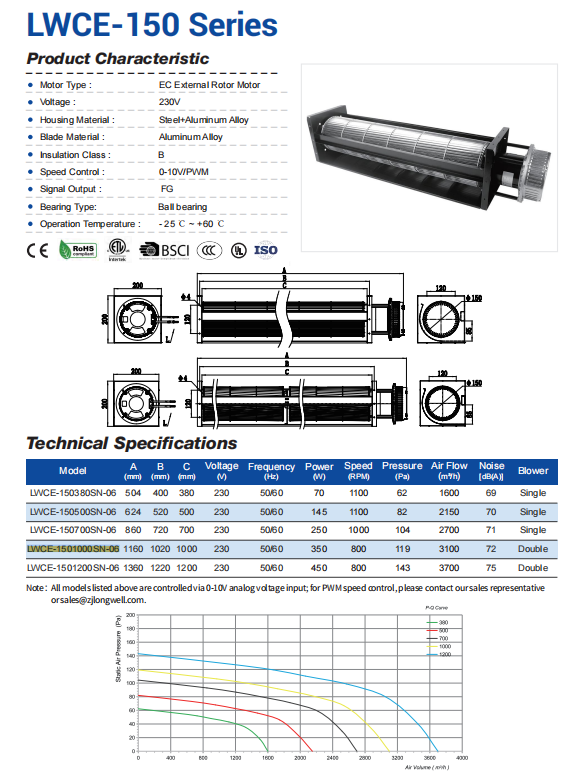
This product series sheet provides procurement managers with an overview of performance data, including the P-Q curve, for the entire LWCE-150 family of cross-flow fans.
If you are installing fans in tandem
A mirrored cross-flow fan comes up often in wide equipment. These are the things that catch people out.
- Decide handedness before the chassis is designed. A mirrored unit is a development project, not a configuration option. Discovering the need after the sheet metal is fixed means either new tooling or a compromised layout.
- Say what must mirror and what must not. Mounting pattern, cable exit and service access usually need to mirror. The control connector and the labelling often should not. Being explicit avoids a second round of drawings.
- Insist on separate part numbers. Two near-identical parts with one number will eventually be fitted the wrong way round. The documentation is what prevents that, which is why it was the real deliverable here.
- Check the airflow direction of both. A mirrored housing can invert the discharge direction if the impeller rotation is not handled. Confirm both units blow the same way before ordering samples.
See our cross flow fan range, the EC cross flow fan section, or air handling units. Airflow testing follows AMCA 210.
Questions about mirrored pairs
Can I not just rotate the standard fan 180 degrees?
Only if your chassis is symmetrical about that axis, which is rare. Rotating moves the mounting holes, the cable exit and the service access along with the motor. Consequently at least one of those ends up unusable on most equipment. That is why a true mirrored cross-flow fan gets drawn rather than improvised.
Does the mirrored version perform identically?
Yes. Impeller diameter, length, speed, airflow, pressure and noise are all unchanged, because nothing aerodynamic was altered. The difference is entirely in where the motor, mounting points and cable sit.
What is the lead time for a mirrored variant?
It runs through our standard NPI process, since the housing is genuinely new rather than a drawing revision. Samples come first, then production once the drawings are approved. Ask early: this is not a change that can be made late in your schedule.
Why does motor position affect weight distribution so much?
Because on a cross-flow fan the impeller is light and long while the motor is compact and heavy. Put two motors at the same end of a wide unit and the mass sits well off center, which loads the mounting unevenly and can excite panel vibration. Splitting them puts the center of mass back where the designer assumed it was.
Technical Documentation & Resources
Got a duty point you need matched?
Tell us the airflow, the pressure and the space you have. Then we mark your duty point on a tested curve and send the drawing back. Meanwhile samples and custom spec sheets take up to 90 days. Since 1990 we have supplied OEMs across HVAC, refrigeration and industry.
Browse Related Products:
🏆 ISO 9001 / ISO 14001 / ISO 45001 | CE (TÜV) | UL/ETL | ATEX Zone 21/22 | AMCA 210/211 / ISO 5801 tested