One frame size, two very different jobs
An industrial HVAC OEM asked for specifications and samples of two 250mm backward-curved centrifugal fans. Notably, they share the same frame, the same 380 VAC three-phase supply, and the same enclosure limits. What separated them was fan static pressure: one duty at 750 Pa, the other at 220 Pa.
In other words, that is not a big fan and a small fan. Rather, it is two different machines wearing the same dimensions.
The shared boundaries
- First, 255mm maximum outer diameter, inside roughly 99mm of depth.
- Next, up to 1455 m3/h of airflow, directly on grid power with no conversion hardware.
- Meanwhile -30C to +60C ambient, for outdoor winter and rooftop summer.
- Finally, 72 dB(A) maximum on the high-pressure unit, with ISO 5801 aerodynamic and JB/T 8689 vibration evaluation.
What the two pressures describe
The 750 Pa unit pushes air through dense resistance: filters, coils, long restrictive paths. Meanwhile the 220 Pa unit serves a product line that values quiet and efficiency over force.
Consequently the OEM was not really ordering two fans. They were ordering two answers to two different systems.
What fan static pressure changes
Airflow tells you how much air; fan static pressure tells you against what. Above all, the second number is what sizes the motor, sets the speed and picks the blade.
Why pressure costs speed
Firstly, pressure rises with the square of impeller speed. So reaching 750 Pa in a 250mm wheel demands a fast motor, and the high-pressure build got a 2-pole configuration spinning 2550 RPM at 60 Hz.
By contrast, the 220 Pa build needs nothing like that speed. Running it on the fast winding would waste power and noise on force its system never asks for.
Two windings, one mechanical platform
Secondly, both variants keep the same frame, mounting and envelope, which is what the customer sheet metal requires. The differentiation lives in the winding and the aerodynamic trim, not the housing.
That split is deliberate. As a result, the OEM stocks one mechanical footprint while shipping two electrically distinct products, and their enclosure tooling never hears about any of it.
Why DC was rejected in one line
Their grid is 380 VAC three-phase. Consequently, converting it to DC would add inverters, cost and a failure point to deliver nothing the AC windings cannot already do.
Why backward-curved carries this duty
Lastly, a backward-curved impeller develops fan static pressure efficiently and behaves stably as system resistance shifts, which matters when the same fan meets different filter states over its life.
Aerodynamic figures for both builds follow ISO 5801 methods, measured per variant.
Technical Specifications
Two builds share this table. Where a row splits in two, fan static pressure is the reason.
| Parameter | LWBA2D250-092NT-16-00 (2-Pole) | LWBA4D250-092NT-20-00 (4-Pole) |
|---|---|---|
| Nominal Voltage | 380 VAC (3-Phase) | 380 VAC (3-Phase) |
| Voltage Range | 342 ~ 418 VAC | 342 ~ 418 VAC |
| Frequency | 50 / 60 Hz | 50 / 60 Hz |
| Speed | 2450 / 2550 RPM | 1450 / 1600 RPM |
| Current | 0.31 / 0.37 A | 0.15 / 0.15 A |
| Power Input | 150 / 200 W | 150 / 200 W |
| Airflow (Max) | 1380 / 1455 m³/h (811 / 855 CFM) | 830 / 950 m³/h (488 / 558 CFM) |
| Static Pressure (Max) | 600 / 750 Pa | 165 / 220 Pa |
| Noise Level (LpA) | 70 / 72 dB(A) | 68 / 70 dB(A) |
| Operating Temperature | -30°C to +60°C | -30°C to +60°C |
| Insulation Class | Class F | Class F |
| Protection Type | IP54 | IP54 |
| Work System | S1 (Continuous) | S1 (Continuous) |
| Bearing Type | Maintenance-free ball bearings | Maintenance-free ball bearings |
| Impeller Material | Galvanized sheet steel | Galvanized sheet steel |
| Certifications | CE, RoHS, Reach | CE, RoHS, Reach |
Technical Documentation

The image displays the catalog performance curve mapping static pressure against air volume for the 4-pole 1600 RPM configuration.
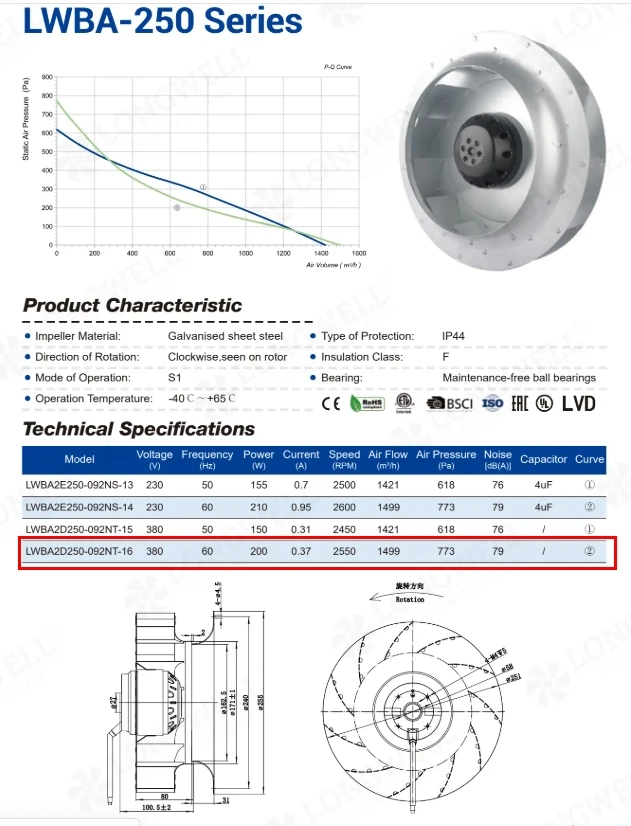
Here the data details the P-Q performance curve for the high-speed 2-pole variant, demonstrating its ability to maintain 1455 m³/h airflow.
LWBA4D250-092NT-20-00 Engineering Specification PDF
HVAC integrators use this finalized specification sheet to verify the 1600 RPM motor dimensions, wiring diagram, and CE compliance limits.
LWBA2D250-092NT-16-00 Engineering Specification PDF
Design engineers rely on this document to map out the physical installation and thermal protection trip thresholds for the high-pressure 2550 RPM fan.
Source Data Sheet 4-Pole (DOCX)
Internal drafting file used by Longwell engineering to construct the 4-pole technical layout prior to PDF generation.
Source Data Sheet 2-Pole (DOCX)
Internal drafting file cataloging all mechanical vibration limits and standard compliance metrics for the 2-pole fan.
Stating your pressure requirement
Most fan selection mistakes are fan static pressure mistakes. Four habits prevent them.
- State pressure at the duty point, not as an afterthought. After all, an airflow figure without a pressure is not a requirement, because every fan delivers its headline airflow at zero resistance. Fan static pressure is the half of the specification that decides the build.
- Measure or estimate your real resistance. Add the filter at end of life, the coil, the grilles and the duct. Otherwise, selecting against day-one resistance means the fan falls short from the first filter change onwards.
- Do not buy one fan for two duties. A fan sized for your hardest case is oversized, loud and hungry in your easy case. So if your product line spans very different resistances, two variants on one platform beat one compromise.
- Ask where on the curve your point sits. Indeed, the same pressure can be met at the stable middle of one fan curve or the unstable edge of another. Ask the supplier to mark your duty point on the curve, and be suspicious if it sits near the top.
See our centrifugal fans range, the backward-curved fans section, or industrial centrifugal fans.
Questions about static pressure
What is the difference between static and total pressure?
Fan static pressure is the resistance the fan must overcome; total pressure adds the energy carried by the moving air itself. Duct system selection normally works in static pressure, which is why datasheet curves plot airflow against it.
Why does my fan move less air than the datasheet says?
Because the datasheet headline comes from zero resistance, and your system has real resistance. Therefore, Find your system pressure on the fan curve and read the airflow there; that is the figure your installation will actually deliver.
Can I get more pressure from the same fan by speeding it up?
Yes, and the bill arrives immediately. Pressure rises with speed squared. However, power rises with speed cubed, and noise climbs even faster. Past a modest increase, a fan designed for the higher duty beats a fan pushed beyond its design.
Why not just always buy the higher-pressure variant?
Because you pay for unused pressure capability in watts and decibels. For example, The 220 Pa system served by the 750 Pa fan would run louder and hungrier for no benefit. Matching the variant to the duty is the whole economy of a two-variant platform.
Technical Documentation & Resources
Have a fan requirement like this one?
Send the datasheet you are working against, or simply the duty point. Then our engineers tell you what fits and what does not. Meanwhile custom spec sheets and samples take up to 90 days. Since 1990 we have been building fans for OEMs worldwide.
Browse Related Products:
🏆 ISO 9001 / ISO 14001 / ISO 45001 | CE (TÜV) | UL/ETL | ATEX Zone 21/22 | AMCA 210/211 / ISO 5801 tested
Choose the right centrifugal fan
Longwell manufactures 1,127 centrifugal fans in-house. Send airflow, static pressure and voltage — an engineer replies with a matching model, performance curve and price within one working day.