What the OEM specified
An HVAC OEM needed a cylindrical tube axial fan with a 250mm impeller for a new ventilation module.
Their airflow target was 1854 m3/h, on a 220V 60Hz supply. Notably that frequency narrows the market, since it points at North America or parts of Asia.
The constraints
- First, a maximum outer diameter of 310mm and axial depth under 175mm, to fit the planned ducting.
- Next, continuous S1 duty from -30C to +60C.
- Meanwhile IP54, to keep dust and moisture out of the motor inside a duct.
- Finally, CE marking plus RoHS and REACH compliance, with data validated to ISO 5801.
One number in the brief beat all the others. They estimated system static pressure at roughly 90 to 100 Pa. Consequently the airflow figure became meaningful.
Selecting the tube axial fan
This was a documentation and quotation project rather than a development one. Usefully, our LWAA-250 series already covers it, and one variant matches 220V at 60Hz directly.
Why AC rather than EC
An EC version exists, with 0-10V and PWM control through our SmartEC interface.
However, the OEM design is built around fixed performance at a controlled cost. Adding an EC motor and its controls would raise the bill of materials without giving their product anything it uses. So the single-speed AC motor was correct.
The figure that actually matters
The tube axial fan produces 1854 m3/h at free delivery, meaning with no resistance at all. However, nobody operates a fan there.
Against their estimated 90 to 100 Pa, the fan sits further left on its curve and delivers less. That is normal and expected. What matters is that the fan reaches their target at their pressure, which is why the pressure estimate in the brief was the useful part of it.
The build
A five-blade cold-rolled steel impeller runs at 2780 RPM. Meanwhile Class F insulation is rated to 155C, leaving wide margin over the 60C ambient limit.
Here the IP54 rating comes from a sealed motor housing and a proper cable gland. Together they protect the maintenance-free deep groove ball bearings, which is what supports the 30,000-hour L10 figure.
What it cost
Noise, at 68 dB(A). That is acceptable in commercial and industrial ducting and would not be in a quiet occupied space.
That is the trade a tube axial fan of this size makes: high airflow for its diameter, at a speed producing real noise. So if the duct discharges near people, plan an attenuator or choose a slower, larger fan.
Technical Specifications
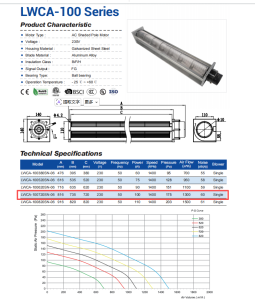
The airflow row below is at free delivery. Their system sits at roughly 90 to 100 Pa, well to the left of it.
| Parameter | Value |
|---|---|
| Model Number | LWAA2E250S-5MYB-30-00 |
| Voltage (Nominal) | 220 VAC |
| Frequency | 60 Hz |
| Maximum Airflow | 1854 m³/h / 1091 CFM |
| Maximum Static Pressure | 134 Pa |
| Speed | 2780 RPM |
| Input Power | 130 W |
| Current | 0.56 A |
| Noise Level (LpA) | 68 dB(A) |
| Operating Temperature | -30°C to +60°C |
| Insulation Class | Class F |
| Protection Class | IP54 |
| Dimensions | Ø310mm (Outer) x 173mm (Depth) |
| Work System | S1 (Continuous) |
| Certifications | CE, RoHS, Reach |
Technical Documentation
LWAA2E250S-5MYB-30-00 Datasheet
Meanwhile the complete technical datasheet contains performance curves, dimensional drawings, and electrical specifications for engineering review and integration.
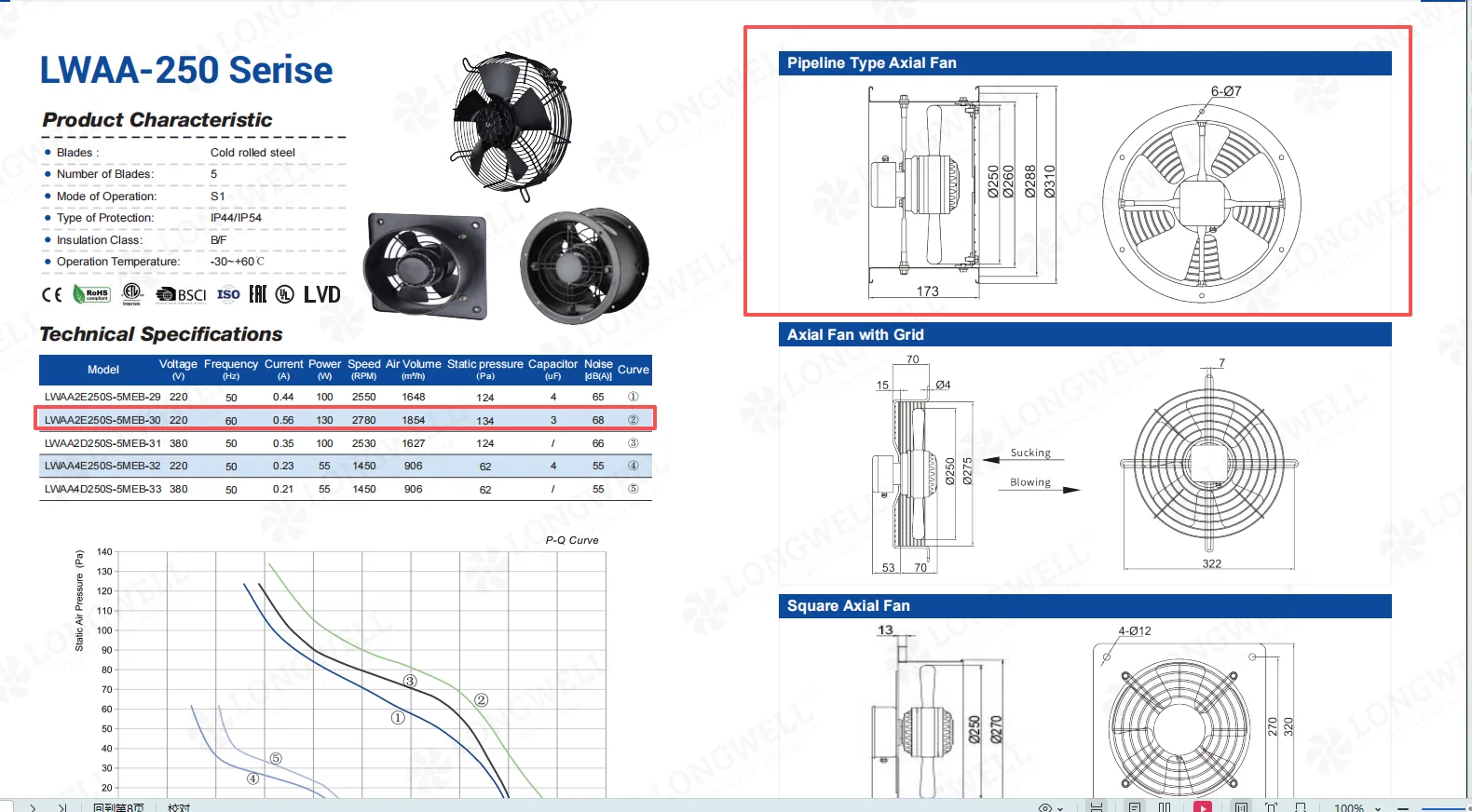
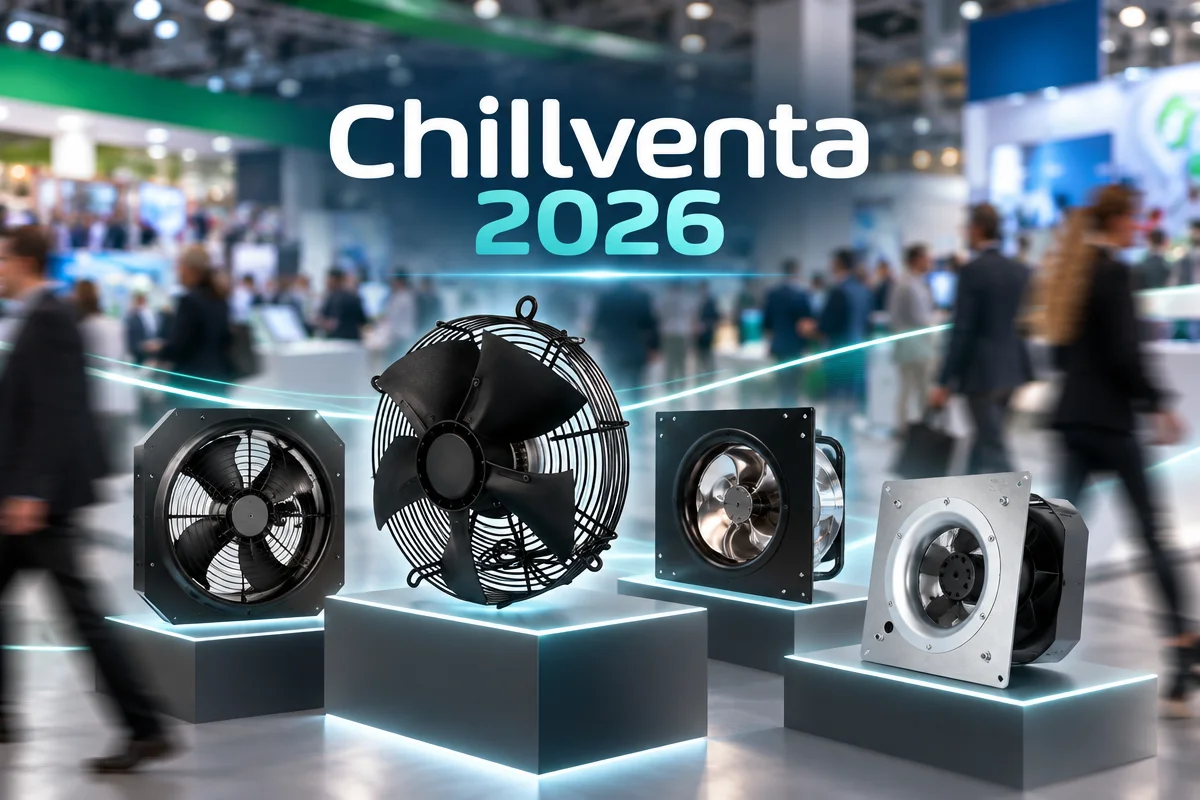
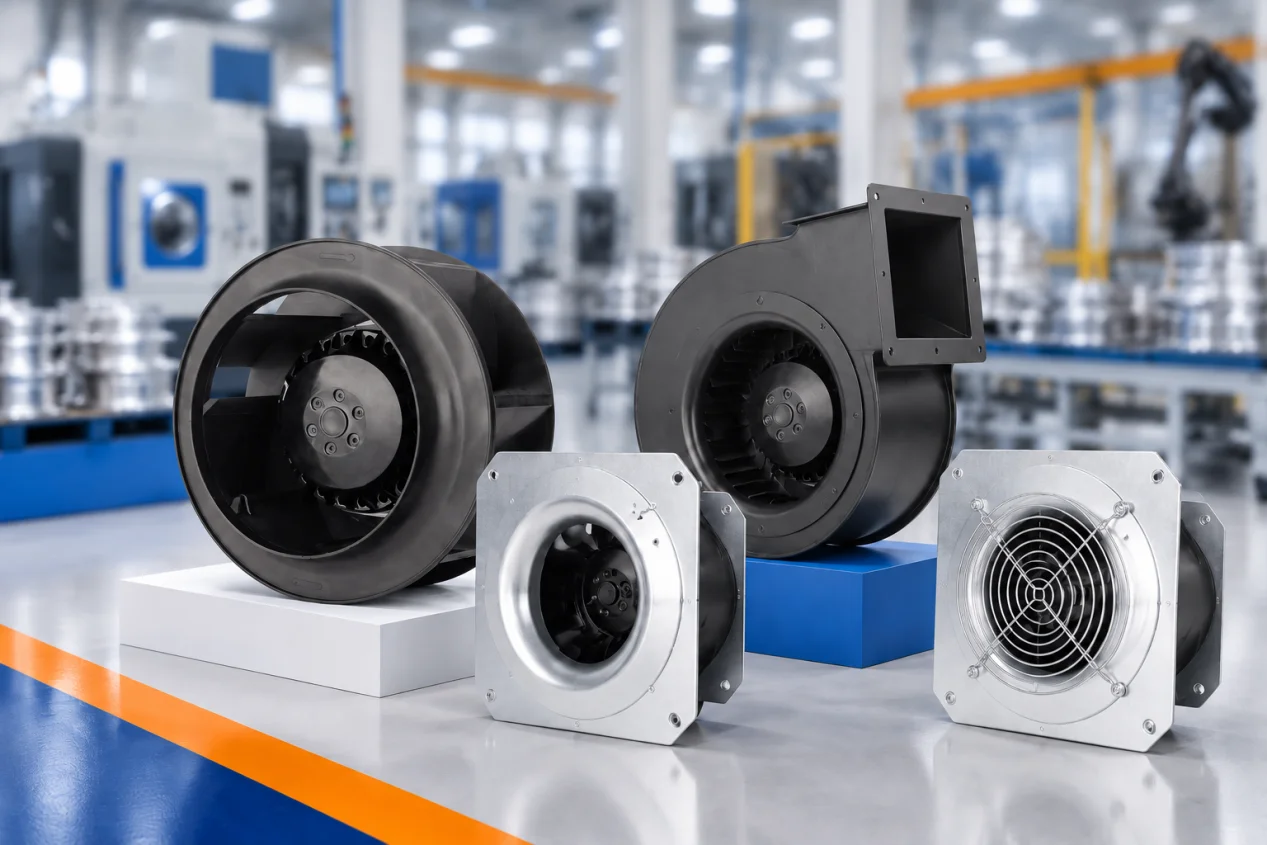
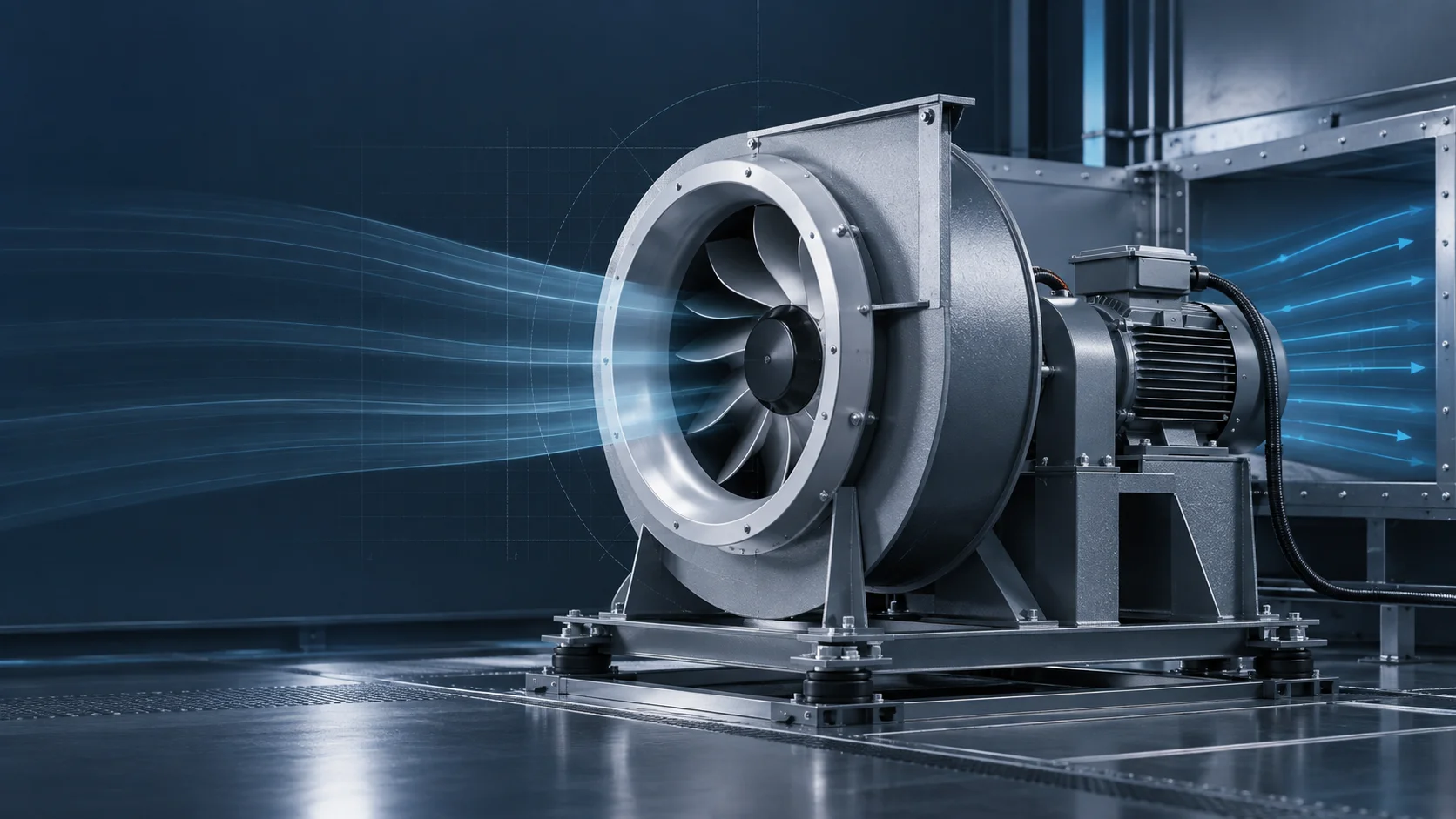
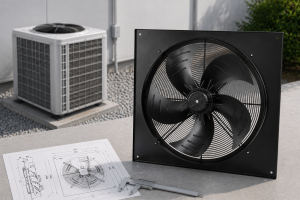
Here the product image shows the LWAA-250 series pipeline axial fan alongside other available mounting configurations, such as square-frame and open-grille.
If you are sizing a ducted fan
Sizing a tube axial fan for ducting goes wrong in one predictable way. These avoid it.
- Give airflow at a stated static pressure, always. A bare airflow figure gets compared against free-delivery numbers, and every supplier will look like they meet it. Naming your pressure is what makes quotations comparable.
- Estimate the system pressure before you shortlist. Add up duct length, bends, grilles and any filter. An estimate you can defend beats a target airflow with no pressure attached, and it takes an hour.
- Check the frequency, not just the voltage. A 220V fan for 50Hz behaves differently on 60Hz. Both figures belong in the enquiry, and leaving one out is a common cause of a wrong part arriving.
- Decide the noise limit early. A tube axial fan at this size is efficient and not quiet. Knowing your dB(A) ceiling before selection avoids discovering it after installation, when the only fix is an attenuator nobody left space for.
See our axial fan range, the duct fan section, or inline fans. Airflow testing follows AMCA 210.
Questions about this fan
Why quote 1854 m3/h if the fan will not deliver it?
Because free delivery is the standard reference for comparing fans, and every published figure uses it. However, your installed airflow sits where the fan curve crosses your system curve, always lower. So ask for the curve rather than the headline number, then find your pressure on it.
What changes between the 50Hz and 60Hz versions?
Motor speed, and everything downstream. At 60Hz the fan turns faster, so airflow and pressure both rise, along with power draw and noise. The mechanical fit is identical, which is why it is easy to order the wrong one. State the frequency explicitly in your enquiry.
Is IP54 sufficient inside a duct?
Generally yes. IP54 covers dust ingress and splashing water, which matches a fan sitting in ducted air that may carry moisture. However, for outdoor intakes, washdown areas or ducts carrying corrosive fumes, ask for a higher rating or a coated construction.
How do I reduce the noise from a fan like this?
Three ways, in order of effectiveness. Run it slower, which cuts noise disproportionately. Choose a larger diameter at lower speed for the same duty. Or fit an attenuator, which works but costs duct length and adds pressure drop. The first two are decisions; the third is a remedy.
Technical Documentation & Resources
Need the same thing for your own unit?
Give us the numbers and the envelope, and you get a shortlist rather than a catalog. Meanwhile custom spec sheets and samples run to 90 days. Since 1990 Longwell has supplied EC fans and blowers to OEMs in HVAC, cold chain, data center and industrial markets.
Browse Related Products:
🏆 ISO 9001 / ISO 14001 / ISO 45001 | CE (TÜV) | UL/ETL | ATEX Zone 21/22 | AMCA 210/211 / ISO 5801 tested
Choose the right axial fan
Longwell manufactures 1,086 axial fans in-house. Send airflow, static pressure and voltage — an engineer replies with a matching model, performance curve and price within one working day.