What the FCU maker needed
An HVAC OEM needed a 50Hz to 60Hz motor conversion: a 100W, 220V unit for their fan coil units, replacing a Korean-made part they already bought.
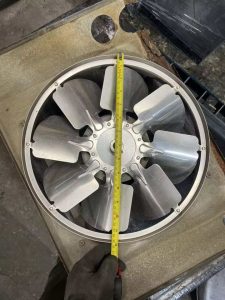
They sent photographs of the target motor and a table of critical dimensions. In other words this was a second-sourcing exercise, where an exact functional match matters more than any improvement.
The constraints
- First, four speeds: 1200, 1100, 1000 and 850 RPM.
- Next, an outer diameter of 110 to 120mm and a housing length of 130 to 150mm.
- Meanwhile a double shaft, roughly 12mm across, extending 50 to 60mm each side for the fan wheels.
- Ball bearings, a corrosion-resistant shaft finish and built-in overload protection.
- Finally, compliance with appliance safety under IEC 60335.
Those four speeds make it awkward. A fan coil unit sells on low, medium and high settings, so the RPM figures reach the end user directly through the airflow they produce.
Doing a 50Hz to 60Hz motor conversion properly
A suitable platform already existed: a 100W four-pole motor built for 50Hz. So the task became a 50Hz to 60Hz motor conversion that held every speed.
Why you cannot just plug it in
An induction motor takes its speed from supply frequency. Move a 50Hz motor to 60Hz and it runs roughly 20% faster.
That is not a small inconvenience. Higher speed means the wheel draws more power and the motor runs hotter. Meanwhile all four settings land in the wrong places. Consequently the unit would be noisier, use more energy and fail early.
What actually had to change
The windings. Engineers recalculated the stator specification, adjusting wire gauge and the number of turns on each of the four speed taps.
Each tap needed working out separately, since the customer wanted specific figures rather than a proportional set. Ultimately the motor reaches 1200, 1100, 1000 and 850 RPM on 60Hz, which is what drop-in actually means.
The option we set aside
An EC motor would be more efficient and would make speed control trivial.
However, the brief asked for a like-for-like AC replacement. Switching technology would have forced changes to their control wiring and their product cost, on a project whose entire purpose was to change nothing visible. So we kept the AC architecture.
What it cost
Efficiency, in the sense that this is a multi-speed induction motor rather than a modern EC one. It draws what a motor of this type draws.
That was the correct answer for a second-source project. It would be the wrong answer for a clean-sheet product, and it is worth being clear about which situation you are in before choosing.
Technical Specifications
Here the four speed figures below are the specification. Everything else exists to make a 50Hz to 60Hz motor reach them.
| Parameter | Value |
|---|---|
| Longwell Model | LWYSK100-4P-002 |
| Voltage | 220 V |
| Frequency | 60 Hz |
| Rated Output Power | 100 W |
| Poles | 4 |
| Speeds (RPM) | 1200 / 1100 / 1000 / 850 |
| Shaft Configuration | Double Shaft |
| Motor Diameter | 112.4 mm |
| Motor Housing Length | 135 mm |
| Shaft Diameter | 12 mm |
| Shaft Extension (Each Side) | 50 mm |
| Bearings | Ball Bearing |
| Protection | Thermal Overload Protection |
| Insulation Class | B/F |
| Protection Class | IP20 / IP44 |
Technical Documentation
The following documents trace the project from initial customer request to final engineering deliverable.
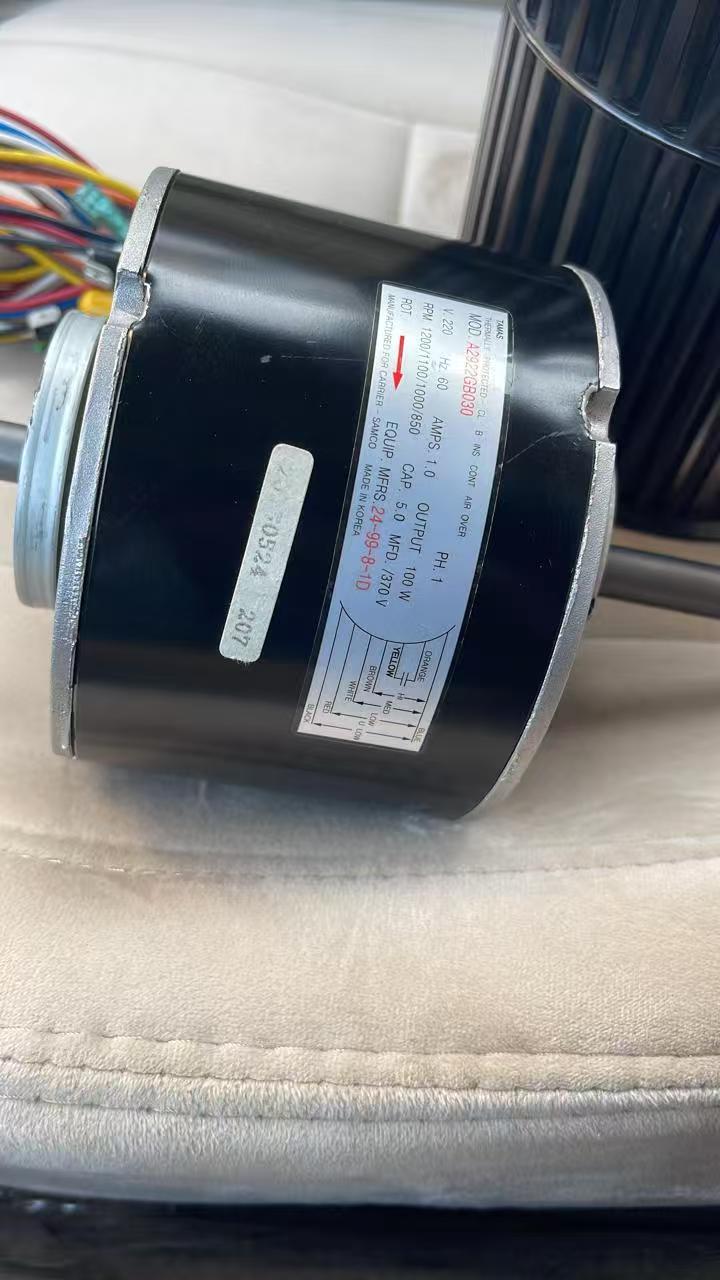
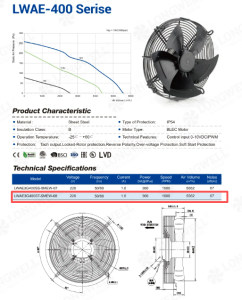
The image shows the label of the competitor’s motor, providing the initial performance targets and specifications for the replacement project.
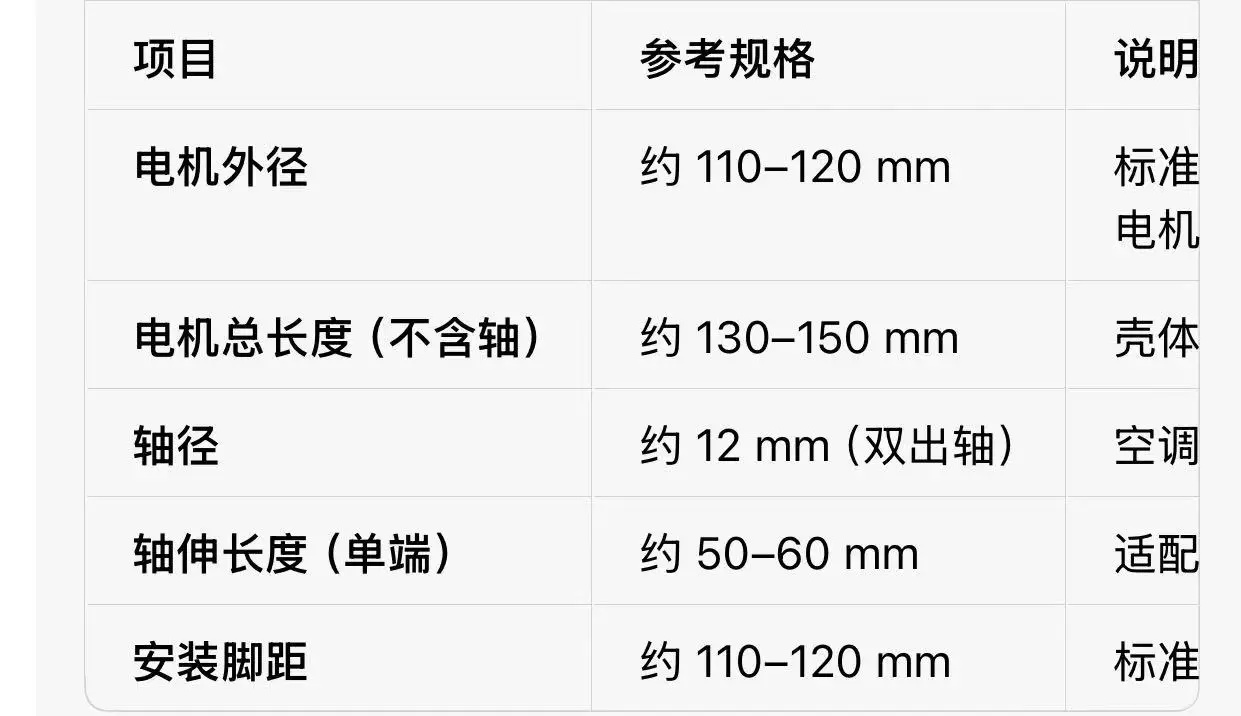
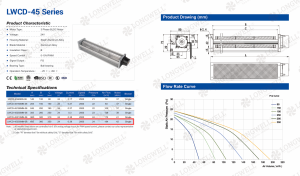
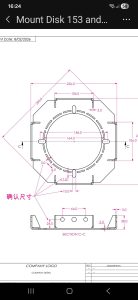
Here the table, submitted by the customer, outlines the critical dimensional constraints for the motor housing and shaft, ensuring a drop-in fit.
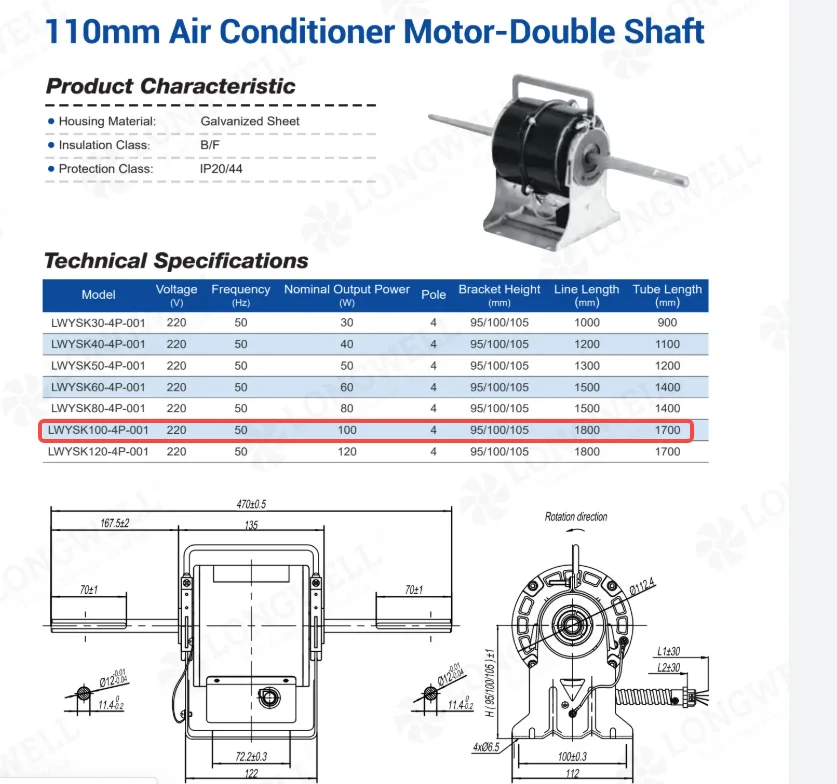
This document details the specifications for the original Longwell 50Hz motor that served as the engineering baseline for the new 60Hz variant.
Final Approved Drawing: LWYSK100-4P-002.pdf
This is the final engineering drawing for the new LWYSK100-4P-002 motor, containing all mechanical dimensions, electrical data, and material specifications required by a procurement manager or quality engineer for part qualification.
If you are second-sourcing a motor
Second-sourcing a motor looks simple and often is not. Consequently these save a round.
- Send dimensions and speeds, not just a photograph. Diameter, housing length, shaft diameter and shaft extension on each side are the figures that decide whether a motor drops in. A photo confirms the type; it does not confirm the fit.
- State the supply frequency explicitly. A motor correct on 50Hz is wrong on 60Hz and vice versa. In practice a missing 50Hz to 60Hz motor note is the commonest cause of a failed second-source, and it stays invisible until the part arrives.
- List every speed tap you need, with its RPM. Multi-speed motors are wound per tap. Giving only the top speed leaves the supplier to invent the others, and they will not match what your users are used to.
- Say whether the technology can change. If EC is acceptable you may get a better motor. If your controls are fixed around AC taps, say so early, so nobody spends a week proposing something you cannot use.
See our fan motor range, the AC motor section, or fan coil units. Appliance safety follows IEC 60335-1.
Questions about this motor
Can a 50Hz motor run on a 60Hz supply?
Electrically it turns, and that is what misleads people. However, it runs about 20% faster, which raises wheel load, increases current and generates more heat. On a fan application that combination shortens life considerably. So for anything beyond a bench test, do the 50Hz to 60Hz motor conversion properly and rewind it.
Why rewind rather than change the pole count?
Because pole count moves speed in large steps. A four-pole motor at 60Hz sits near 1800 RPM synchronous, and six poles near 1200. Neither lands on the four figures this customer needed. Adjusting turns and wire gauge within a four-pole design gives fine control over where each tap sits.
What does the thermal overload protection do?
It opens the circuit if the winding gets too hot, then resets once it cools. In a fan coil unit that matters because a blocked filter or a seized bearing raises motor temperature slowly. Without protection the winding insulation eventually fails; with it, the unit stops and someone investigates.
Why a double shaft?
Because a fan coil unit typically drives a centrifugal wheel on each end of the motor, which balances the load and lets one motor serve a wider coil. It also means shaft extension on both sides has to be right, since a wheel sitting a few millimetres out of position rubs the scroll.
Technical Documentation & Resources
Got a duty point you need matched?
Tell us the airflow, the pressure and the space you have. Then we mark your duty point on a tested curve and send the drawing back. Meanwhile samples and custom spec sheets take up to 90 days. Since 1990 we have supplied OEMs across HVAC, refrigeration and industry.
Browse Related Products:
🏆 ISO 9001 / ISO 14001 / ISO 45001 | CE (TÜV) | UL/ETL | ATEX Zone 21/22 | AMCA 210/211 / ISO 5801 tested
Choose the right fan coil unit
Longwell manufactures 14 fan coil units in-house. Send airflow, static pressure and voltage — an engineer replies with a matching model, performance curve and price within one working day.