What the OEM specified
A European OEM needed a rooftop condenser fan for a new line of packaged air conditioners.
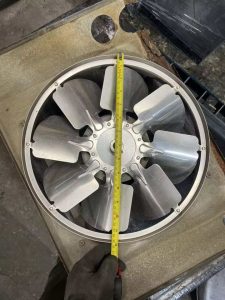
The mounting diameter was fixed at 422mm, with depth capped at 135mm. Notably the condenser chassis already existed.
The constraints
- First, 230V at 50Hz, tolerating 198 to 242 VAC.
- Next, airflow near 2,800 m3/h at free air, to reject heat from the condenser coil.
- Meanwhile noise capped at 60 dB(A), for commercial property noise rules.
- An ambient range of -30C to +60C and at least IP44, since these sit outdoors across Europe.
- Finally, CE marking with EN 60335-1 safety and performance documented to ISO 5801.
Two of those cannot move: the diameter and the noise ceiling. Consequently everything else had to be found within them.
Designing the rooftop condenser fan
With diameter fixed, airflow comes from blade design and speed. Meanwhile noise rises steeply with speed. In short, that tension is the whole project.
Why AC, not EC
An EC motor is more efficient and was considered.
However, the customer had a cost target and existing AC control systems. So a permanent split capacitor AC motor was chosen, which balances reliability, cost and starting torque well for this duty.
Furthermore a four-pole design reaches 1380 RPM on a 50Hz supply directly, with no gearing or drive.
Finding the blade geometry
This is where the work went. We simulated several blade geometries against the 350mm diameter limit.
A five-blade design with a specific pitch and curvature came out ahead. Consequently this rooftop condenser fan reaches 2781 m3/h while holding noise at 58 dB(A). That is two decibels inside their ceiling, which is margin rather than luck.
Here the impeller is cold-rolled steel for outdoor rigidity, balanced to G6.3. That grade matters, since residual imbalance becomes vibration. Meanwhile vibration on a rooftop unit makes noise and wears bearings alike.
Protecting it from itself
Class F insulation is rated to 155C, well above the 60C ambient limit.
Furthermore an internal thermal protector opens the circuit between 150 and 160C, resetting once the winding cools to between 100 and 130C. That covers a locked rotor or an unusually hot day, and on a rooftop where nobody is watching, it turns a burnt-out motor into a fan that stopped.
What it cost
Efficiency and control. A PSC motor draws more than an EC equivalent, and it runs at one speed.
On a condenser running most of the cooling season, that is a real operating cost over the unit life. Certainly it was the right call against this customer cost target. However, an OEM modulating head pressure would reach the opposite conclusion.
Technical Specifications
Read the noise row against the airflow row below. Holding both at that diameter was the design problem.
| Parameter | Value |
|---|---|
| Model Number | LWAA4E350S-5MEB-01 |
| Nominal Voltage | 230 VAC |
| Frequency | 50 Hz |
| Max Airflow | 2781 m³/h / 1636 CFM |
| Max Static Pressure | ~110 Pa (from P-Q curve) |
| Input Power | 135 W ±10% |
| Current | 0.6 A ±10% |
| Speed | 1380 RPM ±10% |
| Noise Level | 58 dB(A) |
| Dimensions (Basket Dia. x Depth) | Ø422 x 133 mm |
| Operating Temperature | -30°C to +60°C |
| Protection Class | IP44 |
| Insulation Class | Class F |
| Bearing | Maintenance-free deep groove ball bearings |
| L10 Life Expectancy | 30,000 hours (@ 20°C) |
| Certifications | CE, RoHS, Reach |
Technical Documentation
The following documents were produced during the project lifecycle and represent the final approved deliverables, now archived in the Longwell system.
Full Technical Datasheet (PDF)
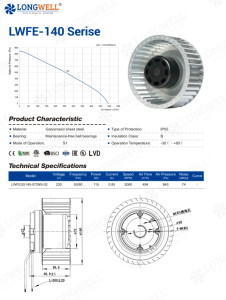
This is the final A0 revision datasheet, containing all performance data, mechanical drawings, and P-Q curves an engineer needs for system integration.

The image shows the final product rating label, which a compliance engineer or field technician would use to verify electrical ratings and certifications like CE.
Initial Project Scope (DOCX)
Here the document represents the initial project request from the customer, used by the Longwell PM to define the project scope and key performance targets.
If you are specifying for a rooftop unit
Specifying a rooftop condenser fan comes down to four things. These are the ones that decide it.
- Give the noise limit and the diameter together. Either alone is easy. Both at once constrains blade design, and that is where a supplier either has the aerodynamic work already done or is guessing. Ask what margin they hold against your limit.
- Specify the ambient extremes, not the average. A rooftop unit sees more than a design engineer expects. The low end decides the bearing grease; the high end decides the insulation class and the thermal protector setting.
- Insist on a thermal protector. Nobody inspects a rooftop condenser fan regularly. A protector that disconnects on a locked rotor is what stands between a debris jam and a burnt motor.
- Ask for the balance grade, not just the noise figure. A quiet fan that is poorly balanced becomes a noisy one after a season of vibration. G6.3 or better is a reasonable expectation for outdoor fans of this size.
See our axial fan range, the condenser fan section, or roof exhaust fans. Ingress ratings follow IEC 60529.
Questions about this fan
How was 58 dB(A) achieved when 60 was the limit?
By simulating several blade geometries rather than accepting the first that met airflow. The chosen five-blade pitch and curvature reduces turbulence at the operating speed, which is where most axial fan noise originates. The two decibels of margin means the fan still complies if site conditions are less favorable than the test.
Why does the thermal protector reset automatically?
Because most trips are transient. A hot day, a temporary obstruction, or a brief overload will clear on its own, and an auto-reset fan resumes without a service visit. If your application needs a manual reset so faults are always investigated, we can specify that instead.
Would an EC fan have been quieter?
Not inherently at this duty point, since noise comes mainly from blade aerodynamics. However, an EC rooftop condenser fan can run slower when full heat rejection is not needed, and slower is always quieter. So if night-time noise matters at your sites, that argues for EC more strongly than efficiency does.
What does the G6.3 balance grade mean in practice?
It sets the permissible residual imbalance relative to rotor mass and speed. At this diameter and 1380 RPM it keeps vibration low enough that the bearings reach their rated life and the unit does not transmit hum into the chassis. It is a standard grade for fans, and it is worth confirming rather than assuming.
Technical Documentation & Resources
Got a duty point you need matched?
Tell us the airflow, the pressure and the space you have. Then we mark your duty point on a tested curve and send the drawing back. Meanwhile samples and custom spec sheets take up to 90 days. Since 1990 we have supplied OEMs across HVAC, refrigeration and industry.
Browse Related Products:
🏆 ISO 9001 / ISO 14001 / ISO 45001 | CE (TÜV) | UL/ETL | ATEX Zone 21/22 | AMCA 210/211 / ISO 5801 tested
Choose the right condenser cooling fan
Longwell manufactures 17 condenser cooling fans in-house. Send airflow, static pressure and voltage — an engineer replies with a matching model, performance curve and price within one working day.