Airflow up, power down, noise capped
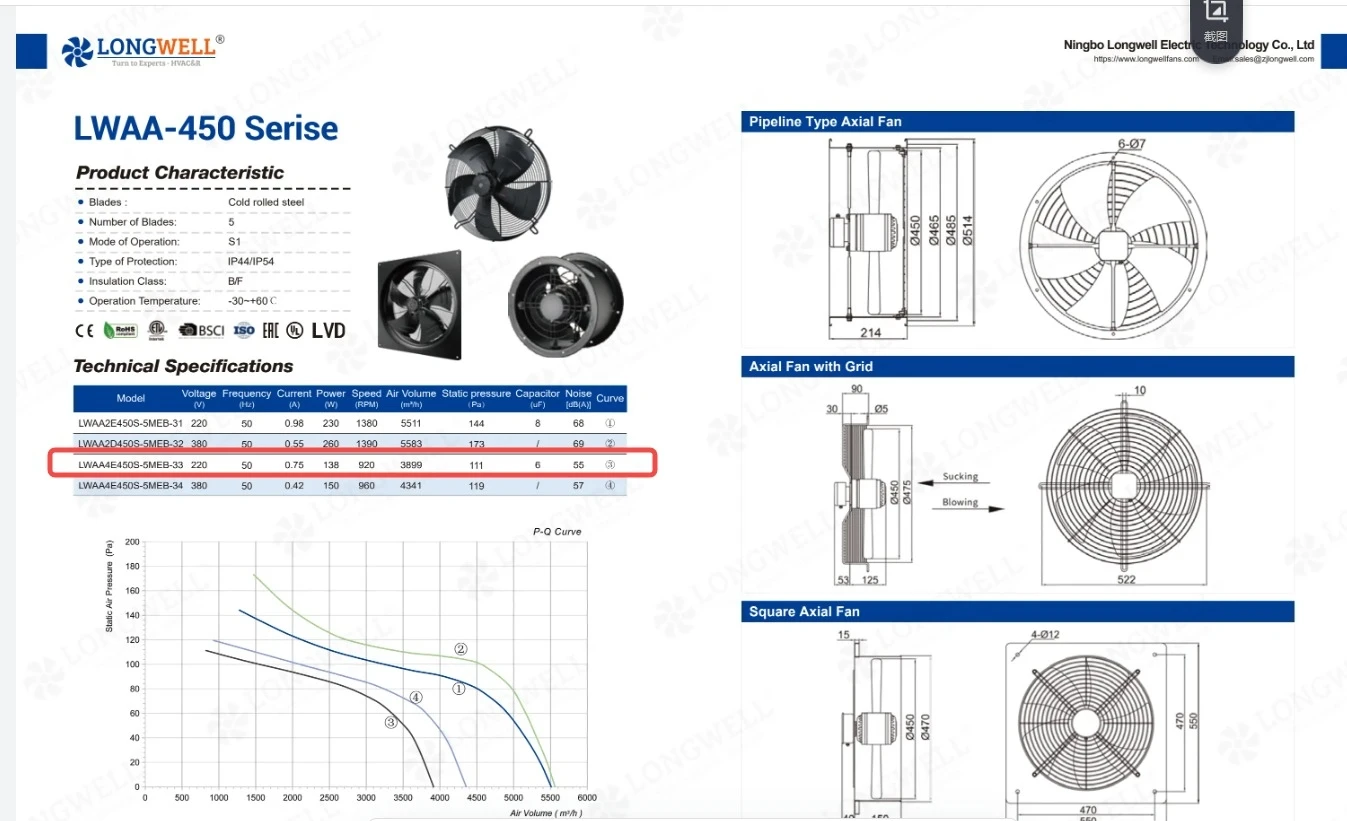
A commercial cooling OEM needed 3,899 m3/h from a fan on a 550 by 550mm panel, no deeper than 150mm. The line that shaped the design was fan power consumption: 138 W maximum.
In fact, that cap ruled out several older motor designs before any drawing was opened.
The rest of the envelope
- First, single-phase 220 VAC at 50 Hz, tolerating 198 to 242 V.
- Next, 55 dB(A) maximum, because the unit sits near occupied space.
- Meanwhile IP54 and Class F insulation, for dust, spray and internal heat.
- Finally, -30C to +60C ambient, with CE, EN 60335-1 and GB 12350 compliance.
Why the power cap is the interesting constraint
Airflow targets are met all the time by spending watts. Consequently a hard power ceiling changes the question from can we move the air into how cheaply the air can be moved.
After all, the answer decides the electricity bill of every unit shipped, for its whole service life.
Fan power consumption follows the cube law
The physics offers one big lever. Fan power consumption rises with roughly the cube of impeller speed, while airflow rises only in proportion.
What the cube law buys you
For example, halve the speed and the same impeller moves half the air for about an eighth of the power.
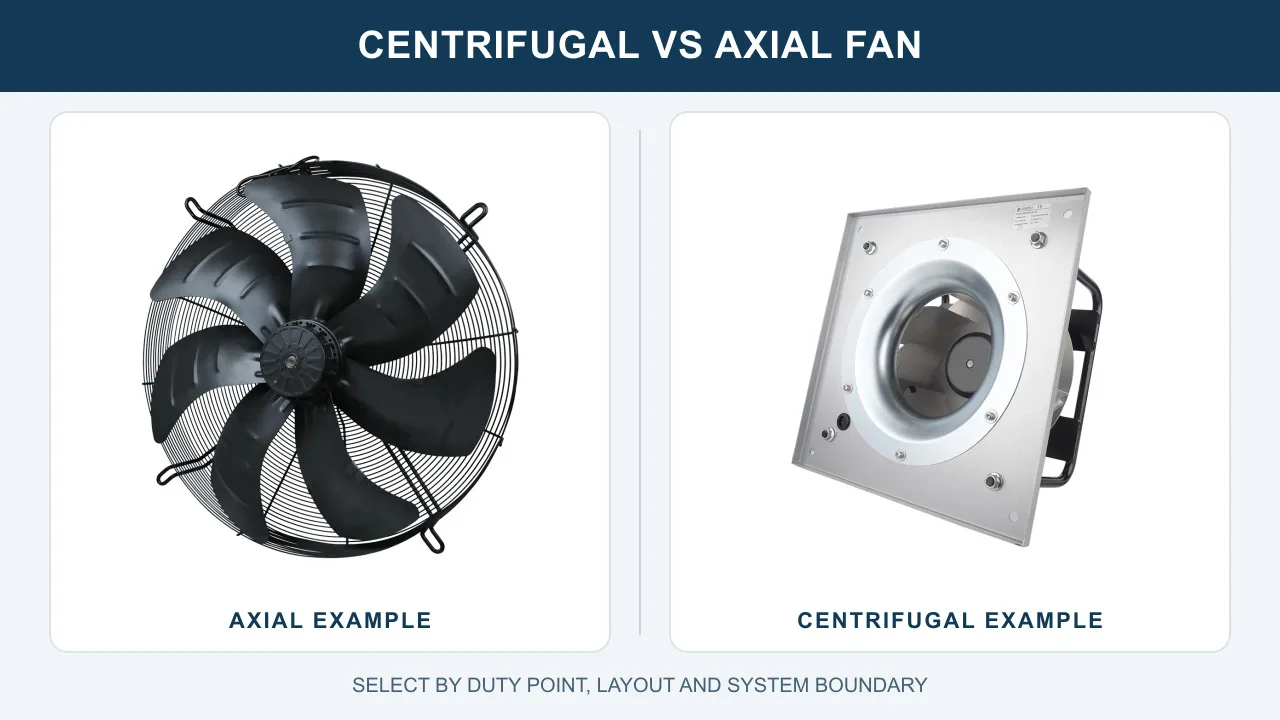
So the efficient way to a target airflow is the largest impeller the panel allows, turned as slowly as the target permits. Here that meant a 450mm impeller at 920 RPM, which is slow for this class.
The noise limit came along free
Meanwhile, aerodynamic noise climbs even faster with tip speed than power does. So a slow large impeller is quiet by construction rather than by treatment.
Consequently the 55 dB(A) requirement, which usually costs a design effort of its own, was met by the same decision that met the power cap. That alignment is worth noticing: power and noise budgets usually pull the same direction.
Why we did not use EC here
An EC motor would cut fan power consumption further, and we still advised against it.
The customer grid is raw 220 VAC with no 0-10V or PWM infrastructure. An EC fan would add cost and a failure point to deliver control signals nobody can send. At a fixed duty point, a well-selected AC motor closes most of the efficiency gap.
The details that keep the figure honest
Firstly, a five-blade stamped steel impeller beat a six-blade design, which produced more acoustic turbulence near the 111 Pa pressure point.
Secondly, deep groove ball bearings carry the 30,000-hour L10 figure at 40C, and Class F insulation covers the +60C ambient corner. The 470mm hole pattern drops into the customer existing sheet metal, so the panel needed no rework.
Airflow and power figures follow ISO 5801 test methods.
Technical Specifications
Read the power row against the airflow row. The ratio between them is the design, and the rest of the table follows from it.
| Airflow | 3899 m³/h (2293 CFM) |
| Static Pressure (Max) | 111 Pa |
| Input Power | 138 W |
| Speed | 920 RPM |
| Voltage | 220 VAC (Range: 198~242 VAC) |
| Frequency | 50 Hz |
| Current | 0.75 A |
| Capacitor | 6 μF |
| Dimensions | 450mm impeller / 550x550mm panel / 150mm depth |
| Noise Level (LpA) | 55 dB(A) |
| Protection Type | IP54 |
| Insulation Class | Class F |
| Operating Temperature | -30°C to +60°C |
| Life Expectancy | 30,000 Hours (L10 at 40°C) |
| Certifications | CE, RoHS, Reach |
Technical Documentation
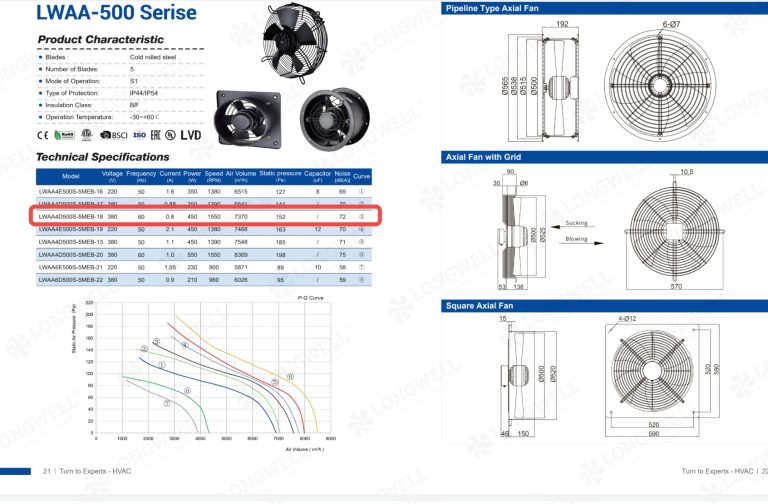
LWAA6E450S-5MEB-33 Specification Sheet
The approved document provides the mechanical dimensions, wiring diagram, and P-Q airflow curve required by system integrators.
Visual confirmation of the cold-rolled sheet 5-blade impeller and 550x550mm square mounting plate.
Project Source File
The original editable project file used by the technical PM to track iterations and component changes.
Working with a power budget
If your specification caps fan power consumption, these four points get you a better fan.
- State the cap with the airflow, not after it. Fan power consumption and airflow trade against each other through speed. A supplier who knows both numbers up front can size the impeller correctly; one who learns the cap late can only derate what exists.
- Give the fan the biggest opening you can. Every extra millimetre of impeller diameter lets the same air move slower. Shrinking the cut-out to simplify sheet metal is often the most expensive saving in the whole unit.
- Treat the noise and power budgets together. Both fall with tip speed. If one is tight and the other loose, the tight one sets the design and the loose one comes along free, so specify them together rather than negotiating them separately.
- Ask what the power figure was measured at. A wattage at free air and one at your operating pressure differ. The honest comparison is input power at your duty point, measured to a stated standard.
See our axial fans range, the AC axial fans section, or condenser fans.
Questions about fan power
Why does slowing a fan down save so much power?
Because fan power consumption follows the cube of speed. Cut speed 20% and power falls roughly half, while airflow drops only 20%. Recovering that airflow with a larger impeller costs far less energy than spinning a small one harder.
Would an EC motor not have been more efficient?
Somewhat, at this fixed duty point. EC earns its premium where speed varies or a control signal exists. On a raw AC supply with one operating point, a properly sized AC motor delivers most of the efficiency at lower cost and with one less thing to fail.
Does a bigger impeller always mean a quieter fan?
At the same airflow, generally yes, because it turns slower and tip speed drives noise. The exceptions are enclosure resonance and blade passing effects, which is why the blade count still gets tested rather than assumed.
How do I compare power figures between two datasheets?
Check the test standard and the operating point first. A figure quoted at zero static pressure flatters the fan; your system has resistance. Ask both suppliers for input power at your actual duty point under the same standard, and compare those.
Technical Documentation & Resources
Sizing something comparable?
Share the airflow, pressure, voltage and control interface, and we come back with a tested curve and a drawing. Meanwhile custom work runs to 90 days for spec sheets and samples. Since 1990 Longwell has supplied fans to HVAC and industrial OEMs.
Browse Related Products:
🏆 ISO 9001 / ISO 14001 / ISO 45001 | CE (TÜV) | UL/ETL | ATEX Zone 21/22 | AMCA 210/211 / ISO 5801 tested