What the OEM needed
An industrial equipment manufacturer needed a 400mm axial fan with a duty point no catalog covers. In the end it took a custom motor winding.
They wanted 9,000 to 11,000 m3/h, at a fixed 2800 RPM, drawing no more than 300 to 350W, from a 220V single-phase supply.
Why that combination is awkward
Individually each requirement is ordinary. Together they conflict.
At 2800 RPM a 400mm fan turns fast for its diameter, which is how it reaches that airflow. However, spinning an impeller that hard normally costs more than 350W.
Meanwhile single-phase supply limits the motor options available, and a fixed speed means there is no drive to help.
The airflow and speed together point at ducted air exchange or fume extraction in a factory, where the system resistance is real and the fan runs for long periods.
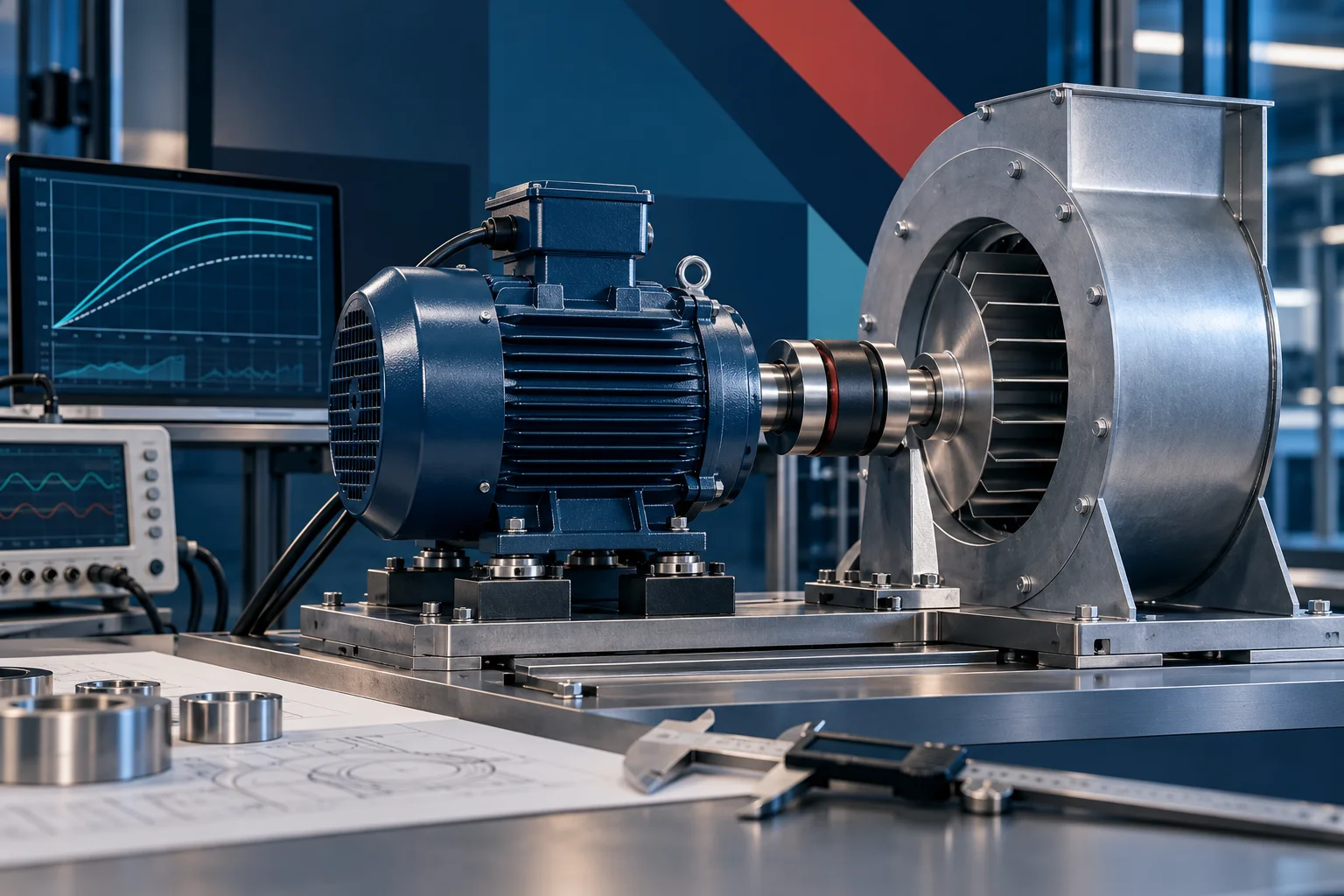
Reaching 2800 RPM with a custom motor winding
We logged this as minor development. In short, the platform was fine while the motor was not.
Why not an EC motor
An EC motor hits a precise speed easily, which is exactly what was asked for.
However, this is a fixed-speed application. All the EC capability beyond reaching 2800 RPM would be paid for and never used, and it would add integrated electronics to a bill of materials the customer was watching closely.
So a custom motor winding on an AC asynchronous motor was the more direct answer.
What was kept
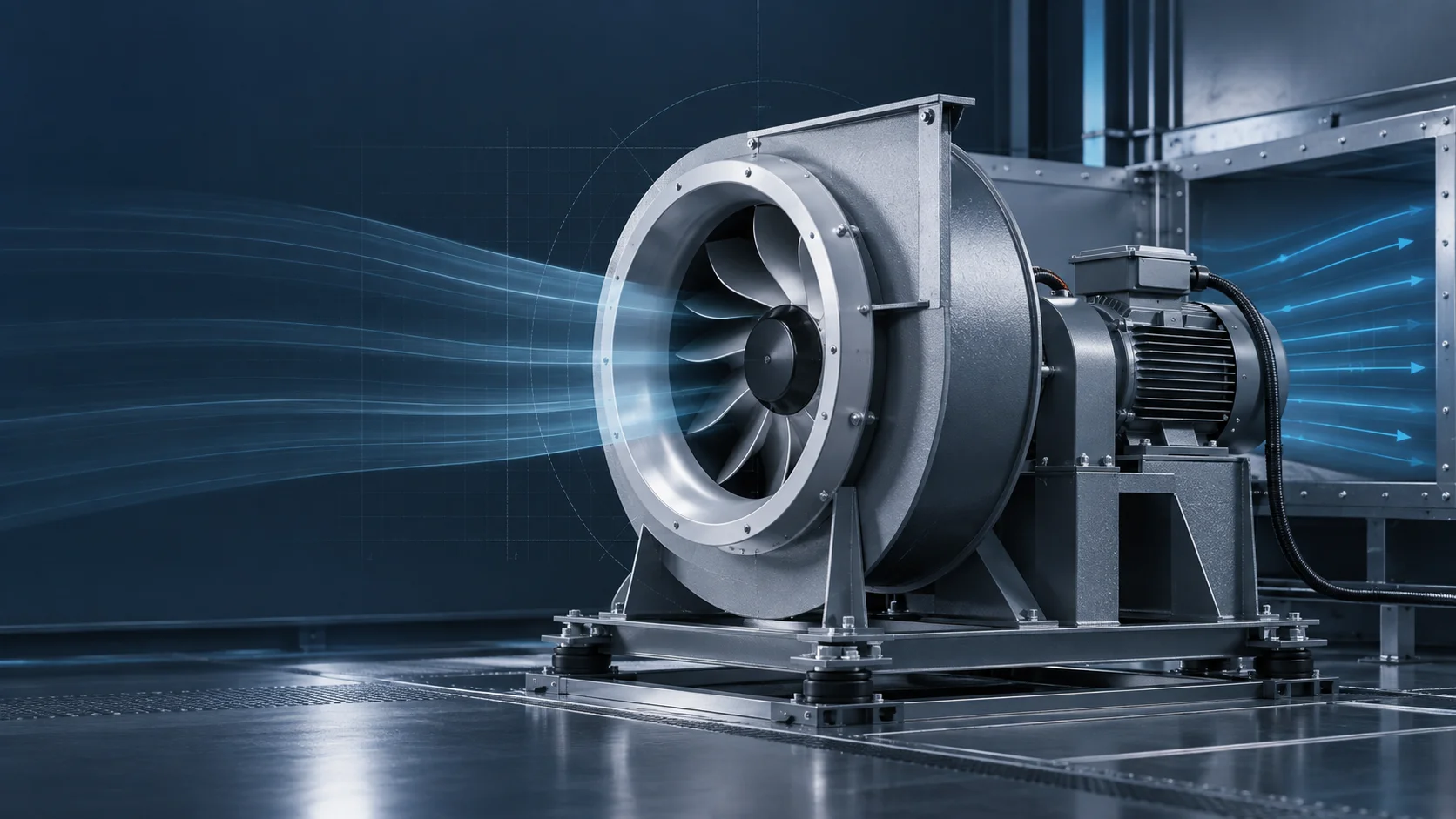
Here the existing LWA-400 platform gave us the full-metal casing and the blade design. Simulation confirmed those blades stay efficient at 2800 RPM, so nothing argued for redesigning them.
That matters commercially. Keeping the casing and impeller means no new tooling, which is most of what makes a custom fan expensive.
What was changed
Our engineers recalculated the stator winding from scratch. The new custom motor winding makes enough torque to drive the impeller to 2800 RPM under load, while holding input power under 350W.
Those two conditions pull against each other, which is why this needed calculation rather than selection from a range. More turns give torque and raise resistance; fewer give speed and lose torque under load.
Finally we issued a new part number, so the variant stays traceable and nobody confuses it with the standard model on a shop floor.
What it cost
Noise and margin. A 400mm impeller at 2800 RPM is loud, and there is no way around it. Tip speed makes noise.
Furthermore, a custom motor winding close to its power ceiling leaves less thermal headroom than a conservative one. It stays within rating, although ambient temperature and airflow obstruction matter more here than on a lightly loaded fan. So keep the inlet clear.
Technical Specifications
Read the speed row against the power row below. Holding both at once is what needed the rewind.
| Parameter | Value |
|---|---|
| Model Number | LWA-400(16″)SM-10 |
| Voltage | 220 V |
| Frequency | 50/60 Hz |
| Input Power | 350 W |
| Speed | 2800 RPM |
| Airflow | 9,000 m³/h | 5,297 CFM |
| Impeller Diameter | 400 mm |
| Flange Diameter | 450 mm |
| Casing Length | 260 mm |
Technical Documentation
The following documents were generated and approved to finalize the technical solution for the customer.
Final Specification Sheet: This document provides the official performance parameters, features, and ratings for the customized LWA-400(16″)SM-10 fan.
Industrial Axial Blower Series Parameters: This document gives technical context for the broader product family, which an engineer can use for comparing other available sizes.

Dimensional Drawing: An OEM procurement manager or system integrator needs this drawing for precise mechanical integration.

Installation Diagram: This shows a typical through-wall duct application for air exchange.
If your duty point is off the catalog
Duty points outside the catalog are common. So these decide whether you get a real answer or a nearby one.
- Say which requirement is firm and which can move. Here speed and power were both fixed, which is what made it a development job. If either had been negotiable the answer would have been a standard fan, faster and cheaper.
- Ask what has to change and what can stay. A custom motor winding on an existing casing and impeller avoids tooling entirely. A new impeller does not. That distinction is most of the cost difference between weeks and months.
- Check the power figure is at your duty point. Input power varies along the curve, and a fan drawing 350W at free delivery may draw more against real resistance. Give your system pressure so the power budget is checked where you will actually run.
- Insist on a distinct part number. A rewound motor looks identical to the standard one. Without its own designation it will eventually be substituted, and the substitution will not be noticed until performance drops.
See our axial fan range, the industrial axial fan section, or axial blowers. Airflow testing follows AMCA 210.
Questions about custom windings
Why rewind rather than pick a bigger motor?
Because a bigger motor would break the 350W budget and probably the envelope too. By contrast a custom motor winding adjusts turns and wire gauge within the same frame, moving the torque and speed relationship with no mechanical change. In short, it is a calculation rather than a substitution.
How loud is a 400mm fan at 2800 RPM?
Loud enough that it belongs in a plant room or a duct rather than beside a workstation. Noise rises steeply with tip speed, and this fan runs fast for its diameter. If your installation is near people, ask about a larger, slower fan for the same airflow instead.
What is the lead time on a custom winding?
Faster than most people expect, because no tooling is involved. Drawings and a costed specification come back in days, and samples follow once the winding is approved. Compare that with a new impeller, which needs a mold and turns weeks into months.
Does running near the power ceiling shorten life?
It reduces thermal margin rather than the rating. We specify the winding for continuous duty at this load, so it is safe as designed. However, a blocked inlet or a high ambient eats into a smaller reserve than on a lightly loaded fan. So keep the airway clear and check ambient against the datasheet.
Technical Documentation & Resources
Need the same thing for your own unit?
Give us the numbers and the envelope, and you get a shortlist rather than a catalog. Meanwhile custom spec sheets and samples run to 90 days. Since 1990 Longwell has supplied EC fans and blowers to OEMs in HVAC, cold chain, data center and industrial markets.
Browse Related Products:
🏆 ISO 9001 / ISO 14001 / ISO 45001 | CE (TÜV) | UL/ETL | ATEX Zone 21/22 | AMCA 210/211 / ISO 5801 tested