What the OEM design team requested
An OEM design team asked for two DC cross-flow fan datasheets by name. Namely the LWCD-60120MN-07 and the LWCD-60180MN-07, which deliver 102 and 152 m3/h.
Naming exact model numbers tells you the design is well advanced. This looks like rack-mounted telecoms hardware, or perhaps a compact air purifier. Either way, a wide and even air curtain has to sweep a whole surface rather than blow through one point.
The model numbers themselves carry the constraints.
- A 24 VDC rail, since that is standard in control and telecom equipment.
- A 60mm impeller diameter, fixed by the enclosure.
- Two widths, so one chassis covers two performance tiers.
- A 186mm total length on the shorter unit, and 246mm on the longer one.
- Formal datasheets, which usually means a CE or UL submission is coming.
Noise never appeared in writing, and yet 38 dB(A) is written on both models. A DC cross-flow fan at that level can sit in an office or a living room without anyone noticing it.
Validating the DC cross-flow fan selection
Here the task was not merely to send a file. Rather, our application engineer had to confirm the selection was right and the data current.
Checking the part numbers
Both models are active production items. Furthermore, the -07 suffix confirms the latest motor and controller revision. That matters, since an OEM designing against a superseded datasheet inherits a problem two years later.
Why cross-flow is the right shape
We considered the other fan types and dismissed them quickly.
An axial fan produces a concentrated column, not a wide curtain, so coverage across the outlet would be uneven. A centrifugal blower makes plenty of pressure, though it cannot deliver a uniform flow profile across a 123mm or 184mm outlet. Only a cross-flow impeller does that naturally.
What is inside
Both fans use a three-phase brushless DC motor from our SmartEC platform. Brushless construction outlasts a brushed motor considerably. In addition, it allows precise 0-10V analogue speed control.
That control matters more than it first appears. It lets the OEM vary airflow against thermal load or an air quality sensor rather than running flat out continuously, which is where the energy saving in a modern system actually comes from.
Why 2000 RPM
The published data is at 2000 RPM, and that figure is a deliberate compromise. Faster would give more airflow and more pressure, yet it would break the 38 dB(A) limit. Slower would be quieter, though it would miss the airflow target.
Finally the engineer pulled the current drawings and datasheets, including LWCD-60120MN-07-00, filed them and sent them out inside one working day.
Technical Specifications
Two lengths of the same series are compared below. Only the impeller length differs, which is what creates the two performance tiers.
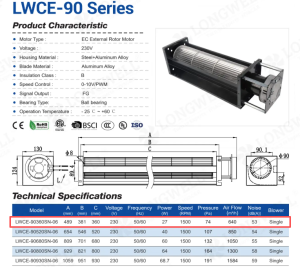
| Parameter | LWCD-60120MN-07 | LWCD-60180MN-07 |
|---|---|---|
| Overall Length (A) | 186 mm | 246 mm |
| Outlet Length (B) | 138 mm | 199 mm |
| Impeller Length (C) | 123 mm | 184 mm |
| Housing Profile (HxD) | 90 mm x 85 mm | 90 mm x 85 mm |
| Voltage | 24 VDC | 24 VDC |
| Current | 0.15 A | 0.20 A |
| Speed | 2000 RPM | 2000 RPM |
| Static Pressure | 27 Pa | 29 Pa |
| Air Flow | 102 m³/h (60 CFM) | 152 m³/h (89.5 CFM) |
| Noise | 38 dB(A) | 38 dB(A) |
| Motor Type | 3-Phase BLDC | 3-Phase BLDC |
| Speed Control | 0-10V | 0-10V |
| Bearing Type | Ball Bearing | |
| Insulation Class | Class B | |
| Operating Temperature | -25°C to +60°C | |
| Materials | Steel/Aluminum Alloy Housing, Aluminum Alloy Impeller | |
| Certifications | CE, RoHS, Intertek | |
Technical Documentation

The summary sheet provides procurement managers and project leads with top-level performance data for quick comparison.
LWCD-60120MN-07-00 Technical Drawing
Mechanical engineers and system integrators require this detailed drawing for CAD modeling and physical integration verification.
LWCD-60180MN-06-00 Technical Drawing
The document provides complete dimensions, bill of materials, and performance specifications for the related 180mm model variant for design-in analysis.
Why the datasheet request converted
A datasheet request seems trivial. Even so, how it is handled decides some projects.
- An engineer answered, not a mailbox. The reply came in hours from an application engineer who verified the data was revision-controlled and current. A sales-only chain takes days and occasionally sends the wrong revision.
- One platform, several tiers. This project used two lengths of the same series. An OEM can design one chassis and offer multiple performance levels from the LWCD-60 range, which cuts R&D work and simplifies inventory.
- Compliance built in. Datasheets carry CE and RoHS markers as standard, since we engineer for global compliance from the start. For non-standard projects, our China-local TUV NORD relationship shortens custom CE or ATEX timelines substantially.
- A full specification, not a stripped one. The LWCD-60 series carries a three-phase BLDC motor, 0-10V control, aluminum alloy construction and long-life ball bearings together. Making all of it in house is what allows the whole list, rather than a choice between items on it.
Browse our cross-flow fan range, or the DC cross-flow fan series for other lengths. Test methods are defined in ISO 5801.
Questions design engineers ask
What is the difference between the -07 and -06 models?
Meanwhile the letters describe the motor and the revision. M means a 24V motor and L means 12V, while -07 is the newer motor and electronics generation, more efficient than -06. In this series the LWCD-60120MN-07 runs on 24V drawing 0.15A, whereas the LWCD-60120LN-06 is a 12V part drawing 0.68A.
Can it be mounted vertically?
Yes, in any orientation, because it runs on ball bearings rather than sleeve bearings. Mounting uses two 3.3mm holes in each side plate. The plates are 90mm tall and the holes sit 64mm apart center to center, with exact coordinates on the technical drawing.
What are the lead time and MOQ at 500 units?
A 500-unit make-to-order run takes 15 to 25 days, and the minimum order quantity at this level is 100 units. Under a frame agreement with a rolling forecast we hold local stock, which brings lead times down to 1 to 5 days.
Why does a cross-flow fan sound quieter than an axial fan at the same airflow?
Because it moves the air more slowly across a much wider outlet. Noise rises sharply with air velocity, so spreading the same volume over 184mm rather than forcing it through a small round aperture is the single biggest reason a DC cross-flow fan holds 38 dB(A).
Technical Documentation & Resources
Have a fan requirement like this one?
Send the datasheet you are working against, or simply the duty point. Then our engineers tell you what fits and what does not. Meanwhile custom spec sheets and samples take up to 90 days. Since 1990 we have been building fans for OEMs worldwide.
Browse Related Products:
🏆 ISO 9001 / ISO 14001 / ISO 45001 | CE (TÜV) | UL/ETL | ATEX Zone 21/22 | AMCA 210/211 / ISO 5801 tested
Choose the right dc cross flow fan
Longwell manufactures 50 dc cross flow fans in-house. Send airflow, static pressure and voltage — an engineer replies with a matching model, performance curve and price within one working day.