What the AHU maker specified
An OEM developing a new range of commercial air handling units needed a single-inlet EC centrifugal fan. Specifically, one reaching 1957 m3/h against up to 422 Pa.
Meanwhile the cabinet was the binding constraint. Overall dimensions could not exceed 406mm high by 376mm wide.
- 230V at 50 or 60Hz, since commercial buildings there use it.
- 0-10V analog or PWM control, because a building management system drives it.
- An operating range from -20C to +60C, since these units ship to varied climates.
- IP54 protection, with compliance to EN 60335-1.
- Lastly, no more than 78 dB(A) at full load.
Speed control sits in that list as a requirement rather than a feature. Demand-based ventilation only works if the fan slows down. Furthermore, modern efficiency expectations assume it does.
Configuring the EC centrifugal fan
Two decisions defined this fan. Firstly the impeller type, then the motor.
Why forward-curved
A forward-curved wheel moves plenty of air from a small housing. That is exactly what a tight AHU cabinet rewards.
Backward-curved would be the better choice at higher pressure. At 422 Pa, though, it would be oversized here and less efficient in this duty. Consequently forward-curved is not a compromise but the correct answer.
Why EC, without much debate
The motor choice was easy. Basically, only an EC motor meets the efficiency and speed control this brief demands.
We considered an AC variant briefly, then rejected it. Reaching the required turndown needs an external variable frequency drive. That adds cost, complexity, a real failure point and integration work the OEM would carry.
Our SmartEC platform reads 0-10V and PWM directly, so none of that arises. We configured the control logic to take both 0-10VDC and PWM between 1 and 10 kHz. Consequently the OEM uses whichever signal their controller already produces.
Materials and life
Galvanized sheet steel for the impeller and housing balances strength, rust resistance and cost sensibly for commercial HVAC air.
Here the motor carries Class F insulation and maintenance-free deep groove ball bearings, giving a 40,000-hour L10 life under continuous S1 duty.
Finally, the LWFE3G250-102SS-01 meets every target. It gives 1957 m3/h at 1320 RPM while drawing 500W.
Technical Specifications
The speed control row is what separates this EC centrifugal fan from an AC equivalent. Otherwise everything above describes a fairly ordinary 250mm fan.
| Parameter | Value |
|---|---|
| Model Number | LWFE3G250-102SS-01 |
| Fan Type | EC Forward Centrifugal Fan |
| Nominal Voltage | 230 VAC |
| Voltage Range | 176 ~ 264 VAC |
| Frequency | 50/60 Hz |
| Max Speed | 1320 ± 10% RPM |
| Max Airflow | 1957 m³/h / 1165 CFM |
| Max Static Pressure | 422 Pa |
| Max Power Input | 500 W ± 16% |
| Max Current | 2.9 A ± 16% |
| Noise Level | 78 dB(A) |
| Speed Control | 0-10VDC / PWM (1K-10KHz) |
| Tach Output | 4 Pulse/R |
| Protection Type | IP54 |
| Insulation Class | Class F |
| Operating Temperature | -20°C to +60°C |
| Life Expectancy (L10) | 40,000 hours at 40°C |
| Impeller Material | Galvanized sheet steel |
| Dimensions (HxWxD) | 406 x 376 x 227 mm |
| Work System | S1 (Continuous) |
| Certifications | CE, RoHS, Reach |
Technical Documentation
LWFE3G250-102SS-01 Specification Sheet
Meanwhile the PDF is the final approved specification sheet containing all nominal data, performance curves, and mechanical drawings an HVAC design engineer needs for system integration.
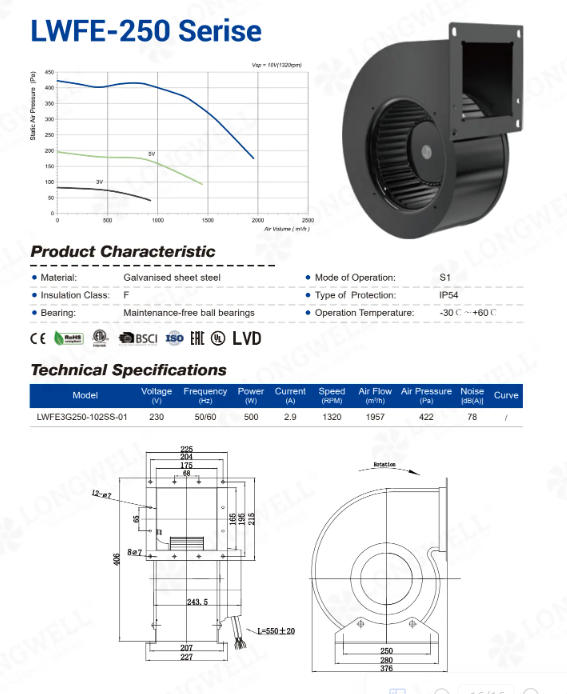
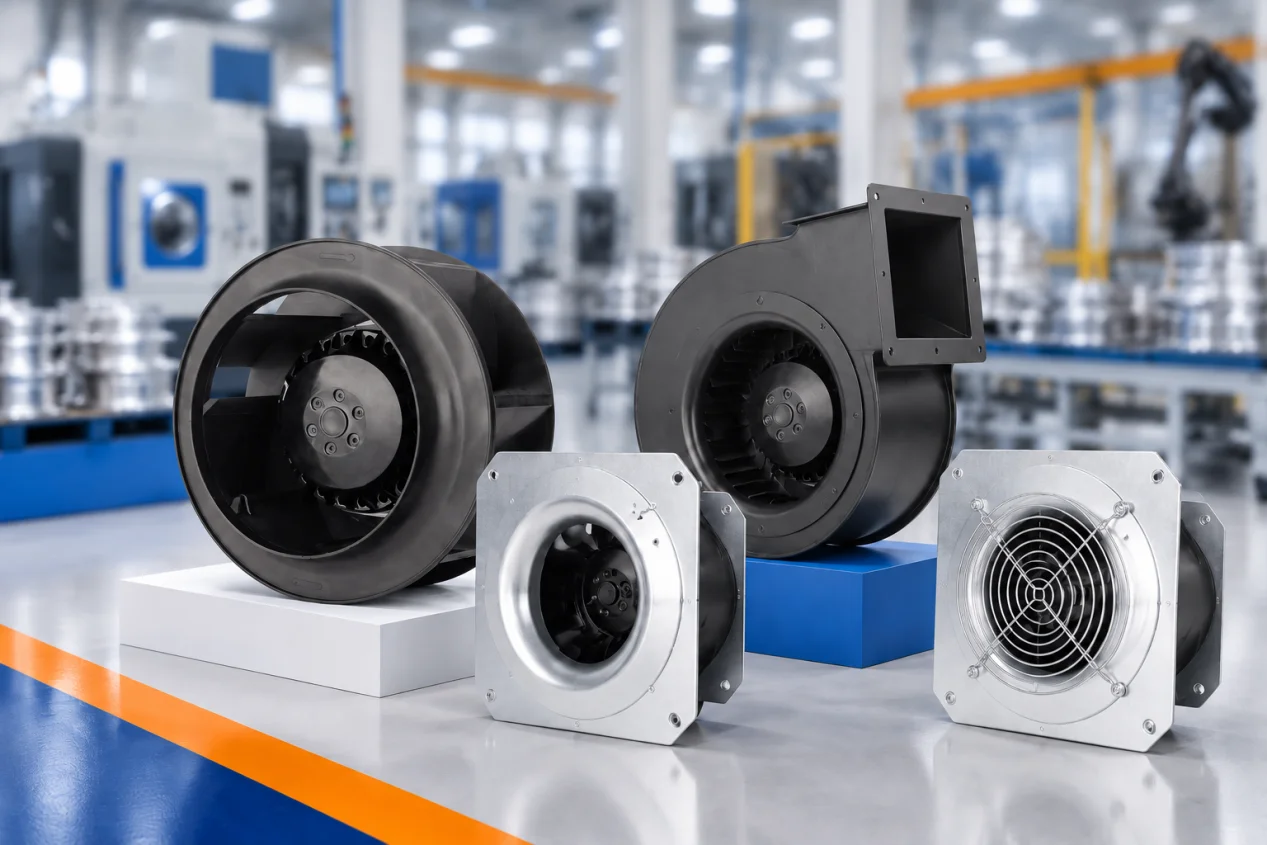
Here the product image provides a quick visual reference of the fan’s construction, showing the forward-curved impeller, EC motor, and scroll housing.
Why the OEM specified our fan
For an OEM building a new AHU platform, four things counted.
- A standard product, already proven. This project wrote up an existing model rather than building one. A deep catalog of tested, documented fans lets an OEM pick off the shelf. Consequently the risk drops, and so does the long NPI wait European suppliers attach.
- Equivalent technology, better economics. This EC centrifugal fan draws on decades of in-house motor and fan manufacture. Vertical integration means the motor, the electronics and the wheel are all our own cost rather than three suppliers prices.
- Compliance already in place. Every EC centrifugal fan here is CE marked, with safety validated against EN 60335-1. Our partnership with a China-local TUV NORD notified body then shortens any customer-specific certification variant considerably.
- Curves from a bench, not a guess. The published P-Q data comes from real testing, in labs that meet AMCA 210/211 and ISO 5801. Consequently engineers can design to those numbers safely.
Browse our EC forward-curved fan range, or the AHU fan section. Appliance safety comes from IEC 60335-1.
Questions AHU designers ask
Can it retrofit an older AC fan in an existing system?
Yes, and swapping an AC fan for an EC centrifugal fan is often done for the energy saving. Two things must be true. A 230V AC line has to be available, and a 0-10VDC or PWM control signal has to come from somewhere. If the old system was single-speed or used triac control, that means a new controller. In many commercial applications the efficiency gain pays that back in under two years.
What does IP54 mean, and can it go outdoors?
IP54 covers limited dust ingress and water spray from any direction. That suits installation inside an AHU or an equipment cabinet, even one sited outdoors. The fan itself is not designed for direct exposure to weather. Its -20C to +60C range keeps it reliable inside such enclosures.
How does 0-10V control work on a 230V fan?
The integrated controller handles it. Mains 230V AC powers the unit, and internally the controller derives a low-voltage supply for its own electronics and provides a separate control circuit. Your BMS or a simple potentiometer feeds 0-10VDC into that circuit, which sets speed anywhere from stopped to 1320 RPM.
Why does forward-curved lose out above about 500 Pa?
Because its power curve keeps climbing as airflow rises, so an oversized system can overload the motor. Backward-curved blades peak, then fall away. Consequently they are safer and more efficient once resistance is high. Below roughly 500 Pa that risk never appears, and forward-curved wins on size.
Technical Documentation & Resources
Sizing something comparable?
Share the airflow, pressure, voltage and control interface, and we come back with a tested curve and a drawing. Meanwhile custom work runs to 90 days for spec sheets and samples. Since 1990 Longwell has supplied fans to HVAC and industrial OEMs.
Browse Related Products:
🏆 ISO 9001 / ISO 14001 / ISO 45001 | CE (TÜV) | UL/ETL | ATEX Zone 21/22 | AMCA 210/211 / ISO 5801 tested
Choose the right centrifugal fan
Longwell manufactures 1,130 centrifugal fans in-house. Send airflow, static pressure and voltage — an engineer replies with a matching model, performance curve and price within one working day.