What the OEM needed
An OEM asked for a drawing and a quotation on a 130mm plastic axial impeller, at 10,000 units. The answer turned on whether existing tooling covered it.
They had seen a similar part before and wanted to know whether we could supply it. That quantity means a mass-produced assembly line, most likely a compact ventilation or air treatment product.
What had to match exactly
- First, 130mm outer diameter, to fit inside an existing shroud.
- Next, a maximum height of 45mm.
- Finally, a central bore of exactly 4mm, to mate with the motor shaft they had already chosen.
Those three numbers are not negotiable in the way airflow figures often are. The shroud exists and the motor is chosen, so the impeller has to fit between them.
Why existing tooling settled it
One question mattered before any other. Did existing tooling already cover this part?
Why tooling dominates the cost
For an injection-molded part, the mold is most of the investment. Once it exists, each part costs material and machine time. Before it exists, you are paying for steel, machining and a validation cycle.
On 10,000 units that difference decides whether the project is viable. Consequently the first task was a catalog search rather than a design review.
The part was already in the range
A standard five-blade plastic axial impeller matched all three critical dimensions: 130mm diameter, 45mm height, 4mm bore.
So there was no new product introduction, no tooling program and no validation cycle. Existing tooling turned a custom-sounding request into a drawing and a volume price within hours.
The material, checked rather than assumed
The standard part is white polypropylene. We considered whether it should be something else.
Glass-filled nylon would give more rigidity and a wider temperature range. However, at 130mm in a residential or light commercial product, neither is needed. Polypropylene is light, tolerates humidity well, and costs considerably less at volume.
Why five blades
Here the existing geometry balances airflow against noise, which is the trade that matters in a product people live beside. More blades would build slightly more pressure and make more noise for it.
What it cost
Flexibility. Using existing tooling means accepting its geometry exactly as it is.
If the customer had wanted a different blade count, a different hub, or a bore of 4.5mm rather than 4mm, none of this applies and the answer becomes a tooling program. That is worth knowing before you design a shroud around a part you have not yet sourced.
Technical Specifications
The bore and diameter below are the two that had to match exactly. Everything else had tolerance.
| Parameter | Value |
|---|---|
| Model | LWA-φ130X45-01 |
| Component Type | Axial Impeller (Fan Blade) |
| Material | Plastic (Polypropylene) |
| Color | White |
| Outer Diameter | 130 mm |
| Height | 45 mm |
| Bore Diameter | 4 mm |
| Number of Blades | 5 |
Technical Documentation
Meanwhile the following documents were provided to the customer to confirm the component’s suitability and facilitate integration.
LWA-φ130X45-01.pdf
The primary technical drawing for the LWA-φ130X45-01 axial impeller provides all critical dimensions an OEM engineer needs for integration into their product housing and for motor shaft compatibility verification.
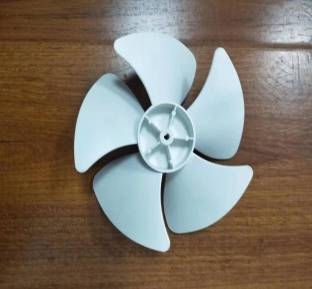
Here the product image shows the 5-blade geometry and standard white plastic construction of the LWA-φ130X45-01 impeller.
How to check before you pay for a mold
Before commissioning a mold, spend a few minutes checking whether existing tooling already covers you.
- Send dimensions, not a description. Outer diameter, height, bore and blade count let a supplier search their catalog directly. A description of the application cannot be matched against a parts list.
- Say which dimensions are fixed and which are not. Here the bore and diameter were absolute while the blade count was open. Naming the flexible ones is often what makes an existing part fit.
- Ask specifically whether existing tooling covers it. Suppliers do not always volunteer this, and it is the single biggest cost lever on a molded component. The answer is usually yes or no within a day.
- Design the shroud after choosing the impeller, not before. A housing built around a part you have not sourced tends to fix dimensions that no standard part happens to hit, which forces tooling you did not budget for.
See our fan impeller range, the fan blade section, or axial fans. Airflow testing follows AMCA 210.
Questions about component supply
How do I find out whether a part already exists?
Send the critical dimensions with tolerances, and say which are fixed. A supplier with a deep catalog can answer within a day. It costs you one email and can save weeks and a tooling bill, so it is worth asking before assuming a custom part is needed.
What does new tooling actually cost in time?
The mold itself is the long pole, followed by first article inspection and validation. Our full NPI cycle runs 90 days from spec lock to first samples. Compare that with a stocked part, where drawings come back the same day and samples ship in about a week.
Would glass-filled nylon be better?
For this application, no. It is stiffer and handles higher temperatures, and neither is needed at 130mm in a domestic or light commercial product. It also costs more and weighs more. Reserve it for larger diameters, higher speeds or hot airstreams.
Can the bore be modified on an existing part?
Sometimes, if you need it larger. A 4mm bore can be machined out to a larger diameter as a secondary operation, though that adds cost per part and a tolerance stack. Going smaller is not possible. Where the bore is the only mismatch, ask before writing off the part.
Technical Documentation & Resources
Working on something similar?
Send us the duty point, the envelope and the supply, and our engineers come back with a shortlist rather than a catalog. Meanwhile custom spec sheets and samples run to 90 days. Since 1990 we have built fans for HVAC, cold chain, data center and industrial OEMs.
Browse Related Products:
🏆 ISO 9001 / ISO 14001 / ISO 45001 | CE (TÜV) | UL/ETL | ATEX Zone 21/22 | AMCA 210/211 / ISO 5801 tested