Upblast and downblast describe where a roof exhaust fan sends its discharge. They do not, by themselves, establish that a fan is suitable for grease, heat, chemicals, or a particular building. The useful first question is what the exhaust contains and where that air could travel after leaving the fan.
An upblast arrangement directs discharge generally upward. A downblast arrangement directs it outward and toward the roof plane. Actual plume movement also depends on discharge velocity, wind, roof geometry, nearby structures, and the position of outdoor-air intakes. Use the direction as a starting sketch, then check the site and the exact fan assembly.
Draw the discharge path before choosing a fan
Mark each exhaust point, roof level, parapet, higher wall, outdoor-air intake, opening, and maintenance route on one roof plan. Then draw both possible discharge directions. An upward outlet may help move a plume away from the roof surface; it is not a guarantee against re-entry. A side or downward outlet needs particular attention when air can spread along the roof toward an intake or occupied opening.
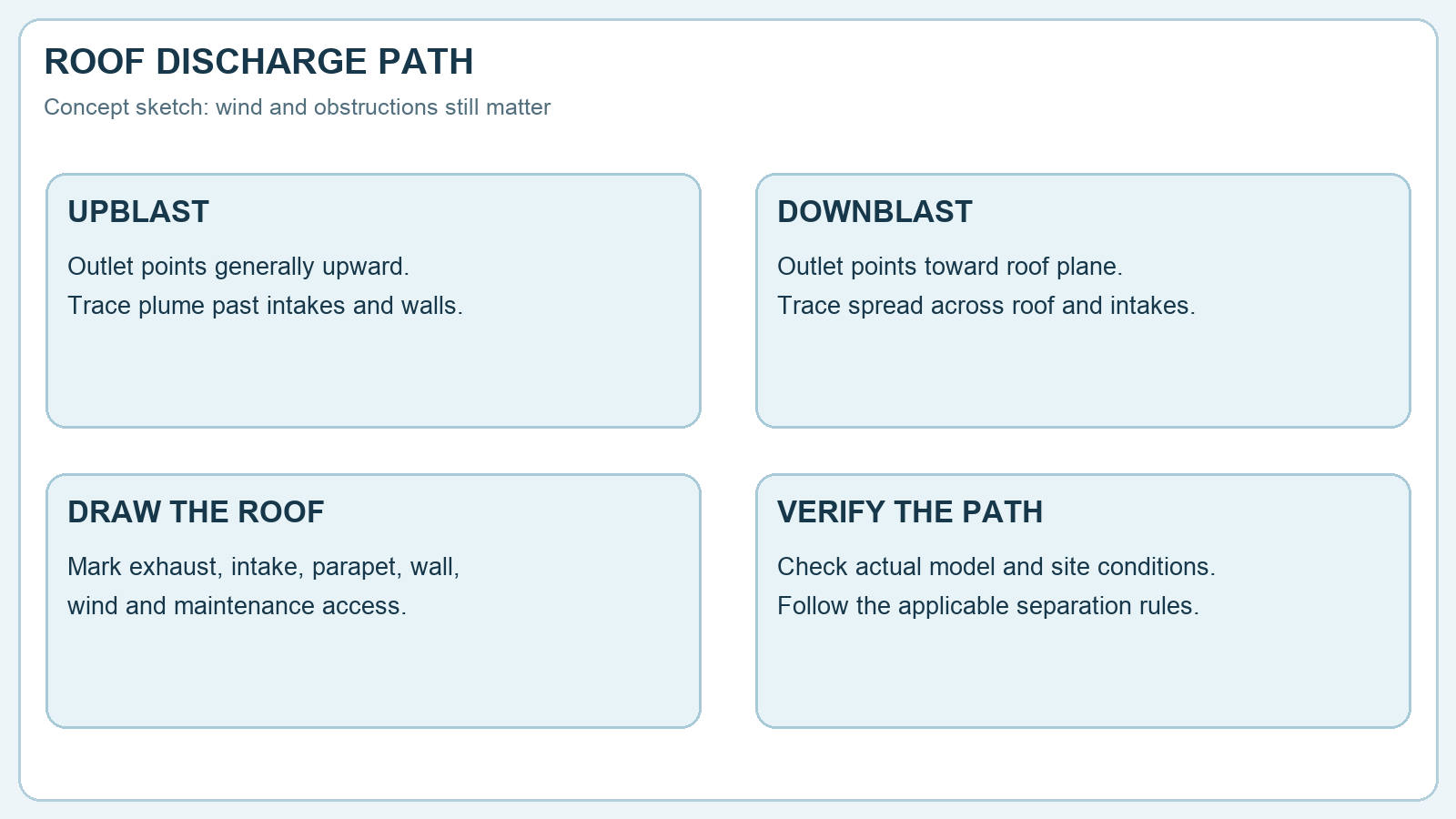
Check the air path at the conditions that matter: prevailing and adverse winds, nearby obstructions, and simultaneous operation of supply and exhaust systems. If the exhaust is odorous or hazardous, a project engineer should evaluate the applicable discharge and intake separation rules and dispersion risk. A generic distance in an article cannot replace that review.
Identify the airstream and the required assembly
Clean general ventilation, humid air, cooking effluent, and process exhaust place different demands on the fan, duct, motor location, materials, and service access. Record the contaminants, temperature range, moisture, required airflow and pressure, and any fire or hazardous-location requirements before comparing catalog entries. The relevant authority and project specification decide which arrangement and listed assembly can be used.
For commercial cooking exhaust, do not select a generic roof fan merely because its outlet points upward. Verify the complete fan and curb assembly, grease handling, cleaning access, fire-related listing where required, and the local code. Greenheck’s published installation material shows how its specific upblast kitchen exhaust configurations address such details; those details do not transfer automatically to a LONGWELL model. Conversely, a downblast label alone does not prove a unit is unsuitable for every non-grease application.
Use LONGWELL material for the scope it actually proves
LONGWELL’s roof exhaust fan family includes centrifugal and axial roof-fan options. Its roof-fan catalog identifies model series such as LWCRF and LWARF and provides model-specific tables and drawings. Those materials help establish product identity, geometry, and published catalog conditions. They do not identify an upblast or downblast kitchen-exhaust approval for every model, nor do they prove the site-specific plume path.
Start with the required duty point and an exact current model, suffix, and revision. Request the performance curve, construction details, motor location, discharge configuration, and any controlled listing or test document needed for the application. The product-family link is a route for finding candidates, not a declaration that a pictured fan is the correct fit.
Check the curb, drainage, and service route
A roof fan is part of a roof assembly. Coordinate curb dimensions, flashing, drainage, electrical isolation, wind restraint, access, and the duct connection with the roof designer and installer. An apparently suitable discharge choice can fail in practice if the roof membrane is poorly detailed or the unit cannot be cleaned and serviced safely. The roof curb and flashing guide provides a useful coordination checklist; the actual installation must follow approved drawings and local requirements.
For contaminated exhaust, ask where condensate or grease can collect and how it will be contained and removed. For clean ventilation, still check rain ingress, backdraft, vibration, and safe access. Maintenance interval is set by the actual duty, inspection findings, the equipment instructions, and applicable rules. A universal quarterly or annual interval would be misleading.
Make a comparison sheet for the exact project
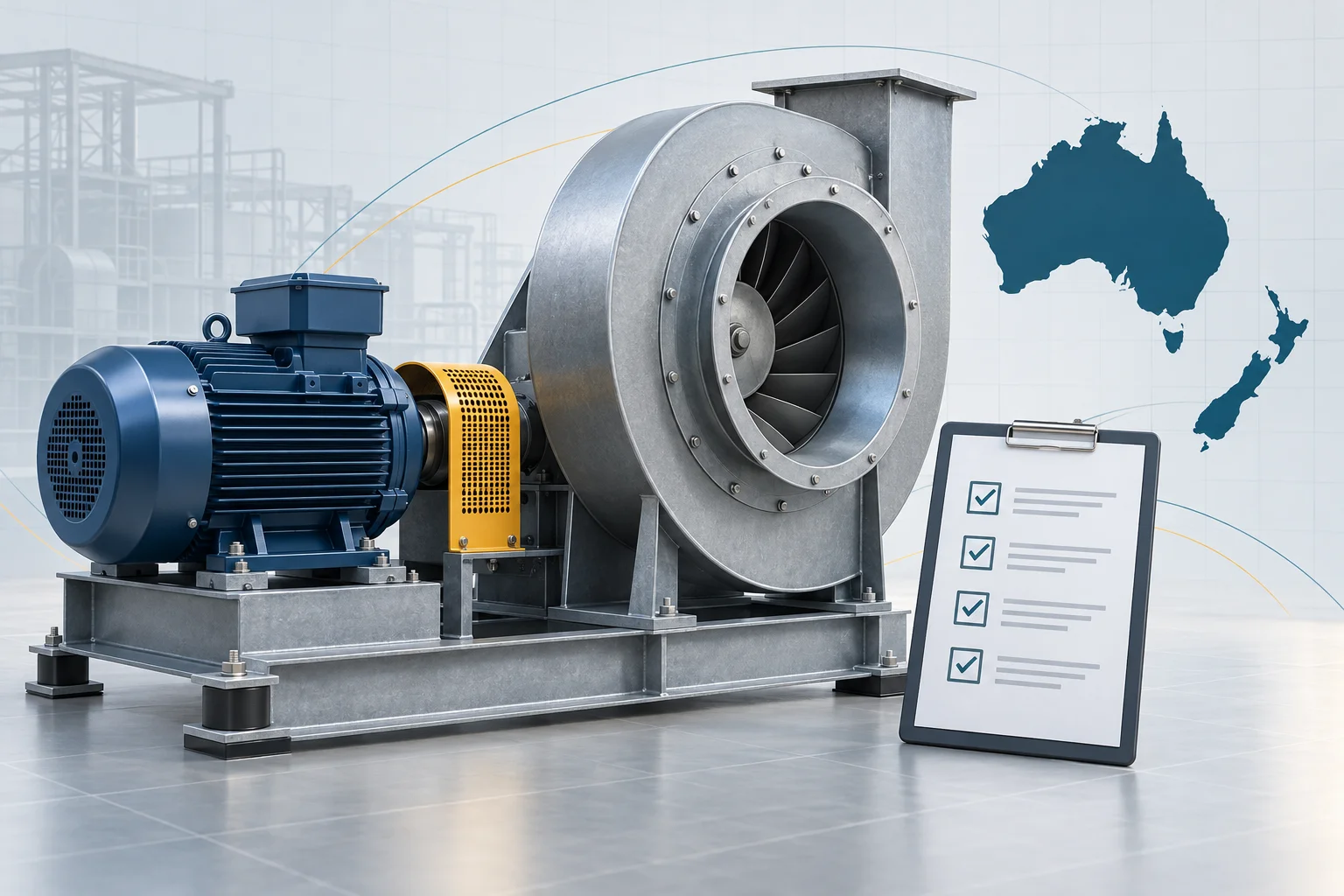
Compare the same required airflow and system pressure for each eligible arrangement. Add contaminant and temperature limits, the verified discharge path, the distance and relationship to intakes, weather protection, sound constraints, installation details, and the maintenance route. Only then compare electrical input and cost at equivalent duty. The second figure is a release checklist rather than a ranking: any unresolved application or documentation item sends the choice back for verification.
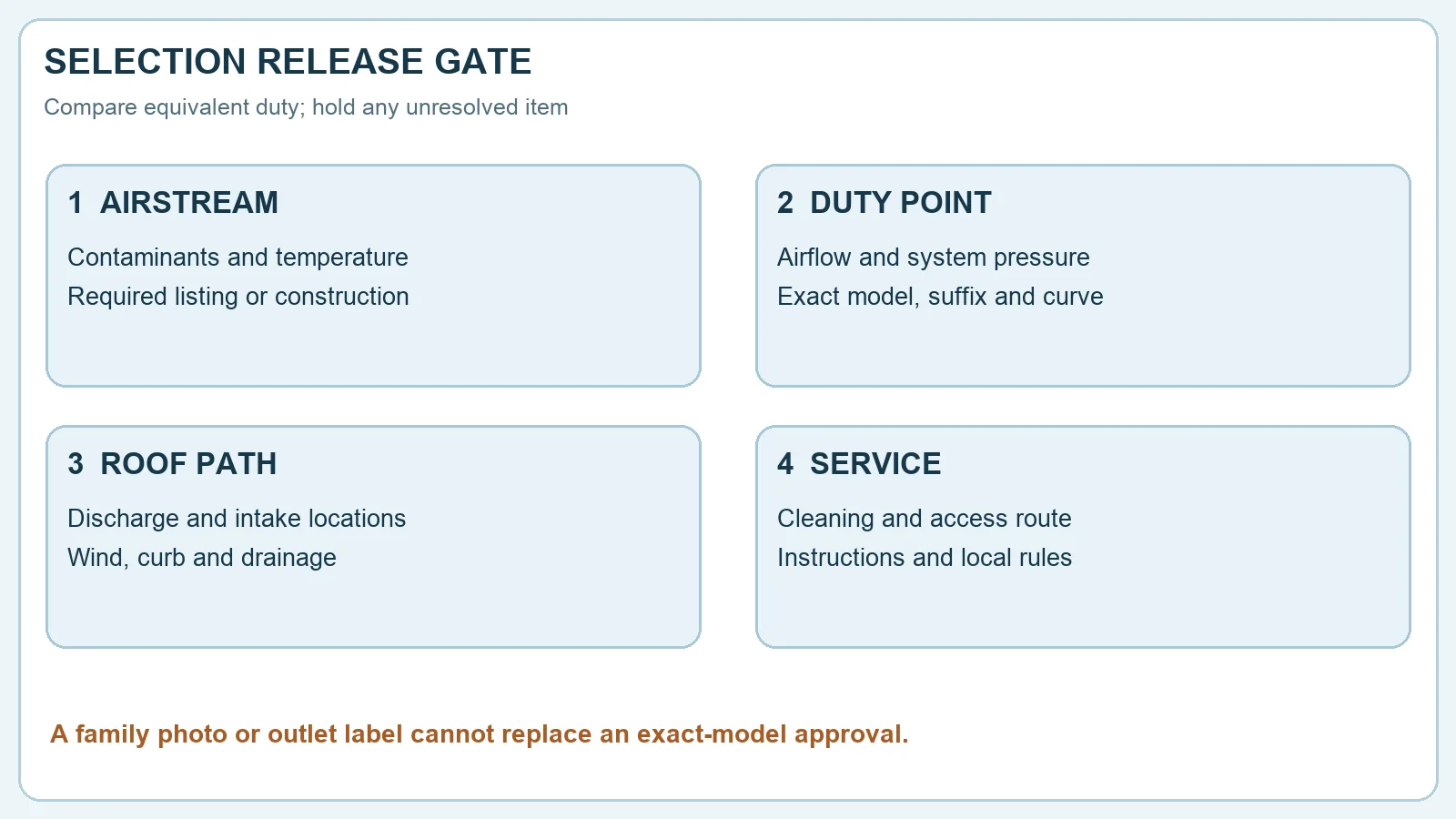
If neither candidate has a controlled document covering the airstream, or if the discharge path cannot be shown to satisfy the project requirements, the correct outcome is to hold selection. For broader roof ventilation context, see LONGWELL’s roof-fan application overview, then return to the exact model and the site drawings.
Questions to resolve before ordering
Is upblast always required for a kitchen? The answer depends on the jurisdiction, cooking duty, equipment listing, and complete exhaust design. Verify the applicable code and approved assembly; do not infer compliance from outlet direction alone.
Does downblast always cause re-entrainment? No. The risk depends on the outlet, roof geometry, wind, nearby intakes, and exhaust properties. Evaluate the actual roof and operating conditions.
Can a catalog photo prove the outlet direction? A photo can show visible construction. Ask for the exact model drawing and installation instructions before treating it as a discharge or application specification.
For an exact roof-fan review, send the airflow and pressure duty, exhaust contents, roof plan, intake locations, and the required compliance documents to sales@longwellfans.com.
Choose the right exhaust fan
Longwell manufactures 241 exhaust fans in-house. Send airflow, static pressure and voltage — an engineer replies with a matching model, performance curve and price within one working day.