A voltage change with inspection criteria attached
A customer already running our 230 V cross-flow fan needed the identical performance on a 110/115 V grid, with a 40-unit pilot run first. Their engineering drawing carried something else worth writing about: explicit fan quality inspection criteria.
Specifically, the drawing states that surfaces must show no rust spots, no mildew, no scratches, no obvious burrs, and that shell riveting must seal tight with no obvious gaps.
The unchangeable envelope
- First, 340 m3/h at 1700 RPM from the 445mm assembly with its 363mm impeller section, untouched.
- Next, 115 V 50 Hz in place of 230 V, holding the 33 W draw.
- Meanwhile S1 continuous duty from -25C to +60C, under 48 dB(A).
- Finally, GB/T 13933 safety compliance governing final acceptance.
Why the conversion is harder than it sounds
Halve the voltage at the same power and the current doubles. So in a shaded-pole motor already packed into a fixed volume, that doubled current is a heat problem before it is anything else.
Consequently we recalculated the winding for 115 V while keeping the speed, since any RPM loss cuts straight into the 340 m3/h, and the equipment behind it faults on low airflow.
Fan quality inspection, line by line
The acceptance list looks cosmetic until you sort it by what each line actually protects. A good fan quality inspection list is engineering wearing plain clothes.
The line that is really about airflow
Riveting with no obvious gaps reads like neatness. However, it is not. The shell of a cross-flow fan is part of the aerodynamic circuit, and gaps at the seams let air short-circuit inside the housing.
Leakage there costs pressure and creates noise, so the rivet line defends the 62 Pa and the 48 dB(A) at once. In other words, the customer wrote an aerodynamic requirement in fan quality inspection language.
The lines that are really about life
Next, no rust and no mildew are storage and process criteria. They certify that the steel stayed protected between production steps and that packing happened dry.
A rust spot on arrival is a preview of the fan interior five years out, which is exactly why a buyer checks for it on day one.
The lines that are really about handling
Lastly, scratches and burrs tell you how the part was made and moved. A burr on a shell edge also cuts assembly workers, and a scratch through plating restarts the corrosion clock at that point.
What stayed identical, deliberately
Meanwhile the 60mm aluminum impeller with its 30 balanced blades did not change at all, because the customer equipment is qualified around its airflow and acoustics.
That is the discipline of a voltage variant: everything the application touches stays frozen, and the change hides entirely inside the motor. We rejected a DC motor with an inverter for the same reason, since it would add cost and a failure point to deliver an outcome the rewound shaded-pole already delivers. Compliance follows GB/T 13933, with airflow verification to ISO 5801 methods.
Technical Specifications
The table covers what the fan does. The drawing this order came with also covered what the inspector must not find.
| Parameter | Specification |
|---|---|
| Model Number | LWCA-60360UN-06-00 (Modified from LWCA-60360SN-06) |
| Voltage | 115 V |
| Frequency | 50 Hz |
| Air Volume | 340 m³/h |
| Static Pressure | 62 Pa |
| Speed | 1700 r/min |
| Input Power | 33 W |
| Noise Level | 48 dB(A) |
| Dimensions (Total Length) | 445 mm |
| Dimensions (Impeller Length) | 363±1 mm |
| Impeller Diameter | 60 mm (30 blades) |
| Motor Type | AC Shaded Pole Motor |
| Bearings | Ball bearing |
| Housing Material | Galvanized Sheet Steel (SGCC) |
| Blade Material | Aluminum Alloy |
| Operation Temperature | -25°C to +60°C |
| Mode of Operation | S1 (Continuous) |
Technical Documentation
LWCA-60360UN-06-00 Engineering Drawing (PDF)
The official manufacturing drawing outlines the exact 445 mm dimensions, SGCC material requirements, and mounting hole layouts required by integration engineers.
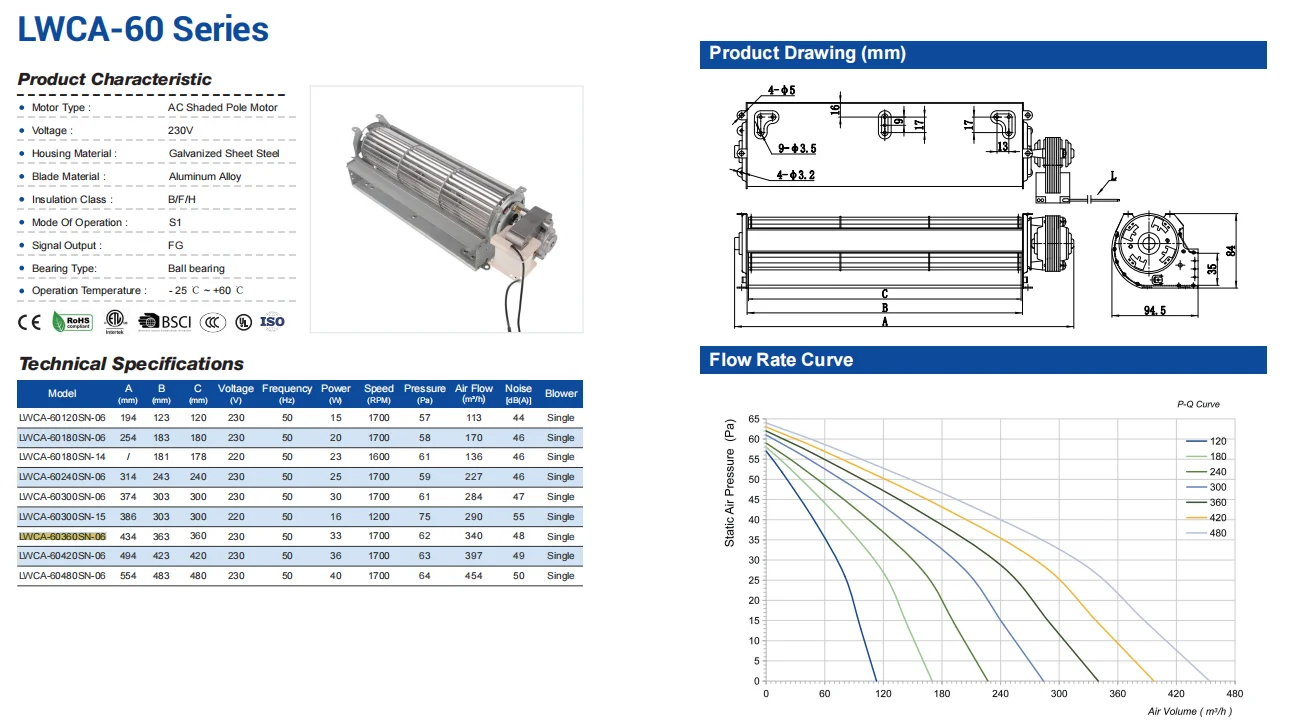
The standard catalog specification sheet provides the baseline P-Q performance curves and electrical data for the original 230V LWCA-60360SN-06 model.
Writing acceptance criteria that work
Acceptance criteria are cheap to write and expensive to omit. Four habits make a fan quality inspection list worth having.
- Write what the inspector must not find. Airflow numbers need a test rig; rust, burrs, scratches and rivet gaps need eyes and minutes. A written fan quality inspection list catches at goods-in what would otherwise surface as field complaints.
- Know which cosmetic lines are functional. Seam gaps on a cross-flow shell are an airflow defect, and a scratch through plating is a corrosion start point. Sorting the list by what each line protects tells you which failures justify rejecting a batch.
- Pin the criteria to the drawing, not to emails. Criteria on the controlled drawing survive personnel changes and repeat orders. The same words in a message thread are archaeology within a year.
- Use the pilot run to calibrate the standard. Forty units is enough to establish what obvious burrs and obvious gaps mean between your inspector and the supplier before volume production makes the disagreement expensive.
See our cross-flow fans range, the AC cross-flow fans section, or cross-flow impellers.
Questions about acceptance criteria
Are cosmetic defects really worth rejecting a fan over?
Sort them first. A scratch on a surface nobody sees may be tolerable; a seam gap on a cross-flow shell costs pressure and adds noise, and plating damage starts corrosion. The list exists so the distinction is agreed before the argument, not during it.
Why does a voltage conversion double the current?
Power is voltage times current, so holding 33 W at half the voltage requires twice the amps. The winding is recalculated with thicker wire and fewer turns, and the thermal design must absorb the higher current in the same physical volume.
What should a pilot run inspect that volume production does not?
Everything, more slowly. The pilot is where acceptance wording gets calibrated: what counts as an obvious burr, how a rivet gap is measured, which surfaces the scratch criteria cover. Volume inspection then applies a standard both sides already understand.
Does the shell really affect airflow that much?
On a cross-flow fan, yes. The housing forms the aerodynamic path that recirculates air through the impeller, so leaks in it are internal short circuits. A visibly gapped seam can measurably reduce pressure and raise noise on an otherwise perfect fan.
Technical Documentation & Resources
Need the same thing for your own unit?
Give us the numbers and the envelope, and you get a shortlist rather than a catalog. Meanwhile custom spec sheets and samples run to 90 days. Since 1990 Longwell has supplied EC fans and blowers to OEMs in HVAC, cold chain, data center and industrial markets.
Browse Related Products:
🏆 ISO 9001 / ISO 14001 / ISO 45001 | CE (TÜV) | UL/ETL | ATEX Zone 21/22 | AMCA 210/211 / ISO 5801 tested
Choose the right cross flow fan
Longwell manufactures 495 cross flow fans in-house. Send airflow, static pressure and voltage — an engineer replies with a matching model, performance curve and price within one working day.