What the market was asking for
The project began differently from most. There was no single customer brief, so it became catalog fan design. Instead we developed the LWCE-100720SN-06 to answer repeated demand from commercial HVAC OEMs for a catalog-ready EC cross-flow fan.
Here the target applications are high-performance air curtains and trench heaters, where a long, linear airstream forms an environmental barrier across a doorway. A secondary use is cooling large enclosed electronics cabinets.
Designing for a catalog rather than one customer changes the constraints. Consequently they have to suit many OEMs at once.
- A total length under 850mm, so it fits standard 900mm door frames, with about 720mm of active impeller.
- A compact cross-section, since 140mm is all the height available.
- 230 VAC at 50 or 60Hz, because European and Asian markets demand it.
- Precise variable speed from the EC cross-flow fan, since ErP rules require it.
- No more than 60 dB(A) at one meter, for indoor commercial spaces.
- Lastly, reliable running from -25C to +60C, plus CE marking.
That door frame dimension is the interesting one. An air curtain must span the opening it protects. In other words, the fan length follows architecture rather than aerodynamics.
Designing the EC cross-flow fan
Two decisions shaped the fan. Firstly how to drive it, then how big to make the impeller.
Why the drive is inside the motor
Initially we evaluated an AC induction motor with an external variable frequency drive. Then we rejected it.
A separate drive adds complexity for the OEM, bulk to the finished installation, and one more component that can fail. A direct-drive EC motor with integrated electronics avoids all three. Built on our SmartEC platform, it reads 0-10V and PWM natively, simplifies the customer wiring, and draws only 75W at full load.
Why the impeller is 100mm
The form factor settles the fan type immediately. Basically, cross-flow is the only architecture producing a long, even airstream from a slim body.
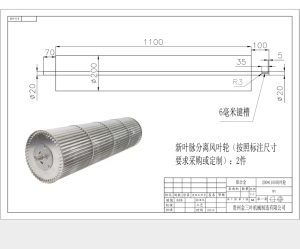
Impeller diameter was the real choice. At 100mm it balances two competing needs. Larger would give more static pressure. Equally, it would push the housing past the 140mm height limit. This diameter reaches 201 Pa while keeping the profile slim.
Materials, chosen for catalog fan design
Meanwhile the blades are aluminum, picked for low spinning mass and rust resistance. Meanwhile the housing is cold-rolled steel, supplying the rigidity an 839mm span needs to avoid resonating.
For the -25C to +60C range, components follow our ThermoFlex approach. High-temperature motor windings and suitable ball bearing lubricants are what deliver a 30,000-hour L10 life across that whole window.
In the end the fan reaches 1500 m3/h at 60 dB(A). That is what makes it usable above a shop doorway, rather than only in a plant room.
Technical Specifications
Look at the input power beside the airflow. Seventy-five watts for 1500 m3/h is what makes this EC cross-flow fan viable under ErP.
| Parameter | Value |
|---|---|
| Model Number | LWCE-100720SN-06 |
| Voltage | 230 VAC (Range: 184-276 VAC) |
| Frequency | 50/60 Hz |
| Max Airflow | 1500 m³/h / 883 CFM |
| Max Static Pressure | 201 Pa |
| Nominal Speed | 1500 RPM |
| Input Power | 75 W |
| Noise Level | 60 dB(A) |
| Control Signal | 0-10VDC / PWM |
| Operating Temperature | -25°C to +60°C |
| Dimensions (L x W x H) | 839 x 140 x 110 mm |
| Impeller Diameter | 100 mm |
| Impeller Length | 720 mm |
| Bearing Type | Ball Bearing |
| L10 Lifespan | 30,000 hours (@ 25°C) |
| Certifications | CE |
Technical Documentation
The full technical specification sheet contains performance curves, dimensional drawings, and wiring diagrams for system integrators and design engineers.
Open LWCE-100720SN-06 Specification Sheet (PDF)
Here the product overview image details the key specifications and available models in the LWCE-100 series for procurement managers and initial evaluation.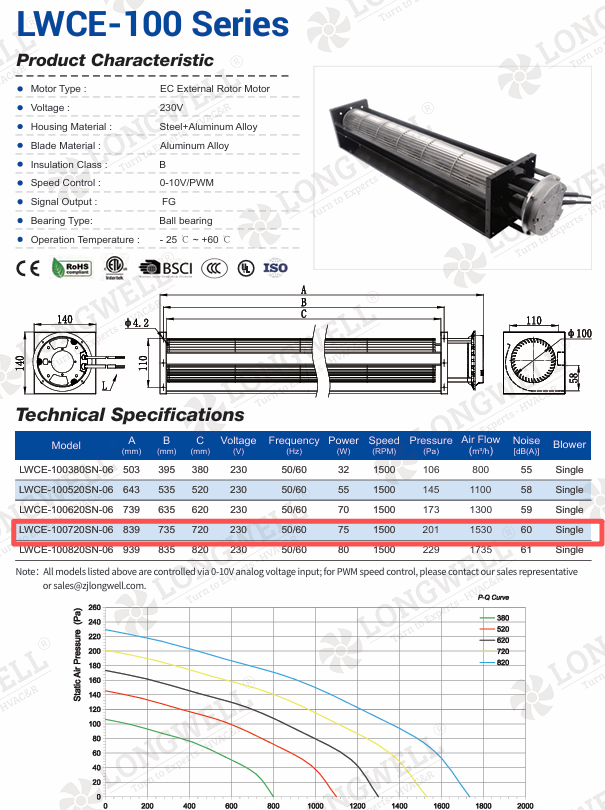
How catalog fan design serves an OEM
When an OEM designs a platform around a catalog fan, four things matter.
- Catalog fan design that follows demand. This standard product followed an accelerated development path mirroring our 90-day NPI cycle, which brings solutions to customers months ahead of typical European timelines.
- Cost that comes from the process. Manufacturing everything from motor components to final assembly on one site removes the handoffs, the freight and the margins that sit between them. That is where the number comes from, rather than from thin pricing.
- Certification without the queue. CE for the LWCE-100 series went through our long-standing China-local TUV NORD relationship, which shortens certification schedules substantially and moves the OEM launch forward with it.
- Every unit tested, not every batch. We test airflow and pressure claims to AMCA 210/211 and ISO 5801. Furthermore, each EC cross-flow fan gets end-of-line electrical and aerodynamic testing before it ships.
Browse our EC cross-flow fan range, or the air curtain section. Ecodesign rules are published by the European Commission.
Questions specifiers ask
How does catalog fan design differ from a custom project?
A custom fan is optimized for one duty point, because you know exactly where it will run. Catalog fan design has to serve a range of customers, so the impeller and motor are matched for good behavior across a band of operating points rather than peak efficiency at one. That costs a little at any single point and gains a lot in availability.
Which control signals does it accept?
Here the SmartEC controller takes a 0-10VDC analogue signal or a PWM digital signal. It also provides a 10VDC source, so an external potentiometer gives you manual speed control with nothing else fitted. The wiring diagram in the specification sheet gives the pinouts for power, ground, control and FG speed feedback.
What L10 life and bearings does it use?
It is calculated at 30,000 hours L10 at a 25C ambient, on dual ball bearings. Those bearings are what make the full -25C to +60C range achievable. AC fans using sleeve bearings generally cannot hold that span, which is one reason this platform is EC.
Can the length be customized?
Yes. This model sits in a series covering standard impeller lengths from 380mm to 820mm. Where OEM volume justifies it, we develop custom lengths and mounting arrangements through our 90-day NPI process, which is usually how a fan ends up fitting a specific door frame exactly.
Why does an air curtain need low pressure but long length?
Because it pushes air through nothing at all. The job is laying a continuous sheet of moving air across an opening, so the fan needs width and evenness rather than pressure. Consequently a cross-flow impeller suits it exactly, whereas an axial fan cannot.
Technical Documentation & Resources
Sizing something comparable?
Share the airflow, pressure, voltage and control interface, and we come back with a tested curve and a drawing. Meanwhile custom work runs to 90 days for spec sheets and samples. Since 1990 Longwell has supplied fans to HVAC and industrial OEMs.
Browse Related Products:
🏆 ISO 9001 / ISO 14001 / ISO 45001 | CE (TÜV) | UL/ETL | ATEX Zone 21/22 | AMCA 210/211 / ISO 5801 tested
Choose the right cross flow fan
Longwell manufactures 495 cross flow fans in-house. Send airflow, static pressure and voltage — an engineer replies with a matching model, performance curve and price within one working day.