What the OEM needed to change
An existing OEM customer building compact HVAC systems wanted to take a North American product into Europe and Asia. Their unit was built around our 115 VAC EC centrifugal fan. Meanwhile the new markets run on 230 VAC.
One thing ruled the rest. It had to drop straight in.
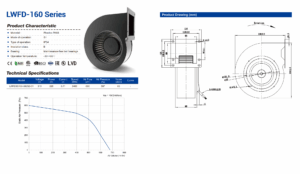
- A total height of 115.2mm, entirely unchanged.
- The same 153mm inlet, since the ducting is fixed.
- The identical 4-M6x10 mounting bolt pattern.
- Roughly 1463 m3/h against up to 824 Pa, exactly matching the 115V unit.
- Lastly, a top speed capped at 3000 RPM rather than the standard 3600 RPM.
That last line came from an earlier rework order. Frankly, it is the most interesting part of the brief.
Capping the speed keeps noise and energy use the same across the whole product family, whatever the supply voltage. In other words, the customer wants their European machine to behave like their American one, rather than merely to work.
Building a 230V EC centrifugal fan in a 115V body
The ran as light development rather than a full NPI. Basically the task was adaptation, not invention.
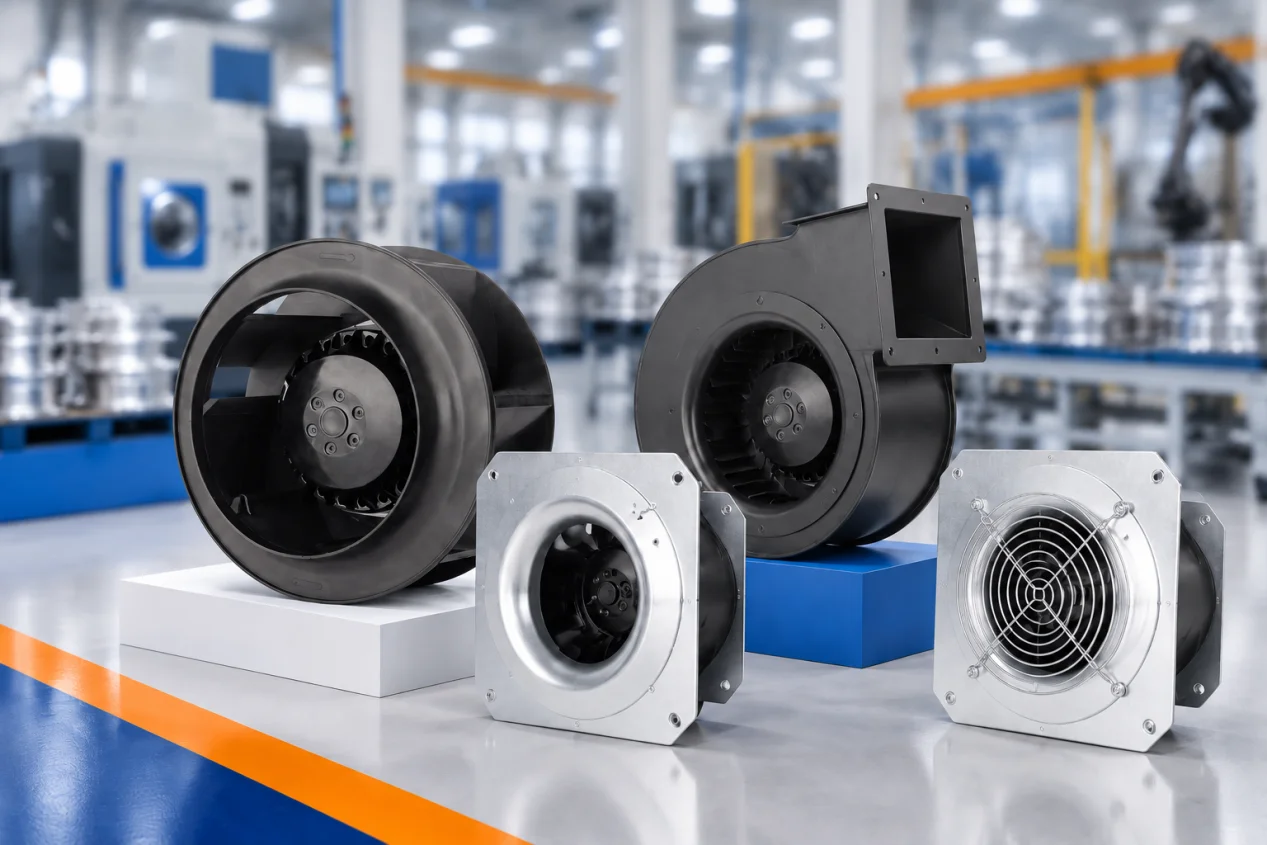
Our engineers began by comparing drawings for the 230V source and the 115V target. Both come from the LWBE-225 series with a 225mm impeller. However, the motor stacks differ between 115V and 230V. Consequently the housing and mounting plate differ slightly too.
Why not a step-down transformer
Here the customer could have fitted a transformer inside their unit and kept the 115V fan. Nevertheless we dismissed that at once.
A transformer adds cost, weight, a failure point and real losses, all to avoid changing one part. In short, the only sensible route was a true 230V EC centrifugal fan inside the 115V envelope.
The hybrid build
So we married the motor and electronics from the 230V model to the stamped housing and mounting plate from the 115V one. The modular LWBE platform is what makes that possible.
Afterwards a new bill of materials and assembly drawing followed. That is what turns a clever idea into something a production line builds the same way every time.
Capping the speed in firmware
Meanwhile the 3000 RPM requirement had two possible answers. Either rewind the motor, or change the software.
Rewinding is slow and costly. Instead we adjusted parameters in the onboard SmartEC controller, rescaling the 0-10VDC input so a 10V signal now means 3000 RPM rather than 3600 RPM.
That is a firmware flash with no hardware cost, and it hits the target precisely. Consequently the finished fan runs on 230V, yet it is the same shape as the 115V one.
Technical Specifications
Note the voltage row carries two entries. The platform is 115V, the shipped EC centrifugal fan is 230V, and every mechanical dimension is shared.
| Parameter | Value |
|---|---|
| Nominal Voltage | 115 VAC (Target Platform) / 230 VAC (Delivered) |
| Voltage Range | 176-264 VAC |
| Frequency | 50/60 Hz |
| Max Speed | 3000 RPM |
| Max Current | 2.9 A |
| Max Power Input | 200 W |
| Max Airflow | 1463 m³/h / 861 CFM |
| Max Static Pressure | 824 Pa |
| Noise Level (LpA) | 71 dB(A) |
| Ambient Temperature Range | -25°C to +60°C |
| Insulation Class | Class B |
| Protection Type | IP55 |
| Impeller Material | Metal |
| Weight | APPROX 2.8 kg |
| Control Input | 0-10VDC / PWM |
| Life Expectancy (L10) | 40,000 Hours @ 40°C |
Technical Documentation
The following documents were generated or referenced during the project, forming the complete technical package for the customer and for internal archiving.
LWBE3G225-092NU-17 S1 Spec Sheet: This document details the target mechanical structure and performance baseline the customer required for the new custom model.
LWBE3G225-072NS-24-00 Spec Sheet: This specification for a related 230V model was used as an internal engineering reference for motor performance curves.
LWBE3G225-072NS-07-00 Spec Sheet: Another 230V variant specification consulted during the technical assessment phase.
 The final approved mechanical drawing for the custom fan, issued to the customer’s engineering team for integration into their CAD models.
Customer Requirement Brief: The original input from the sales department containing the customer’s request and references to past orders.
Rework Order Analysis: Internal engineering notes analyzing the speed and performance requirements from the referenced rework order.
Why the adaptation happened here
In the end, four things made this adaptation quick.
- A modular platform. Building the same shape of fan with different electrics, and skipping a full NPI cycle, let the OEM keep its chassis and its line. The saving on retooling dwarfs the price of the fan.
- Tuning at the drive, not the winding. A 3000 RPM cap on this EC centrifugal fan became a firmware change on a standard controller. Consequently OEMs get precise control over the acoustic and energy profile of their system without any hardware change.
- One part number for the sheet metal. Since the substitute EC centrifugal fan is physically perfect, the customer keeps one part number for brackets, sheet metal and harnesses across every market. That cuts a lot of work out of buying and stock control.
- One team, three disciplines. Our mechanical, electrical and code people sit in one team. Nobody had to coordinate with an outside motor supplier or a software contractor. Consequently the whole solution turned around in weeks.
Browse our EC fan range, or the backward-curved centrifugal fan series. Protection ratings are defined in IEC 60529.
Questions about custom adaptations
Can you customize speed curves or mounting patterns?
Yes, and this project is a direct example. We set custom speed curves in firmware on the SmartEC platform, often with no hardware cost. Custom mounting patterns are common too, handled inside our standard 90-day NPI process with new drawings and prototype validation. Simple adaptations finish faster still.
What is the lead time for a small custom batch?
A light job reusing existing parts runs three to four weeks, from locked spec to prototype shipment. After approval, mass production for custom models takes 30 to 45 days, well inside the timelines imported European brands quote for new products.
Can we get a higher IP rating than IP55?
Yes. Every standard LWBE series EC centrifugal fan is certified to IP55. Higher ratings like IP67 or IP68 come as a custom job, usually with potted motor electronics and sealed connectors. That work runs through our 90-day NPI cycle, and we do it for wash-down and high-humidity applications.
Why cap the speed instead of just running it slower on site?
Because a site setting can be changed, forgotten or set wrongly. Meanwhile a range that acts differently in each market is costly to support. Capping it in firmware makes the behavior a property of the part number. That is what keeps the noise and energy figures honest on every unit shipped.
Technical Documentation & Resources
Got a duty point you need matched?
Tell us the airflow, the pressure and the space you have. Then we mark your duty point on a tested curve and send the drawing back. Meanwhile samples and custom spec sheets take up to 90 days. Since 1990 we have supplied OEMs across HVAC, refrigeration and industry.
Browse Related Products:
🏆 ISO 9001 / ISO 14001 / ISO 45001 | CE (TÜV) | UL/ETL | ATEX Zone 21/22 | AMCA 210/211 / ISO 5801 tested
Choose the right centrifugal fan
Longwell manufactures 1,130 centrifugal fans in-house. Send airflow, static pressure and voltage — an engineer replies with a matching model, performance curve and price within one working day.