What the enclosure maker needed
An OEM building compact climate control for telecom and modular electronics enclosures needed a heat exchanger cooling fan.
The binding constraint was length: 253mm overall, at most 100mm high and 112mm deep. Notably their enclosure was already designed.
The requirement behind the requirement
They asked for at least 214 m3/h. However, the phrasing mattered more than the number. They wanted stable, linear airflow across the full width of a heat exchanger, to keep cooling even and prevent hot spots.
That is a different requirement from moving 214 m3/h. Plenty of fans deliver the volume. By contrast, far fewer deliver it evenly across a rectangle.
- First, a 24V DC bus, standard in telecom equipment.
- Next, variable speed over a 0-10V analog input, for acoustics and energy.
- Meanwhile an ambient range of -25C to +60C, covering cold starts and enclosed thermal load.
- Finally, CE and RoHS support for European sale, aligned with EN 60335.
Matching the heat exchanger cooling fan to the surface
Here the customer had pre-selected a model, so our job was checking it against the constraints. However, the fan type was the interesting part.
Why the airstream shape decides this
A heat exchanger presents a flat rectangular face. So a heat exchanger cooling fan has to cover that whole face with roughly equal airflow.
An axial fan produces a cone, so the center gets more air than the corners. Meanwhile a centrifugal blower discharges from a point, which is worse still unless you add a plenum to spread it.
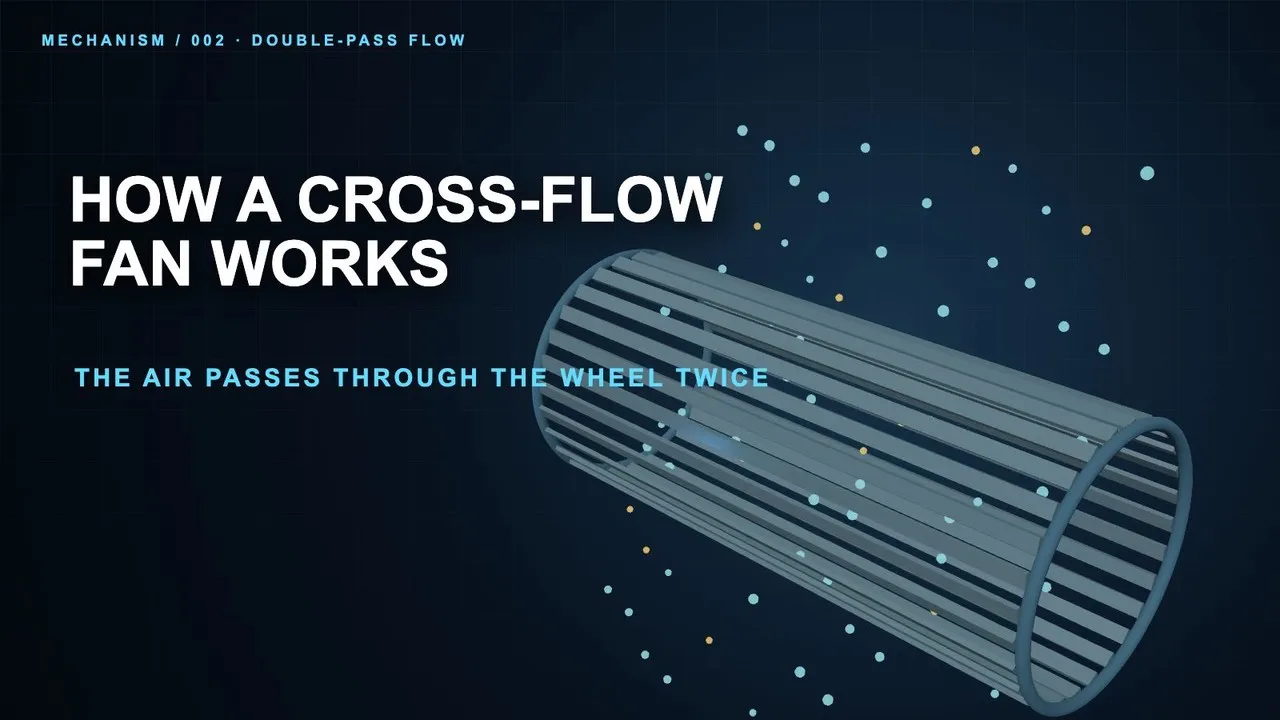
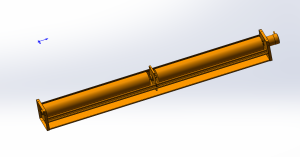
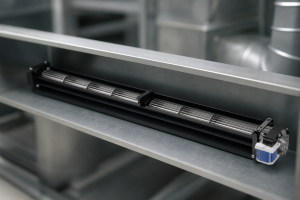
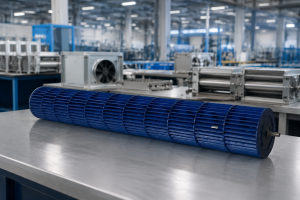
A cross-flow impeller draws air along its entire length and discharges along the same length. Consequently the airstream is already the shape of the exchanger face, with no plenum, no ducting and no wasted depth.
Why brushless DC
Their system runs on 24V DC. An AC motor would need an inverter inside the enclosure, adding cost, a failure point and its own heat into a space that is already being cooled.
The three-phase brushless DC motor connects directly. Furthermore the 0-10V control input is built in, so their control board drives it without an intermediate module.
Aluminum for both impeller and housing
Notably this choice does three things at once.
Aluminum keeps rotational inertia low, so the fan responds quickly when the controller changes speed. Furthermore it is rigid enough to hold shape over a 184mm impeller. Meanwhile it conducts heat away from the motor, which matters at the +60C end.
What it cost
Pressure, as always with cross-flow. Specifically, at 41 Pa this heat exchanger cooling fan pushes air across a face and no further.
Add a filter or any ducting and the airflow collapses. So the enclosure design has to keep the air path short and open, which is a constraint on the whole product rather than just the fan.
Technical Specifications
Note the impeller length against the housing width below. That ratio is what covers the exchanger face.
| Parameter | Value |
|---|---|
| Model Number | LWCD-65180MN-07 |
| Voltage | 24 VDC |
| Current | 0.6 A |
| Air Volume | 214 m³/h (~126 CFM) |
| Static Pressure | 41 Pa |
| Speed | 1800 RPM |
| Motor Type | 3-Phase Brushless DC |
| Speed Control | 0-10V Analog |
| Bearings | Dual Ball Bearing |
| Housing Dimensions (A x H x D) | 253 mm x 100 mm x 112 mm |
| Impeller Length (B) | 184 mm |
| Impeller Diameter | Ø 65 mm |
| Housing Material | Aluminum Alloy |
| Impeller Material | Aluminum Alloy |
| Insulation Class | Class B |
| Operating Temperature | -25°C to +60°C |
| Acoustic Noise | 47 dB(A) |
Technical Documentation
Meanwhile the technical drawing provides all mechanical dimensions, mounting hole locations, material specifications, and electrical parameters for the LWCD-65180MN-07. It is essential for mechanical engineers and system integrators performing fit checks and CAD modeling.
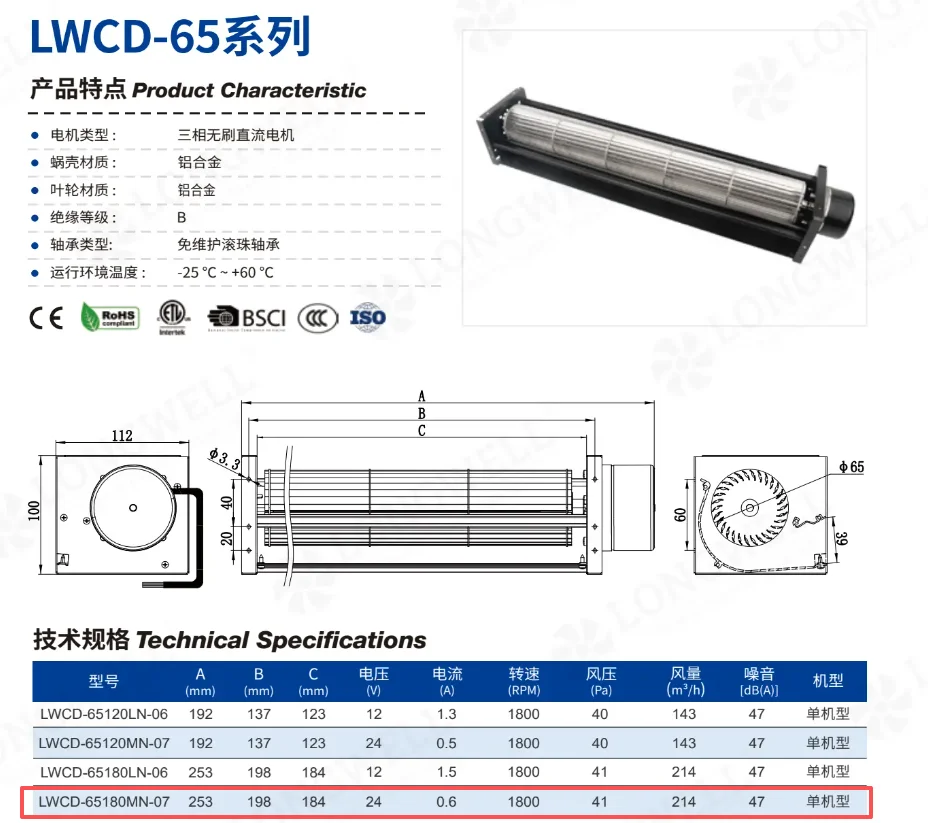
The datasheet and performance curve summary is a critical document for HVAC and electrical engineers to confirm the fan meets system airflow, pressure, and power requirements. It also details compliance marks such as CE and RoHS.
Download the LWCD-65180MN-07 document
If you are cooling a flat exchanger face
Choosing a heat exchanger cooling fan is a geometry problem before it is an airflow problem.
- Match the airstream shape to the surface. A rectangular exchanger wants a rectangular airstream. Using an axial fan and hoping the air spreads leaves cold corners and a hot center, which shows up as one cell or one component running warmer than the rest.
- Size the impeller length to the face width, not the housing. The active length is what covers the exchanger. A fan that fits the space but is shorter than the face will leave an unswept strip.
- Keep the air path short. Cross-flow fans work at tens of pascals. Any filter, grille with low free area, or bend will consume that budget quickly. Decide whether filtration is needed before choosing this fan type.
- Use the speed control for thermal stability, not just noise. Varying airflow with measured temperature keeps components at a steadier temperature than switching a fan on and off, and thermal cycling is what ages electronics.
See our cross flow fan range, the DC cross flow fan section, or DC cooling fans. Appliance safety follows IEC 60335-1.
Questions about this fan
Why not use an axial fan and a diffuser?
You can, and it costs depth. A diffuser needs distance behind it to spread the cone. However, that distance is exactly what a shallow enclosure lacks. By contrast a cross-flow heat exchanger cooling fan produces the wide airstream directly, which is why it suits a 112mm housing.
What happens if the impeller is shorter than the exchanger?
Here the uncovered strip gets little airflow and runs hotter than the rest. In a battery or electronics enclosure that becomes the limiting component, so the whole system derates to protect it. Match the active impeller length to the face you need to cool.
Can this fan pull air through a dust filter?
Not really. Maximum static pressure is 41 Pa, and most filters consume more than that alone. If your enclosure needs filtration, choose a centrifugal fan sized for the filter pressure drop from the start rather than discovering the limit in testing.
Why does low rotational inertia matter?
Because it decides how quickly the fan can change speed. A light aluminum impeller reaches a new speed in a fraction of a second when the controller adjusts, so airflow tracks temperature closely. A heavy rotor lags, which makes closed-loop thermal control sluggish and prone to overshoot.
Technical Documentation & Resources
Need the same thing for your own unit?
Give us the numbers and the envelope, and you get a shortlist rather than a catalog. Meanwhile custom spec sheets and samples run to 90 days. Since 1990 Longwell has supplied EC fans and blowers to OEMs in HVAC, cold chain, data center and industrial markets.
Browse Related Products:
🏆 ISO 9001 / ISO 14001 / ISO 45001 | CE (TÜV) | UL/ETL | ATEX Zone 21/22 | AMCA 210/211 / ISO 5801 tested