Space Limits for a Convection Heater
A customer needed a compact cross flow fan. Meanwhile, they built a thin commercial convection heater. Therefore, space became the biggest project limit. Therefore, the metal chassis left an opening measuring exactly 50 by 53.3 millimeters.
Any cooling fan had to slip into this exact gap. In practice, it also needed to push air flatly and evenly across the wide heating coils. Next, the electrical power source posed another strict limit. Meanwhile, the heater supplied 230V AC at 50 Hz.
We could not fit an internal DC power supply into the machine. Therefore, furthermore, the system runs all day in very hot spaces. The ambient heat reaches +60°C. In practice, the heater also works in tough winter places.
The lowest air temperature drops to -25°C. As a result, this wide heat range forces specific metal choices. The total fan length could not pass 158 millimeters. Every part had to justify its size.
Noise created another hard boundary. Commercial spaces demand quiet rooms. The buyer capped the sound output at 25 dB(A). Meanwhile, strict safety rules apply here.
The system needed a 95°C thermal protector built right into the compact cross flow fan windings. Finally, the target airflow sat at 23 cubic meters per hour. The static pressure target was 8 Pa. So, the compact cross flow fan team mapped out the best options to hit these hard numbers exactly.
Engineering the Compact Cross Flow Fan
First, we looked at different fan types. Standard axial fans seemed like a fast fix. However, we rejected axial fans quickly. They push air in a circle.
This shape leaves dead spots on flat heat sinks. Instead, the heater needed a wide and even breeze. A compact cross flow fan does exactly this.
Choosing the Motor
Next, we reviewed motor options. An EC motor offers great power savings. By contrast, an EC motor holds bulky control parts. These parts would not fit inside the 50-millimeter height limit.
Therefore, we picked a basic 4812 shaded-pole AC motor. This choice takes more power. It uses 8 Watts to run. Even so, the motor connects straight to the 230V mains.
The unit fits the tiny space perfectly. We also achieved a materially lower cost.
Fixing the Noise
We then turned to the noise limit. The sound could not pass 25 dB(A). We picked a 30-millimeter impeller to keep it quiet. The team made this part from light aluminum alloy.
Furthermore, they gave it 20 blades. Five metal disks support these blades. Consequently, the fan hits 2400 RPM without shaking. This smooth spin hits the 8 Pa pressure goal easily.
Dealing with High Heat
Finally, the +60°C heat forced a bearing change. Standard sleeve bearings dry out fast in hot air. We rejected them to stop early breakdowns. Instead, we used steel ball bearings.
This switch raised the unit cost. However, it gives true continuous S1 operation. We also wired a 95°C thermal switch inside the motor. In short, the LWCA-3090SN-07 trades a little electrical efficiency for a perfect fit and high safety.
Technical Specifications
| Parameter | Value |
|---|---|
| Airflow | 23 m³/h |
| Static Pressure | 8 Pa |
| Input Power | 8 W |
| Speed | 2400 RPM |
| Voltage | 230 V AC |
| Frequency | 50 Hz |
| Dimensions (L x W x H) | 158 x 53.3 x 50 mm |
| Impeller Diameter | 30 mm |
| Noise Level | 25 dB(A) |
| Housing Material | Galvanized Sheet Steel |
| Blade Material | Aluminum Alloy |
| Bearing Type | Ball bearing |
| Insulation Class | B/F/H |
| Operating Temperature | -25 °C to +60 °C |
| Certifications | CE, RoHS, ETL, BSCI, CCC, UL, ISO |
These numbers show the final engineering choices. First, the 158-millimeter length fits the tight heater box perfectly. The 30-millimeter impeller hits the exact 23 cubic meters per hour target. Furthermore, the 2400 RPM speed keeps the aerodynamic noise under 25 dB(A). The steel ball bearings handle the wide -25 °C to +60 °C range safely. Next, the 8 W input power reflects the shaded-pole AC motor choice. We test these airflow limits to AMCA 210-16 methods. This testing ensures the fan performs exactly as the chart claims in the real world.
Reference: AMCA 210 covers the test method behind these figures.
Technical Documentation
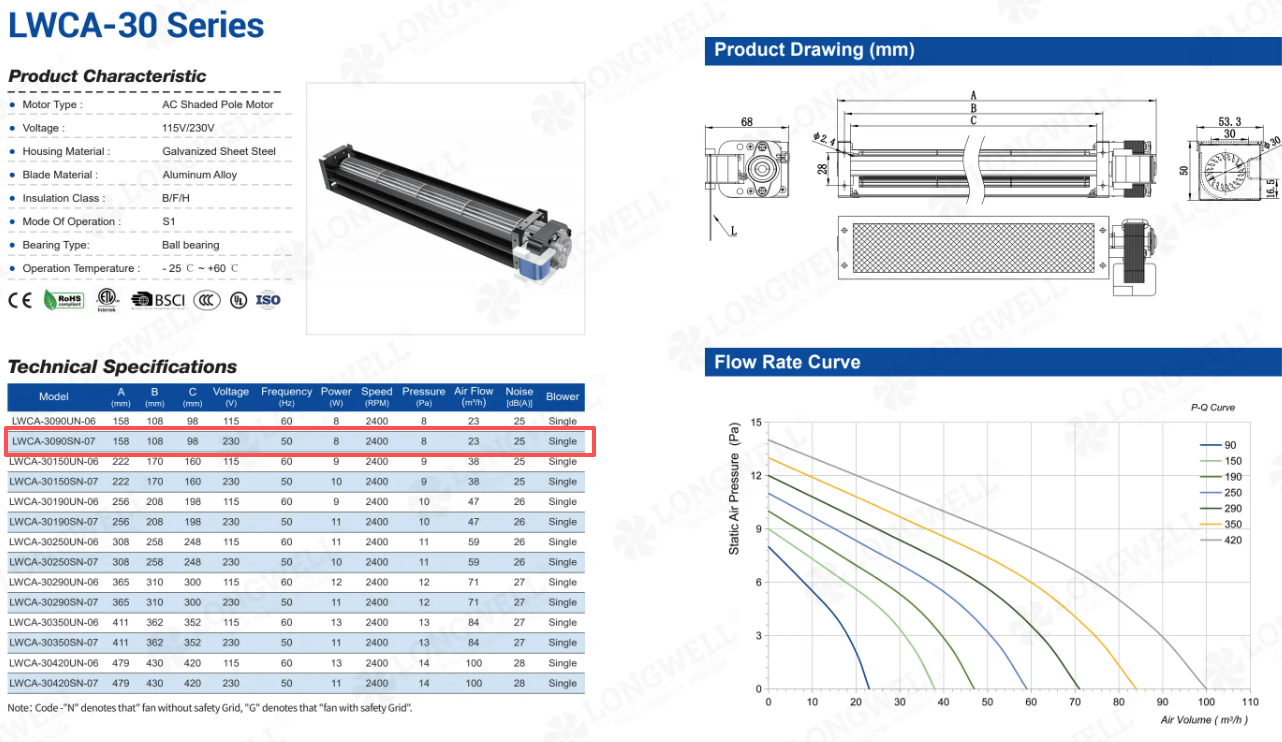
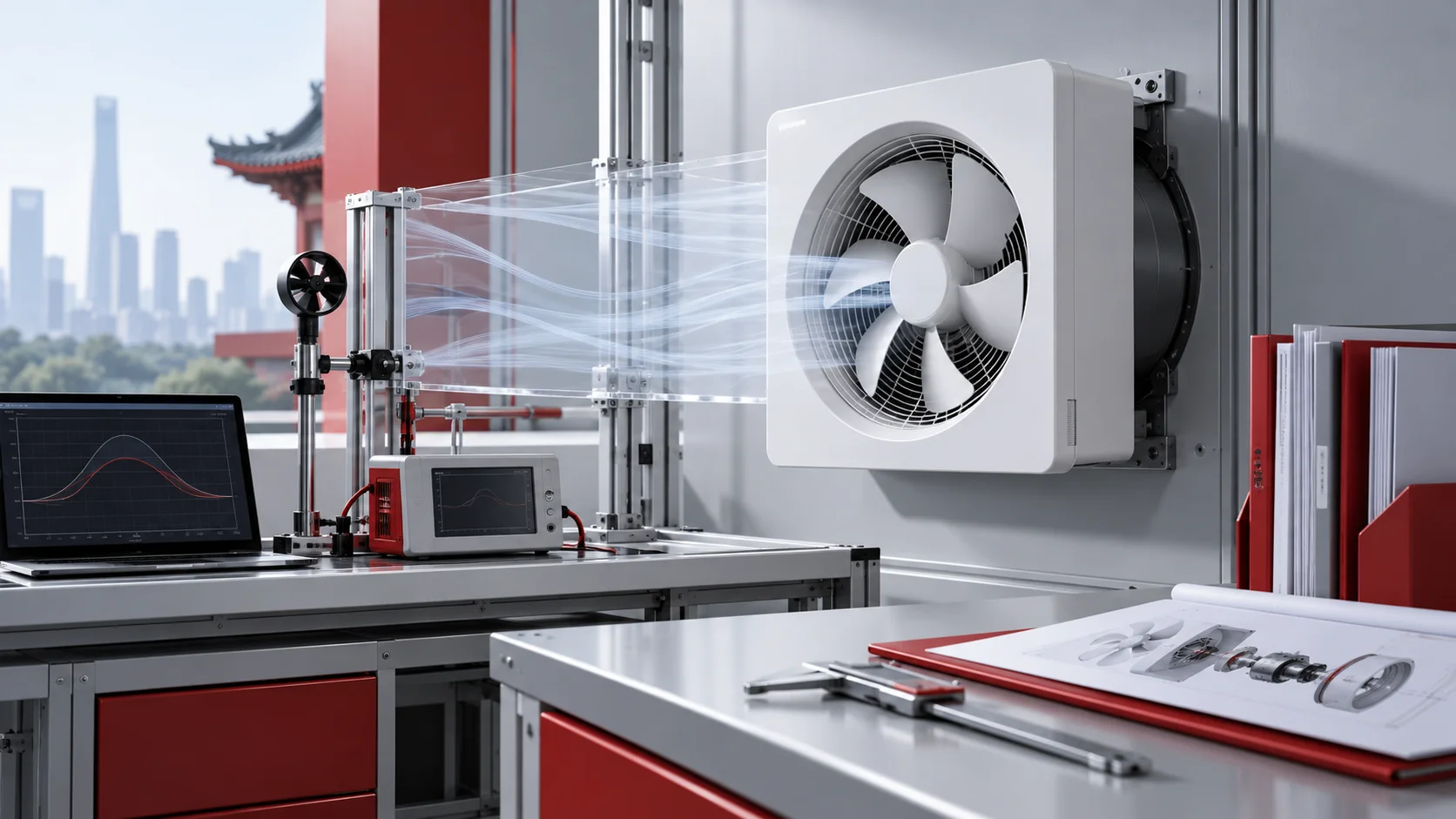
This specification sheet charts the strict electrical limits and the airflow curves. Engineers use it to match the fan to their available power budget. Furthermore, it details the test conditions for the performance data.
Download Technical Drawing LWCA-3090SN-09-00
This technical drawing maps the exact housing size and the screw hole spots. Builders need it to check their physical clearances before final assembly. It also lists the metal types used for the frame.
How to Specify a Compact Cross Flow Fan
Picking a compact cross flow fan for a small space takes care. You must find your hardest limit first.
- Check your real height limit: The motor is the tallest part. If you have less than 55 millimeters, a simple AC motor fits best. An EC motor usually needs more room for its drive board.
- Pick your voltage source: Running AC mains directly to the fan saves money. However, you must add safety parts. You will need thermal protectors in the motor to pass fire tests.
- Find the real air temperature: Heat kills cheap bearings fast. If the air tops 40°C, you must specify ball bearings. They stop early field failures.
- Ask for exact wire lengths: Our technical drawings show a strict 500-millimeter wire. This stops factory workers from cutting and joining wires by hand.
Finally, list your hard limits clearly. Send the exact box size and voltage to your supplier. Related: Cross Flow Fans.
Common Engineering Questions
Technical Documentation & Resources
Browse our blowers range, the exhaust blowers section, or centrifugal blowers.
Have a Similar Fan Requirement?
Longwell’s engineering team delivers custom spec sheets and samples within 90 days. Since 1990, we have supplied EC fans and blowers to OEMs across HVAC, cold chain, data center, and industrial applications worldwide.
Browse Related Products:
🏆 ISO 9001 / ISO 14001 / ISO 45001 | CE (TÜV) | UL/ETL | ATEX Zone 21/22 | AMCA 210-16 / ISO 5801 tested
Choose the right cross flow fan
Longwell manufactures 495 cross flow fans in-house. Send airflow, static pressure and voltage — an engineer replies with a matching model, performance curve and price within one working day.