Why the Customer Needed a Class F EC Centrifugal Fan
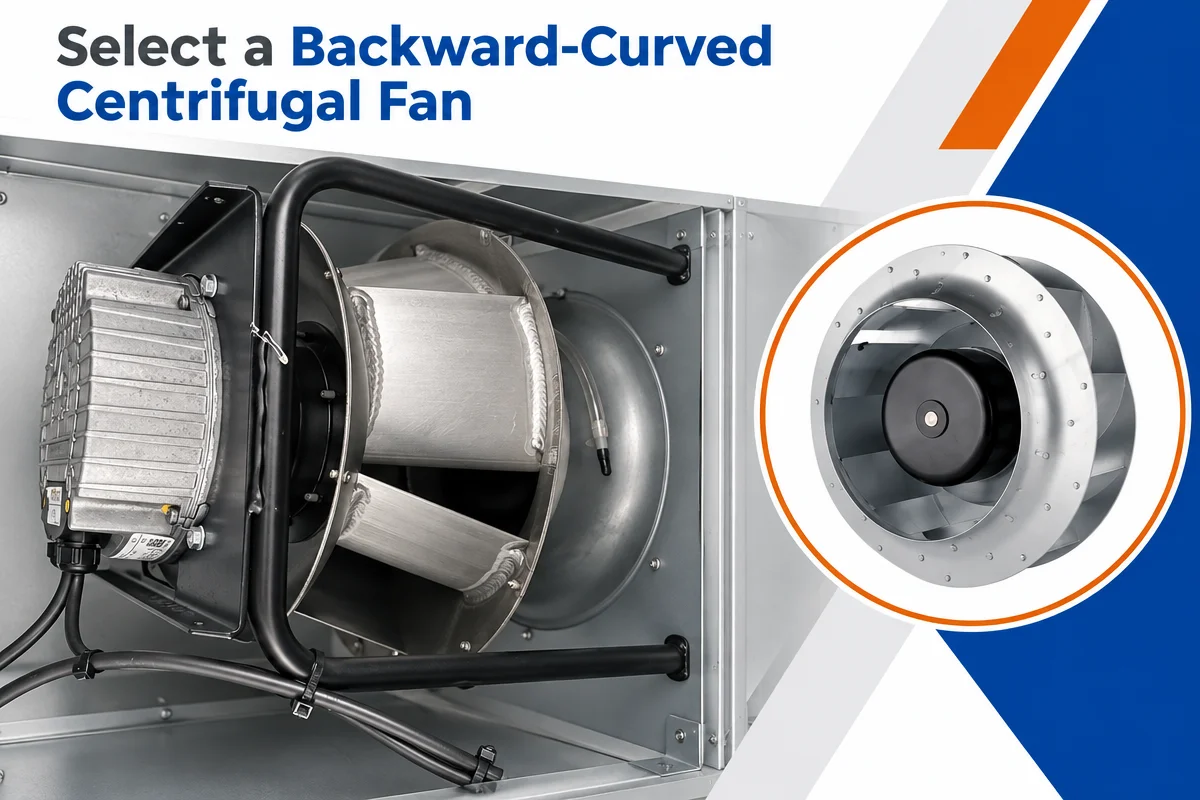
The customer asked us to upgrade a compact air handling unit. They had a working design, but not a Class F EC centrifugal fan. It used a 225mm impeller. However, the existing motor got too hot during peak loads.
Therefore, they needed a Class F EC centrifugal fan. This upgrade would create a safe margin for internal motor heat. First, the voltage rail gives 230 VAC. It operates between 176 and 264 VAC.
Next, the space is very tight. It limits the Class F EC centrifugal fan to a 225mm width and a 99mm depth. Furthermore, the system needs 1313 m³/h (772 CFM) of airflow. It must push this air against 1030 Pa of static pressure.
Meanwhile, the equipment sits outdoors. Consequently, the fan must survive a cold start at -25 °C. It must also handle peak summer heat at 60 °C. By contrast, the hardest rule was the insulation rating.
The old motors used Class B materials. Class B parts handle heat up to 130 °C. Instead, the customer needed Class F. This pushes the safe limit to 155 °C.
Finally, their market requires UL 507 and EN 60335-1 safety standards. We test all aerodynamic performance to AMCA 210-16 methods. This testing proves the Class F EC centrifugal fan can truly reach 1030 Pa.
Designing the Insulation Upgrade
We looked at two main ways to solve the heat problem. First, we thought about making the motor housing larger. A larger housing sheds heat faster. Instead, we rejected this idea.
A larger motor pushed the depth past the strict 99.0 mm limit. Consequently, the customer would have to rebuild their metal chassis. Second, we tried lowering the motor speed. Lower speeds make less internal heat.
Even so, we rejected this option too. Dropping the speed below 3100 RPM ruined the air pressure. The fan could no longer hit the 1030 Pa target. Therefore, we changed the motor materials instead of the size.
We upgraded the copper wire coating. We also changed the slot liners and the varnish. These new parts meet strict Class F rules. As a result, the motor safely handles internal heat up to 155 °C.
This choice came with a clear cost. The special resins cost more money. Furthermore, the custom winding steps added days to our normal lead time.
Control System for the Upgraded Fan
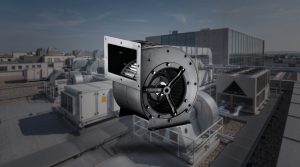
Despite the new materials, we kept the SmartEC control design for the Class F EC centrifugal fan. The final fan is model LWBE3G225-072NS-23-00. It easily reads standard 0-10VDC or PWM control signals. It reaches 3100 RPM and 1030 Pa.
At this peak, it draws exactly 170 W and 1.26 A. Furthermore, we added electrical safety limits to protect the new wires. The motor uses a soft start delay. It takes just under 15 seconds to reach full speed.
Consequently, this stops large current spikes from heating the motor during startup. We also built in locked-rotor protection. Therefore, if the plastic blades jam, the motor cuts the power. It shuts down long before the wires reach 155 °C.
Next, we built the impeller from PA6+GF30% glass-reinforced plastic. Consequently, the whole unit weighs only 2.2 kg. Even so, the deep groove bearings promise a 40,000-hour life at 40 °C. Finally, the design limits noise to 70 dB(A). It also offers IP55 protection against dust and water.
Technical Specifications
| Nominal Voltage | 230 VAC (Range: 176~264 VAC) |
| Frequency | 50/60 Hz |
| Speed | 3100 RPM |
| Current | 1.26 A |
| Power Input | 170 W |
| Air Flow (Max) | 1313 m³/h (772 CFM) |
| Static Pressure (Max) | 1030 Pa |
| Noise Level (LpA) | 70 dB(A) |
| Ambient Temperature | -25 °C to 60 °C |
| Insulation Class | Class F |
| Protection Type | IP55 |
| Weight | 2.2 Kg |
| Certifications | CE, ETL (UL 507, CSA C22.2#113) |
The insulation class dictates the safe heat limit under heavy load. Meanwhile, the wide 176-264 VAC voltage range helps the fan. It maintains 3100 RPM even when grid power drops. The input power row shows a strict 170 W limit. By contrast, the high 1030 Pa static pressure means the fan works hard. It pushes air through thick filters. Therefore, the 1.26 A current must stay very steady. Finally, the IP55 rating proves the motor stops dust and low-pressure water.
Reference: AMCA 210 covers the test method behind these figures.
Technical Documentation
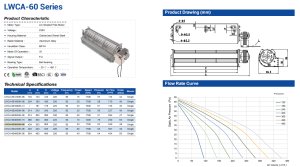
Download the full technical specification and performance curves (PDF).
This file shows the physical sizes and electrical wires for your assembly team.

Meanwhile, this drawing confirms the exact fan layout for incoming quality checks.
How to Specify a Class F EC Centrifugal Fan
If you need a fan for a hot space, follow these practical steps.
- First, measure the real air temperature right next to the motor. Do not just measure the room outside the metal box.
- Second, check your strict power limits. Fans pushing past 1000 Pa draw more current. This extra current quickly heats up the motor wires.
- Next, do not forget the cold limit. High-heat plastics can snap in freezing weather. So, state your lowest startup temperature clearly.
- Finally, send your exact voltage range and insulation class with your first request. Because we build the impellers and motors here, knowing these limits early saves time.
Related: Centrifugal Fans.
Common Engineering Questions
Browse our centrifugal fans range, the backward-curved fans section, or forward-curved fans.
Have a Similar Fan Requirement?
Longwell’s engineering team delivers custom spec sheets and samples within 90 days. Since 1990, we have supplied EC fans and blowers to OEMs across HVAC, cold chain, data center, and industrial applications worldwide.
Browse Related Products:
🏆 ISO 9001 / ISO 14001 / ISO 45001 | CE (TÜV) | UL/ETL | ATEX Zone 21/22 | AMCA 210-16 / ISO 5801 tested
Choose the right centrifugal fan
Longwell manufactures 1,130 centrifugal fans in-house. Send airflow, static pressure and voltage — an engineer replies with a matching model, performance curve and price within one working day.