What the OEM asked for
An HVAC OEM had already chosen an 820mm AC cross-flow fan for an air curtain. They wanted two things added: a fan guard grille and a specific terminal block.
The guard goes over the intake. Meanwhile the terminal block had to sit with no exposed terminals anywhere on the assembly.
Why both requests are safety requirements
An air curtain hangs above a doorway with its intake facing outward. That intake is reachable, so a fan guard grille is not optional once the product goes near the public.
Meanwhile exposed mains terminals on a unit mounted at head height fail inspection for the same underlying reason. Both requests come from the same place: somebody can touch this.
Their system runs on simple on-off 230V power, so nothing about the electrical side needed to change.
Designing the fan guard grille
We logged this as light development. The fan was already correct, and the work was mechanical.
The EC question, answered quickly
An EC motor with 0-10V or PWM control was considered and dropped.
Their system is on-off. Adding EC would mean control wiring they do not have and a higher unit cost the application cannot justify. So the AC variant stayed.
The real trade in a guard
A fan guard grille is where the genuine engineering sits.
It has two jobs that oppose each other. Denser mesh stops a finger more reliably. However, denser mesh blocks more air, and every square millimetre of wire is airflow the fan works around.
Here the design was worked to pass the finger probe while adding as little static pressure as the geometry allows. Wire diameter, spacing and the pattern all move that balance, and the answer is not simply the finest mesh that fits.
The result is a steel wire fan guard grille that meets the safety requirement while the fan keeps its rated performance, verified against AMCA 210/211 and ISO 5801 methods.
Solving the terminal cover by removing a part
Meanwhile the terminal block needed mounting, and the customer wanted nothing exposed.
The obvious answer is a separate plastic cover. Instead the side plate was redesigned with a formed metal shroud built into it.
Consequently the protection is part of a panel that already existed. That removes a component from the bill of materials, a step from assembly, and a part that can be left off or lost in service.
What it cost
Some airflow, unavoidably. Any fan guard grille costs pressure. Honestly, this one costs the least the geometry allows rather than nothing at all.
A new side plate also means new tooling for that panel, which is a real cost. It was worth it here because the alternative added a part to every unit forever.
Technical Specifications
Here the specification below is the modified build, with the guard and terminal block fitted.
| Parameter | Value | Unit |
|---|---|---|
| Longwell Model Number | LWCA-100820SG-06-37 | – |
| Nominal Voltage | 220 / 230 | VAC |
| Frequency | 50 | Hz |
| Speed | 1400 ±10% | RPM |
| Input Power | 110 | W |
| Airflow | 1700 ±10% | m³/h |
| Airflow | ~999 (calculated) | CFM |
| Noise Level | 61 | dB(A) |
| Operating Temperature Range | -30 to +60 | °C |
| Overall Length | 928 ±2 | mm |
| Housing Height / Width | 142 ±1 | mm |
| Impeller Material | Aluminum | – |
| Frame Material | Cold-rolled sheet (Iron) | – |
| Bearings | Ball Bearing | – |
| Life Expectancy (L10) | 30,000 | Hours |
| Certification | CE | – |
Technical Documentation
The following documents were generated as the final deliverables for this project, approved by engineering and confirmed by the sales team for production.
LWCA-100820SN-06 Technical Specification.pdf
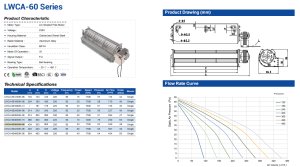
Meanwhile the document details the performance and specifications of the original base model used for the customization. It is useful for procurement managers comparing the modification against a standard catalog item.
LWCA-100820SG-06-37 Final Assembly Drawing.pdf
This is the final, approved mechanical drawing for the new custom part number. It provides exact dimensions, component callouts, and assembly details for system integrators and quality control engineers.
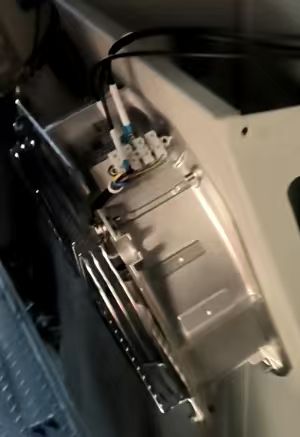
Here the image shows an assembled sample of the custom fan, highlighting the mounting of the terminal block on the modified side plate before shipment.
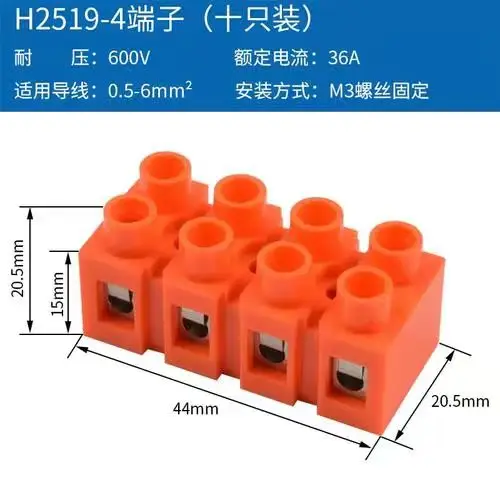
This image shows the specific H2519-4 style, 600V 36A terminal block requested by the customer for electrical connection.
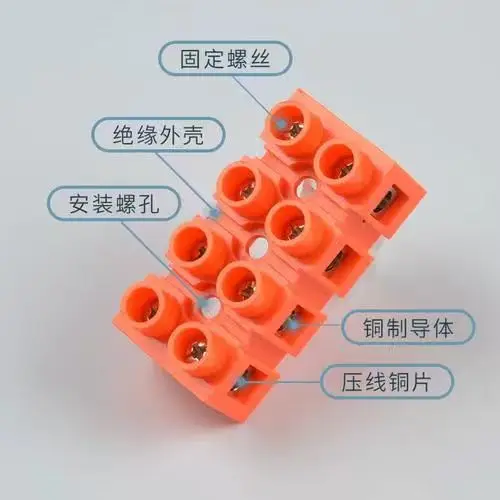
Above, the document is a visual reference for the components of the specified terminal block, used by the assembly team.
If you are adding a guard to a fan
Adding a fan guard grille late in a design is common. So these keep it from costing more than it should.
- Ask for the guard at the same time as the fan. A fan selected without one and then fitted with a guard loses pressure you already budgeted. Selecting with the guard in place gets you the real curve from the start.
- Do not specify mesh density directly. State the safety standard you must meet and let the supplier find the most open geometry that passes it. Asking for fine mesh usually buys more airflow loss than protection.
- Look for protection built into existing panels. A shroud formed into a side plate beats a separate cover on cost, assembly time and the chance of it being missing later.
- Check the guard is on the right face. Intake and discharge present different hazards and different airflow penalties. Guarding the wrong side costs performance without removing the risk.
See our cross flow fan range, the fan accessories section, or AC cross flow fans. Appliance safety follows IEC 60335-1.
Questions about guards and terminals
How much airflow does a guard cost?
It depends entirely on the geometry, which is why a fan guard grille is worth designing rather than accepting. Wire diameter, spacing and pattern all matter, and a good one costs a fraction of what a generic fine mesh does. So ask for the fan curve with the guard fitted rather than without.
What does the finger probe test actually check?
Whether a standardized jointed test finger can reach a hazardous part through any opening. It is a dimensional test rather than a strength test, so the mesh has to control opening size in every direction, including at the edges where guards are often weakest.
Why build the terminal cover into the side plate?
Because it removes a part. A separate cover has to be made, stocked, fitted and not lost during service. A shroud formed into a panel that already exists does the same job with no additional component, and it cannot be left off.
Can a guard be retrofitted to a fan already in service?
Mechanically often yes, though the performance changes. The fan will deliver less air against the same system, so check whether your duty point still sits in an acceptable place. Retrofitting a guard without rechecking the airflow is how a compliant product becomes an underperforming one.
Technical Documentation & Resources
Have a fan requirement like this one?
Send the datasheet you are working against, or simply the duty point. Then our engineers tell you what fits and what does not. Meanwhile custom spec sheets and samples take up to 90 days. Since 1990 we have been building fans for OEMs worldwide.
Browse Related Products:
🏆 ISO 9001 / ISO 14001 / ISO 45001 | CE (TÜV) | UL/ETL | ATEX Zone 21/22 | AMCA 210/211 / ISO 5801 tested