Specifying a Cross Flow Fan Replacement
A manufacturer in the new energy sector needed a cross flow fan replacement. First, they sent us their old ZFB-1042H specification sheet. The old unit failed to meet their production needs. Therefore, we had to engineer a new part for 1,500 machines.
Next, we reviewed the hard limits of their system. The available space was exactly 543 mm by 153 mm by 130 mm. So, the new blower had to fit this exact footprint. Also, the legacy part delivered 900 m3/h of airflow.
Thus, our new model had to match this high volume. However, achieving 900 m3/h from a 90 mm diameter rotor is difficult. Specifically, the impeller must spin at 2,600 RPM. Standard fans of this size run at only 1,200 RPM.
Consequently, this high speed puts extreme stress on the plastic blades. Furthermore, the system runs on a strict 230V rail at 50 or 60 Hz. Meanwhile, the ambient temperature ranges from -20C to 60C. This means the parts sit outdoors in cold and hot weather.
Finally, the design strictly capped the noise at 62 dB. In short, we had to build a fast unit that fits a tight space safely. Additionally, we had to pass the GB/T13933-2008 safety test.
Engineering the High-Speed Solution
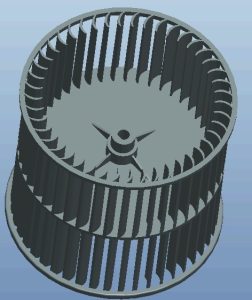
We looked at several ways to build this cross flow fan replacement. First, we thought about using an aluminum impeller. However, aluminum is very heavy. A heavy rotor needs a much bigger motor to reach 2,600 RPM.
Then, that bigger motor would break the strict 130 mm height limit. Therefore, we rejected the heavy metal impeller. Instead, we chose an ABS and PA66 plastic blend. This composite plastic keeps the weight very low.
Thus, a smaller 160W AC capacitor motor can drive it easily. Next, we focused on the housing strength. The old frame used thin painted steel. However, our new design uses SGCC galvanized steel.
Specifically, we used SGCC for the right side plate, the air outlet plate, and the air inlet plate. This material improves the frame stiffness a lot. Consequently, it handles the strong vibrations of a 2,600 RPM rotor safely. Also, we used an 8 mm steel shaft.
Standard fans use a standard 6 mm shaft. However, a 6 mm shaft bends under high speeds. So, the 8 mm shaft keeps the 450 mm long rotor perfectly straight.
The Cost of a High-Speed Cross Flow Fan Replacement
Every engineering choice has a clear price. First, the high 2,600 RPM speed was completely necessary. We had to move 900 m3/h of air inside a 545 mm total length. However, this high speed reduces the ball bearing life.
Specifically, the life expectancy drops to 15,000 hours. By contrast, a standard 1,200 RPM model lasts 30,000 hours. Furthermore, moving air this fast creates more noise. Thus, the fan produces a constant 62 dB of acoustic noise.
Therefore, the customer accepted a shorter lifespan and higher noise. They did this to meet their thermal goals. Ultimately, we finalized the LWCA-90450SN-08-00 model. This final unit fits the 545 mm footprint perfectly.
Finally, it mounts securely using a 480 mm hole span. In short, we solved the problem with careful trade-offs.
Electrical Integration and Wiring
Next, we had to match the electrical controls. The customer uses a basic AC power supply. Therefore, we selected a standard AC capacitor induction motor. This motor provides great starting torque.
Also, it draws exactly 0.80 A to 0.90 A of current. Consequently, it works perfectly with their control boards. We included a standard four-wire setup. Specifically, the drawing shows yellow, blue, black, and red wires.
So, the factory workers can install the new unit quickly. In short, the electrical match was just as vital as the physical size.
Technical Specifications
| Parameter | Value |
|---|---|
| Model Number | LWCA-90450SN-08-00 |
| Airflow | 860 / 900 m3/h |
| Speed | 2500 / 2600 RPM |
| Input Power | 160 W |
| Current | 0.80 / 0.90 A |
| Voltage | 230 V |
| Frequency | 50 / 60 Hz |
| Dimensions | 545 x 130 x 130 mm |
| Impeller Size | 90 x 450 mm |
| Mounting Span | 480 mm |
| Operating Temperature | -20C to 60C |
| Bearing Type | Ball Bearing |
| Weight | 4.0 kg |
| Design Life | 15,000 Hours |
| Certifications | GB/T13933-2008 |
The 160W power and 2,600 RPM speed are the most critical rows. Specifically, they prove the motor has enough torque to spin the 450 mm rotor fast enough. Also, the 130 mm dimension confirms it fits the tight space.
Reference: AMCA 210 covers the test method behind these figures.
Technical Documentation
LWCA-90450SN-08-00 Engineering Drawing
This PDF contains the exact 480 mm mounting dimensions needed by mechanical engineers.
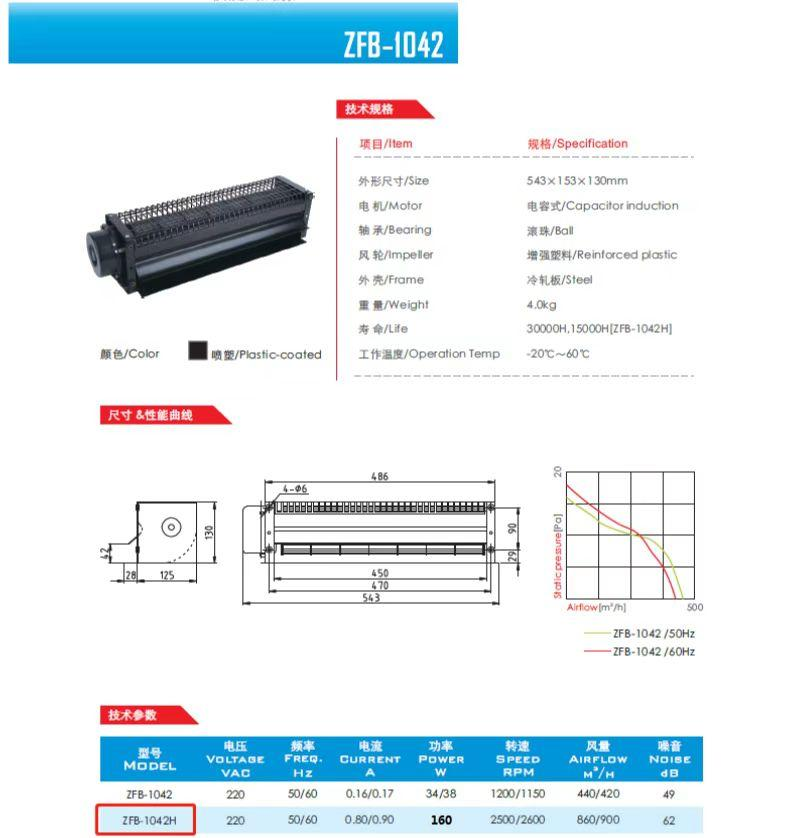
This image shows the original 160W power and 62 dB noise constraints we had to match.
How to Specify a Cross Flow Fan Replacement
When you need a similar cross flow fan replacement, check your limits first.
- First, measure your exact mounting span. These long rotors will rub the frame if the chassis bends even 1 mm.
- Next, accept the bearing life limits. Running a 90 mm rotor above 2,000 RPM cuts the ball bearing life from 30,000 hours down to 15,000 hours.
- Also, specify your internal shaft diameter. We use an 8 mm steel shaft because standard 6 mm shafts warp under heavy loads.
- Finally, confirm your site voltage. A motor built for 230V loses airflow quickly if your actual power drops to 210V.
Related: Cross Flow Fans.
Common Engineering Questions
Technical Documentation & Resources
Browse our cross-flow fans range, the AC cross-flow fans section, or cross-flow impellers.
Have a Similar Fan Requirement?
Longwell’s engineering team delivers custom spec sheets and samples within 90 days. Since 1990, we have supplied EC fans and blowers to OEMs across HVAC, cold chain, data center, and industrial applications worldwide.
Browse Related Products:
🏆 ISO 9001 / ISO 14001 / ISO 45001 | CE (TÜV) | UL/ETL | ATEX Zone 21/22 | AMCA 210-16 / ISO 5801 tested
Choose the right cross flow fan
Longwell manufactures 495 cross flow fans in-house. Send airflow, static pressure and voltage — an engineer replies with a matching model, performance curve and price within one working day.