A part number and a screenshot
An HVAC OEM asked us to cross-reference a panel fan on a commercial condenser unit. They sent a part number and a screenshot of its specification, and asked what we had that would drop in.
This is routine procurement work. After all, a second source protects a production line, so somebody is asked to find one.
What the screenshot gave us
In short, it gave us the numbers and not much else.
- First, 2,678 m3/h maximum airflow.
- Next, three-phase 220 VAC at 60 Hz, drawing no more than 180 W at 1550 RPM.
- Meanwhile a square mounting plate, 410 by 410mm, with 130mm total depth.
- Finally, IP54 and an ambient range of -30C to +60C, because the unit sits outdoors.
The part the screenshot did not settle
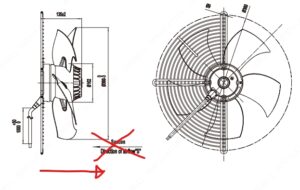
A screenshot fixes the electrical and aerodynamic data. It does not confirm the mounting hole pattern, the airflow direction, or the lead exit.
So the first thing we asked for was the panel drawing, not the fan curve. On a swap, geometry is where projects fail quietly.
Matching the plate, the depth and the supply
Airflow matching is arithmetic. Meanwhile everything else on a panel fan swap is measurement.
Three-phase 220 V is a real constraint
Three-phase at 220 V, 60 Hz is not the same animal as three-phase at 380 V, and it is not interchangeable with it.
It narrows the motor options straight away. Consequently checking supply first saves proposing a fan that fits the hole and cannot be wired.
Why we did not offer EC here
An EC version would run more efficiently and could take a 0-10V or Modbus signal.
But the customer was replacing a fixed-speed fan in an existing control architecture. Adding EC would mean changing the controls to gain a saving they had not asked for, on a project whose whole point was a simple substitution.
That trade-off reverses on a new unit design, where the controls are still open. Here they were not.
What the blade choice cost
We selected a five-blade steel impeller, which delivers high volume against the low resistance a condenser coil presents.
It also lands at 67 dB(A). That is normal for commercial plant and would be unacceptable in an occupied space, so the number is worth reading rather than skipping.
The build for an outdoor life
An external rotor motor with IP54 sealing covers rain and dust. Meanwhile the -30C to +60C rating matters more than it looks, because a roof-mounted condenser sees both ends of it in the same year.
Performance data follows ISO 5801 test methods, which is what makes a curve comparable to the one in the screenshot rather than merely similar.
Technical Specifications
Read the dimensions row before the airflow row. On a panel fan swap it is the one that decides whether the unit closes.
| Parameter | Value |
|---|---|
| Model Number | LWAA4D350S-5MKB-22-00 |
| Nominal Voltage | 3~220 VAC |
| Voltage Range | 198~242 VAC |
| Frequency | 60 Hz |
| Speed | 1550 RPM |
| Input Current | 0.5 A |
| Input Power | 180 W |
| Max Airflow | 2678 m³/h / 1575 CFM |
| Noise Level (LpA) | 67 dB(A) |
| Ambient Temperature Range | -30°C to +60°C |
| Insulation Class | Class F |
| Protection Type | IP54 |
| Work System | S1 (Continuous) |
| Life Expectancy (L10) | 30,000 Hours @ 40°C |
| Bearing | Maintenance-free deep groove ball bearings |
| Certifications | CE, RoHS, Reach |
Technical Documentation
LWAA4D350S-5MKB-22-00 Datasheet
The document is the complete technical datasheet for the LWAA4D350S-5MKB-22-00 AC axial fan, containing performance curves, mechanical drawings, and electrical specifications for OEM design-in and system integration.

Here the image shows the final assembly of the LWAA4D350S-5MKB-22-00 fan, highlighting the square mounting panel, finger guard, and 5-blade impeller configuration.
Cross-referencing a fan without a surprise
If you are sourcing a replacement panel fan yourself, these are the checks that catch the problems late-stage.
- Get the hole pattern, not the frame size. Two 410mm plates can carry different hole spacing and different hole diameters. A panel fan that needs new holes drilled in a sealed condenser panel is not a drop-in, whatever the datasheet says.
- Check depth against what is behind it. Overall depth includes the motor and the terminal box. Clearance to the coil or to the lid is what actually limits you, and it is rarely on the drawing you were sent.
- Confirm rotation and airflow direction. A fan can match every number and blow the wrong way. Direction is stated as air over the motor or air toward it, and getting it backwards on a condenser wrecks the heat rejection.
- Match supply exactly, including phases and frequency. Voltage alone is not enough. Three-phase 220 V at 60 Hz, single-phase 230 V at 50 Hz and three-phase 380 V are three different fans, even where the frame is identical.
See our axial fans range, the condenser fan section, or AC axial fans.
Questions about panel fan replacement
Is a matching airflow figure enough to swap a fan?
No, and it is the weakest of the checks. Airflow is quoted at a stated pressure, so two fans with the same headline figure can behave differently against your coil. Compare the curve at your actual duty point, then confirm the mechanical fit separately.
What usually stops a panel fan swap at installation?
Mounting hole spacing and depth clearance, in that order. Both are easy to verify in advance from a dimensioned drawing and almost impossible to fix on site, which is why we ask for the panel drawing before quoting a replacement.
Can a 50 Hz fan be used on a 60 Hz supply?
It will run, but faster, which changes everything downstream. Speed rises with frequency, airflow rises with it, and power rises with the cube of speed. So a 50 Hz motor on 60 Hz draws considerably more current and gets louder. Specify for the supply you actually have.
Why does IP54 matter on a condenser fan?
Because the unit lives outdoors and the motor sits in the airstream. IP54 covers dust in harmful quantity and splashing water from any direction, which is the realistic exposure for roof-mounted plant. Lower ratings survive a dry season and then do not.
Technical Documentation & Resources
Have a fan requirement like this one?
Send the datasheet you are working against, or simply the duty point. Then our engineers tell you what fits and what does not. Meanwhile custom spec sheets and samples take up to 90 days. Since 1990 we have been building fans for OEMs worldwide.
Browse Related Products:
🏆 ISO 9001 / ISO 14001 / ISO 45001 | CE (TÜV) | UL/ETL | ATEX Zone 21/22 | AMCA 210/211 / ISO 5801 tested