What the OEM asked for
A high-volume OEM needed a fixed-speed DC fan for a new ventilation product: 24V, backward curved, delivering 618 m3/h.
The brief mapped out the ramp: one sample first, then 100 to 200 units, with 2,000 a year projected afterwards. In other words they needed a supplier who could scale, not just one who could quote.
The requirement everyone else would have argued with
One line mattered more than any other. Namely, the fan must not be speed-adjustable.
Their system design wanted a fan that runs at one speed the moment power arrives. No control signal, no configuration, and nothing extra to fail.
The rest of the specification
- Maximum airflow of 618 m3/h against at least 515 Pa of static pressure.
- A tight envelope built around a 175mm impeller.
- Continuous S1 duty from -25C to +60C.
- Finally, both CE and UL 507 compliance for European and North American sale.
That performance from that diameter is demanding. Consequently it rules out most obvious options before the speed question even arises.
Building a fixed-speed DC fan variant
Here the duty point pointed straight at our 175mm DC backward curved series. However, the standard model there carries a SmartEC motor with a 0-10V and PWM interface.
In other words the platform met the performance and contradicted the main requirement.
What we could have done instead
Admittedly two easier answers existed, and both were worse.
- The customer could take the standard variable-speed fan and simply not connect the control wire. They rejected that, correctly, as paying for something they would never use.
- Alternatively we could add an external control module around a simpler motor. That raises system cost and adds another component to source, qualify and stock.
What we actually built
So we opened a light development project for a custom fixed-speed DC fan. The aerodynamics stay untouched: same glass-filled PA66 impeller, same housing, same brushless DC motor.
Everything changed in the electronics. The firmware is locked to a 100% duty cycle, and the wiring harness is reduced to two wires, 24VDC and ground.
Consequently the fixed-speed DC fan runs at a steady 3900 RPM whenever power arrives. There is no signal to send and no setting to get wrong.
Why removing capability improved it
This is worth stating plainly, since it runs against how components are usually sold. Taking the control interface out made the fan simpler to wire and cheaper at volume. Furthermore it is more reliable, because unused electronics can still fail.
Technical Specifications
The specification below is the modified build. Aerodynamically, however, it matches the variable-speed model exactly.
| Parameter | Value |
|---|---|
| Model Number | LWBD3G175-072NM-02-14 |
| Fan Type | DC Backward Curved Centrifugal Fan |
| Nominal Voltage | 24 VDC |
| Voltage Range | 16 – 32 VDC |
| Speed | 3900 RPM |
| Rated Power Input | 75 W |
| Rated Current | 3.2 A |
| Max. Air Flow | 618 m³/h / 364 CFM |
| Max. Static Pressure | 515 Pa |
| Noise Level | 71 dB(A) |
| Operating Temperature | -25°C to +60°C |
| Dimensions (Impeller Dia. x Depth) | 175 mm x 79.5 mm |
| Protection Class | IP44 |
| Insulation Class | F |
| Life Expectancy (L10) | 40,000 Hours at 25°C |
| Certifications | CE, ETL (UL 507, CSA C22.2#113), RoHS |
Technical Documentation
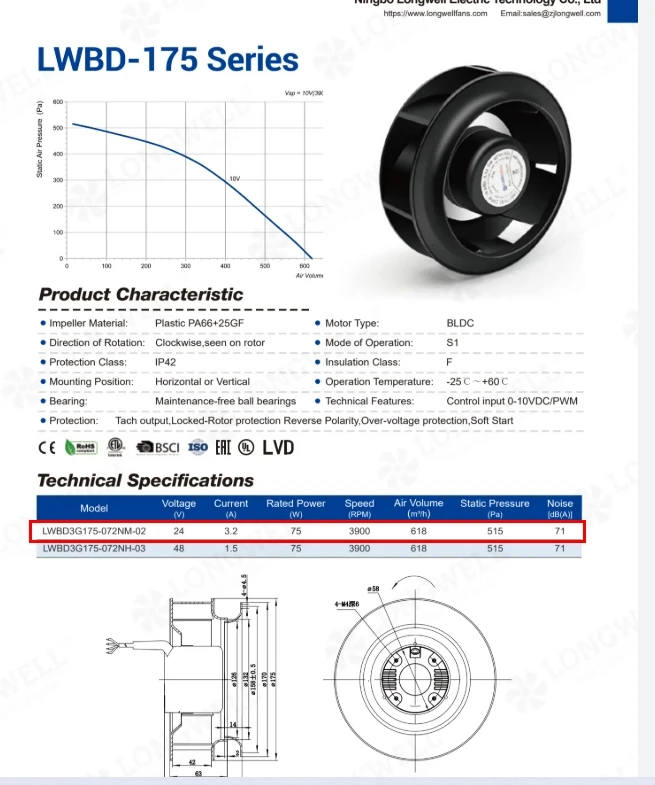
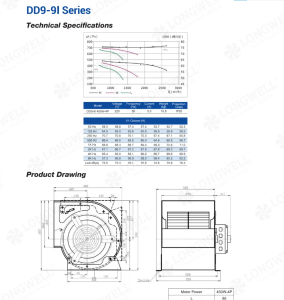
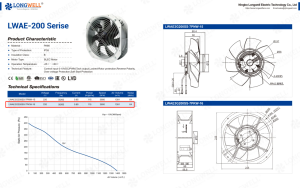
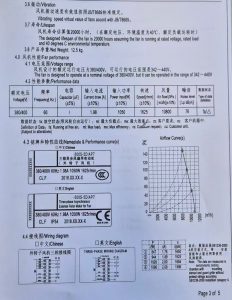
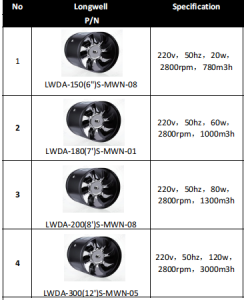
Meanwhile the product image and specification summary provides a quick overview for procurement managers and application engineers to confirm key performance data.
LWBD3G175-072NM-02-14 Specification Sheet (PDF)
The complete technical specification sheet contains detailed dimensional drawings, wiring diagrams, and compliance information needed by design engineers for system integration.
Why the OEM chose this route
Four things made a fixed-speed DC fan the right route here.
- We adapted rather than argued. Instead of pushing a standard variable-speed fan, we modified the platform to match the requirement exactly. That minor NPI ran quickly, against the 12 to 18 month cycles imported European brands quote for custom configurations.
- Value engineering, not cost cutting. A simplified two-wire fixed-speed DC fan met the performance target at a better price for volume production. The saving comes from removing parts, not from cheapening the ones that stay.
- Capacity for the ramp. A projection of 2,000 units a year needs proven volume capability. Building over 120,000 data center units annually gives the assurance behind both the first 100-unit order and the scaling after it.
- Certification carried over. The base platform already holds CE and ETL to UL 507. Consequently the customer integrated the fan into equipment for both markets with no fan-specific compliance testing of their own.
Browse our centrifugal fan range, or the backward curved fan section. Safety testing follows UL 507.
Questions about this fan
Does a fixed-speed variant cost less than the standard fan?
Yes, at volume. Removing the control interface takes out components and simplifies the harness. Both show up in the unit price once quantities are meaningful. On a one-off sample the gap is small, since engineering time dominates.
Can the locked speed be set to something other than 3900 RPM?
Yes. The firmware duty cycle is what fixes the speed, so a different figure is a firmware change rather than a hardware one. Tell us the airflow and pressure you need and we will pick the speed, rather than the other way round.
What if we later want speed control after all?
Here the standard variable-speed model in the same series is aerodynamically identical, so switching back is easy. Mounting, impeller and housing all match. Only the electronics and harness differ. Consequently keeping both options open costs nothing at the design stage.
Is removing the control interface really more reliable?
Modestly, yes. Every component that exists can fail, including ones that are never used, and the control input is an exposed path into the electronics. The gain is not dramatic. However, on a product built in thousands, a simpler fan means fewer things that can go wrong in the field.
Technical Documentation & Resources
Got a duty point you need matched?
Tell us the airflow, the pressure and the space you have. Then we mark your duty point on a tested curve and send the drawing back. Meanwhile samples and custom spec sheets take up to 90 days. Since 1990 we have supplied OEMs across HVAC, refrigeration and industry.
Browse Related Products:
🏆 ISO 9001 / ISO 14001 / ISO 45001 | CE (TÜV) | UL/ETL | ATEX Zone 21/22 | AMCA 210/211 / ISO 5801 tested
Choose the right dc fan
Longwell manufactures 4 dc fans in-house. Send airflow, static pressure and voltage — an engineer replies with a matching model, performance curve and price within one working day.