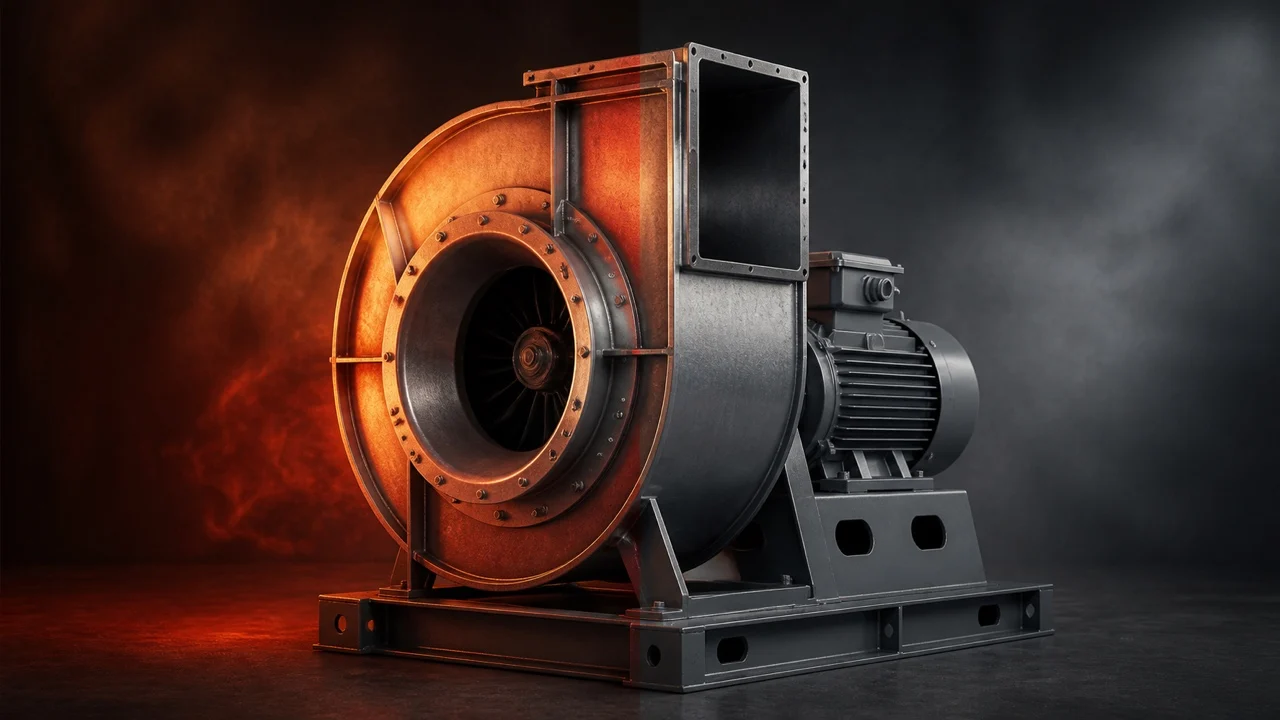
A high-temp fan is not just a standard fan with better paint. Heat changes what every part can do.
Wheels lose strength. Grease breaks down. Bearings expand and motors cook. So each of those needs its own answer.
Standard fans handle roughly 60 to 80 °C. Above that, a high-temp fan moves to steel or stainless wheels, high-temperature grease and thermal isolation at the bearings, with the motor usually outside the airstream. Above about 200 °C a shaft cooling wheel becomes normal, and smoke duties add certification on top.
Material limits set the high-temp fan boundary
| Material | Continuous limit | Note |
|---|---|---|
| Polypropylene | ≈ 70 °C | Good chemical resistance |
| Glass-filled nylon | ≈ 120 °C | Common polymer wheel material |
| Aluminium | ≈ 200 °C | Light, suits large diameters |
| Mild steel | 300 °C and above | Standard for hot duties |
| Stainless steel | 400 °C and above | Hot and corrosive duties |
| Special alloys | 600 °C and above | Smoke extract and process work |
Heat and stress combine, so a wheel that is safe at low speed may not be safe at high speed at the same temperature.
Bearings are the usual failure point
Grease life halves for every 10 K you add, so bearings give up long before the wheel does.
- High-temperature grease extends the range but not indefinitely.
- Thermal isolation between shaft and bearing housing reduces conducted heat.
- Extended shafts move the bearings away from the hot zone.
- Cooling fins on the housing help at moderate temperature.
- Bearing clearance may need increasing to allow for expansion.
- Finally, shorter regreasing intervals become normal rather than optional.
Our bearing guide covers the temperature effect in more detail.
The shaft cooling wheel
Above roughly 200 °C, a small finned wheel on the shaft between the impeller and the bearings becomes standard.
It moves ambient air across the shaft, which intercepts heat travelling from the impeller toward the bearings. Consequently the bearing housing stays far cooler than the airstream, which is what makes high temperatures survivable.
A shaft cooling wheel needs free airflow around it. Boxing it in, or mounting the fan tight against a wall, removes the protection it provides and the bearings fail early.
Motor position and cooling
Keeping the motor out of the hot air is the simplest protection a high-temp fan has.
Belt drive achieves this naturally, which is why hot duties still use belts long after other applications moved to direct drive. Meanwhile a direct drive fan on hot air needs either a shaft cooling wheel or a motor rated for the ambient it will actually see.
Our direct against belt drive guide covers the trade-off.
Expansion and mechanical detail
- Allow for thermal expansion in the casing and the mounting.
- Use flexible connections rated for the temperature.
- Check impeller clearance at operating temperature, not cold.
- Specify gaskets and seals suited to the duty.
- Consider whether the fan runs hot continuously or cycles.
- Finally, allow for differential expansion between shaft and housing.
Cycling duties are harder than steady ones, since repeated expansion loosens fasteners and tires out joints.
Smoke extract is a separate category
A high-temp fan rated for hot process air is not automatically fit for smoke extraction.
Smoke fans are certified as complete assemblies at a rated temperature and duration, commonly 300 °C for two hours or 400 °C for two hours. That certification covers the motor, the bearings, the cabling and the mounting rather than the wheel alone.
Our tunnel ventilation guide covers one of the main uses, while EN 12101 sets out the European rules for smoke control fans.
So decide early which category your duty belongs to. A process fan can be specified from a catalogue, whereas a certified smoke fan has to be selected from a much narrower list and installed exactly as the certificate describes.
High-temperature fan FAQ
What temperature can a standard fan handle?
Usually 60 to 80 °C continuous, limited by the motor and the wheel material. Above that, the design has to change rather than simply being derated.
Can I use a polymer wheel at 100 °C?
Only with a suitable grade, and even then with care. Polymer strength falls as temperature rises, so the safe tip speed drops at the same time.
Does a hot fan need special bearings?
It needs high-temperature grease, often larger clearance, and usually thermal isolation from the shaft. Above 200 °C a shaft cooling wheel becomes normal.
Is a high-temperature fan the same as a smoke fan?
No. Smoke fans carry certification covering the whole assembly for a rated temperature and duration, which a process fan does not.
A high-temperature fan solves three separate problems: the wheel, the bearings and the motor. Address all three, and check whether your duty needs certification as well.