What the OEM was evaluating
An OEM developing high-density industrial control modules asked for specification sheets on three variants of our high-pressure 40mm fan family.
Asking for three at once tells you something. They were not choosing a fan. Rather, they were comparing operating points to find where their system sits.
What the choice implies
A high-pressure 40mm fan gets specified when a small enclosure is packed tight. Heatsinks, dense boards and narrow air paths all resist flow, and there is no room for a bigger fan.
- Rated voltages of 12 VDC and 24 VDC, depending on variant.
- Next, a 40 by 40 by 28 mm envelope, fixed.
- Meanwhile static pressure up to 716 Pa at the top of the range.
- PWM speed control through a 4-pin connector.
- Finally, 50,000 hours of service life across -10C to +60C.
What a high-pressure 40mm fan trades away
The customer had already picked the right family. So our task was supplying data to choose between variants, and being clear about the trade involved.
Why tubeaxial and not plain axial
A tubeaxial design encloses the impeller in a close-fitting tube rather than an open frame.
That restricts air which would otherwise escape around the blade tips. Consequently pressure capability rises for the same diameter, and a tubeaxial fan pushes through a heatsink where an open-frame fan of identical size stalls.
Where 716 Pa actually comes from
Speed, almost entirely. Notably the top variant turns at 24,000 RPM and draws 18 watts doing it.
This is worth stating plainly, because pressure figures on small fans are quoted far more often than the RPM behind them. At 24,000 RPM the fan will be audible in any quiet room, and 18 watts is a real thermal load in a small enclosure.
Meanwhile the lower-speed variants at 18,000 RPM give 475 Pa on roughly 5.5 watts. In practice that is a very different fan, and choosing between them is the real engineering decision here.
Why EC, and why ball bearings
Here the customer bus is DC, so an AC motor would have needed an inverter that adds cost, loss and a failure point.
Furthermore the bearing choice matters more than usual at these speeds. We specified two ball bearings over sleeve or fluid dynamic types, since at 24,000 RPM and up to 60C ambient a sleeve bearing will not reach 50,000 hours. Ball bearings do.
What it cost
Noise, power and bearing life, all following from the speed.
There is no way around this. Pressure in any small axial fan comes from tip speed, so a 40mm impeller must spin very fast to make any. Consequently, if your acoustic or power budget cannot take it, the honest answer is a larger fan or a redesigned air path.
Technical Specifications
Three high-pressure 40mm fan variants appear below. Compare the speed and current columns, since that is where they differ.
| Parameter | LWAD4028LX-10 | LWAD4028MX-10 | LWAD4028LX-11 |
|---|---|---|---|
| Rated Voltage | 12 VDC | 24 VDC | 12 VDC |
| Operating Voltage | 7.0–13.5 VDC | 22.8–25.2 VDC | 7.5–13.5 VDC |
| Rated Current | 0.46 A | 0.24 A | 1.50 A |
| Input Power | 5.52 W | 5.76 W | 18.00 W |
| Rated Speed | 18,000 RPM | 18,000 RPM | 24,000 RPM |
| Maximum Airflow | 20.93 CFM / 35.56 m³/h | 20.93 CFM / 35.56 m³/h | 27.66 CFM / 47.00 m³/h |
| Maximum Static Pressure | 48.41 mmH₂O / 475 Pa | 48.41 mmH₂O / 475 Pa | 73.00 mmH₂O / 716 Pa |
| Acoustic Noise | 58 dBA | 58 dBA | 62 dBA |
| Dimensions (WxHxD) | 40 x 40 x 28 mm | ||
| Bearing Type | Two Ball Bearings | ||
| Life Expectancy (L10) | 50,000 hours @ 40°C | ||
| Operating Temperature | -10°C to +60°C | ||
| Control Interface | PWM Speed Control, FG Tach Output | ||
Technical Documentation

The summary sheet provides a high-level overview of the LWAD4028 series, useful for initial component selection by a design engineer.
LWAD4028LX-10-00 Specification Sheet
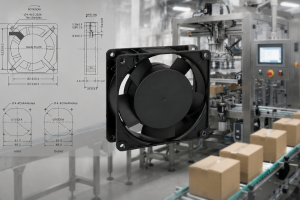
Here the detailed PDF contains the complete electrical and mechanical data, P-Q performance curve, and dimensional drawings for the 12V, 18,000 RPM model, required by engineers for thermal simulation and PCB layout.
LWAD4028LX-11-00 Specification Sheet
This document provides the full technical specifications for the high-performance 12V, 24,000 RPM model, necessary for qualifying the fan in the most demanding thermal applications.
If you are specifying small high-pressure fans
A high-pressure 40mm fan is the easiest component to over-specify and regret.
- Read the pressure figure with the RPM beside it. Maximum static pressure on a 40mm fan always implies a very high speed. Check what that speed does to your noise budget and your enclosure heat load before selecting on pressure alone.
- Use PWM to buy back the noise. These fans need full speed only under worst-case thermal load. Running them from a temperature signal keeps them quiet most of the time and extends bearing life along the way.
- Ask about bearing type at high speed. Sleeve bearings are fine on slow fans and will not survive 24,000 RPM at elevated temperature. If a supplier quotes 50,000 hours, ask what bearing that figure assumes.
- Consider fixing the air path instead. A high-pressure 40mm fan is often compensating for a restrictive enclosure. Where the layout can still change, opening the path costs nothing to run and makes no noise.
See our axial fan range, the compact cooling fan section, or DC cooling fans. Ingress ratings follow IEC 60529.
Questions about this family
Why does such a small fan produce so much pressure?
Because of speed and the tubeaxial housing together. The close-fitting tube stops air escaping around the blade tips, and the very high rotational speed provides the energy. Neither alone would do it, which is why an open-frame 40mm fan at the same speed produces far less.
How loud is a fan at 24,000 RPM?
Audible, clearly, in any quiet environment. We publish figures per variant rather than a family number, since the difference between the 18,000 and 24,000 RPM builds is substantial. If noise matters, start from the lower-speed variant and check whether it clears your pressure requirement.
What is the difference between the three variants?
Voltage, speed and therefore performance. The 12V models run at 18,000 RPM for 475 Pa on about 5.5 watts. The higher-performance model reaches 24,000 RPM and 716 Pa, drawing 18 watts. Same envelope, very different fans, so match the variant to your system curve rather than taking the highest number.
Would a bigger fan be better if I have the space?
Almost always, yes. A larger impeller reaches the same pressure at much lower tip speed, meaning less noise, less power and longer bearing life. In truth a high-pressure 40mm fan exists because sometimes there is genuinely no room, not because it is an efficient way to make pressure.
Technical Documentation & Resources
- Get the LWAD4028 series project photograph (DOCX)
- Open the LWAD4028 series specification sheet (PDF)
- View the LWAD4028 series project photograph 2 (DOCX)
- Get the LWAD4028 series project photograph 3 (DOCX)
- Download the LWAD4028 series specification sheet 2 (PDF)
- Open the LWAD4028 series technical drawing (PDF)
- View the LWAD4028 series technical drawing 2 (PDF)
Have a fan requirement like this one?
Send the datasheet you are working against, or simply the duty point. Then our engineers tell you what fits and what does not. Meanwhile custom spec sheets and samples take up to 90 days. Since 1990 we have been building fans for OEMs worldwide.
Browse Related Products:
🏆 ISO 9001 / ISO 14001 / ISO 45001 | CE (TÜV) | UL/ETL | ATEX Zone 21/22 | AMCA 210/211 / ISO 5801 tested