What the air purifier needed
An OEM developing compact air purification units needed a high static pressure blower, and the number they led with was 515 Pa.
That figure comes from the filters. A stack of dense HEPA and carbon media resists airflow hard. Consequently the fan has to push through all of it inside a chassis with no spare room.
The constraints
- First, a native 24 VDC rail, tolerant from 16 to 32 VDC for supply fluctuation.
- Next, an envelope of 175mm diameter and under 80mm overall height.
- Meanwhile variable speed over 0-10V or PWM, so the unit can respond to air quality.
- Both CE and ETL to UL 507, since the product sells in Europe and North America.
- Finally, -25C to +60C and humidity to 90% RH.
The speed control requirement follows from the filters too. As media loads with dust, resistance climbs. So a fixed-speed fan delivers less and less air as the product ages.
Choosing a high static pressure blower
Here the customer had already named a model. Even so, we checked the aerodynamics first, since 515 Pa from a 175mm high static pressure blower is not a casual request.
Why the blade direction matters here
We ruled out a forward-curved impeller at once. Forward-curved wheels move plenty of air at low pressure in a small housing, which is why they dominate fan coil units.
However, they fall away sharply as resistance rises. Reaching 515 Pa would need a much larger wheel than the envelope allows. Backward-curved geometry builds pressure efficiently instead, which is exactly what a filter stack demands.
Why EC, not AC
The system runs on a 24 VDC bus. Consequently an AC motor would need an inverter ahead of it, adding cost, heat and a failure point inside a sealed consumer product.
By contrast an EC motor connects straight to the rail. Furthermore the speed control this application needs is already inside it, rather than bolted on.
The final build
Meanwhile the chosen high static pressure blower turns at 3900 RPM, giving 618 m3/h and the 515 Pa target. Meanwhile the impeller is glass-filled PA6, which stays rigid at that speed without the weight of metal.
Maintenance-free deep groove ball bearings carry a 40,000-hour L10 life.
What it cost
Noise. At 3900 RPM the fan measures 71 dB(A) at full output, which is loud for something sitting in a room with people.
That is the honest trade in high-pressure work: pressure comes from tip speed, and tip speed makes noise. The saving grace is the speed control. The unit only needs full output when the filters are near end of life, so most of the time it runs far quieter.
Technical Specifications
Read the pressure row against the diameter row below. Together they are the whole point of this selection.
| Parameter | Value |
|---|---|
| Model Number | LWBD3G175-072NM-02-00 |
| Nominal Voltage | 24 VDC |
| Voltage Range | 16 – 32 VDC |
| Speed | 3900 RPM |
| Max Air Flow | 618 m³/h / 364 CFM |
| Max Static Pressure | 515 Pa |
| Input Power | 75 W |
| Current | 3.2 A |
| Noise Level | 71 dB(A) |
| Dimensions (Impeller Dia. x Height) | Ø175 mm x 79.5 mm |
| Operating Temperature | -25°C to +60°C |
| Protection Class | IP44 |
| Insulation Class | Class F |
| Life Expectancy (L10) | 40,000 Hours at 25°C |
| Impeller Material | PA6+GF (Polyamide + Glass Fiber) |
| Control Input | 0-10VDC / PWM |
| Certifications | CE, ETL (UL 507, CSA C22.2#113), RoHS, Reach |
Technical Documentation
The complete technical datasheet for the LWBD3G175-072NM-02, including performance curves, dimensional drawings, and wiring information, is available for design engineers: LWBD3G175-072NM-02 Datasheet.
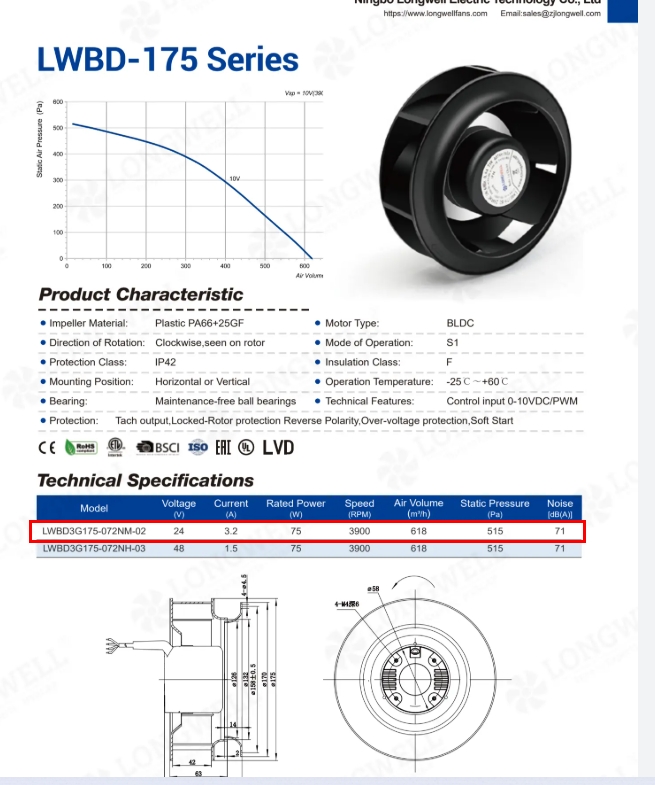
Here the summary product image and feature list for the LWBD-175 series is useful for quick reference by procurement managers and application engineers.
If you are specifying a fan behind filters
Selecting a high static pressure blower to work behind filters has a few traps. Settle these before you shortlist anything.
- Get the pressure drop of the loaded filter, not the clean one. Media resistance can roughly double over service life. A fan sized against a clean filter will underperform for most of the product life, and the complaint arrives months after launch.
- Pressure decides blade direction before anything else. Below roughly 200 Pa a forward-curved wheel is usually smaller and cheaper. Above that, backward-curved wins on both efficiency and achievable pressure. Getting this wrong wastes a whole design round.
- Budget for the noise. High pressure in a small diameter means high tip speed, which means noise. Decide your dB(A) limit early and check it against the fan curve at your real duty point, not at free delivery.
- Variable speed pays for itself here. It lets the fan run quietly when filters are clean and push harder as they load, which keeps delivered airflow roughly constant across the service interval.
See our centrifugal fan range, the backward curved fan section, or filter and carbon units. Safety testing follows UL 507.
Questions about this blower
Why not a forward-curved fan, which is smaller?
Because forward-curved wheels lose pressure capability quickly as resistance rises. Certainly they are excellent below roughly 200 Pa in a compact housing. However, at 515 Pa the wheel must grow beyond the 175mm envelope, and efficiency falls at the same time. So backward-curved geometry is the right answer above that threshold.
Is 71 dB(A) not too loud for a room appliance?
At full speed it would be, which is exactly why the speed control matters. That figure is measured at 3900 RPM against a fully loaded filter. Meanwhile in normal use the unit runs well below maximum and is far quieter. Tell us your acceptable level and we will show you where on the curve it sits.
What does the 16-32 VDC range actually buy?
Tolerance for a supply that sags under inrush or drifts with temperature. The fan holds its commanded speed across that window rather than following the rail, so airflow stays predictable. It also means a nominal 24V or 28V system can both use the same part.
How much does a clogged filter change the operating point?
A great deal. As media loads, the system curve steepens and the operating point slides up the fan curve. Consequently airflow falls even though the fan works harder. In short, sizing a high static pressure blower against clean-filter data is the commonest mistake in this application.
Technical Documentation & Resources
Sizing something comparable?
Share the airflow, pressure, voltage and control interface, and we come back with a tested curve and a drawing. Meanwhile custom work runs to 90 days for spec sheets and samples. Since 1990 Longwell has supplied fans to HVAC and industrial OEMs.
Browse Related Products:
🏆 ISO 9001 / ISO 14001 / ISO 45001 | CE (TÜV) | UL/ETL | ATEX Zone 21/22 | AMCA 210/211 / ISO 5801 tested
Choose the right blower
Longwell manufactures 247 blowers in-house. Send airflow, static pressure and voltage — an engineer replies with a matching model, performance curve and price within one working day.