What the OEM asked for
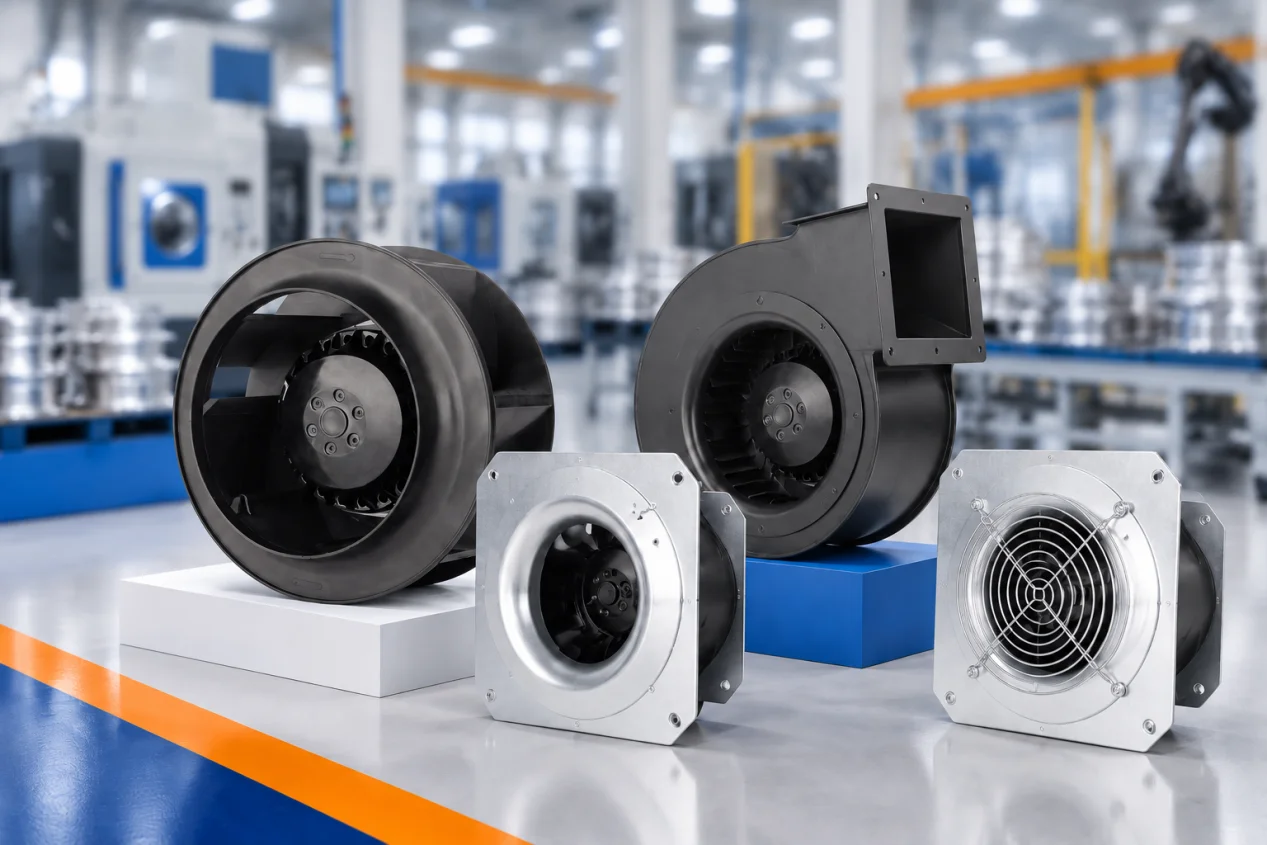
A European OEM designing a compact ventilation unit asked for one thing: the 3D CAD model of a forward-curved blower. That request is where design-in checks begin.
That request tells you where they are. Asking for geometry rather than performance means the fan is already chosen. Consequently they are fitting it into a housing.
What the choice implied
- First, a fixed 230V AC supply at 50Hz.
- Next, enough capability to overcome real resistance, since 294 Pa maximum was the benchmark.
- Meanwhile a tight envelope at 182.5 by 174 by 115 mm, which the 3D model had to confirm exactly.
- Airflow around 263 m3/h.
- Finally, IP54 protection plus CE and RoHS, with data verified to ISO 5801.
Nothing here needed designing. So our job was the design-in checks, then getting the files out without holding up their schedule.
Validating the blower during design-in
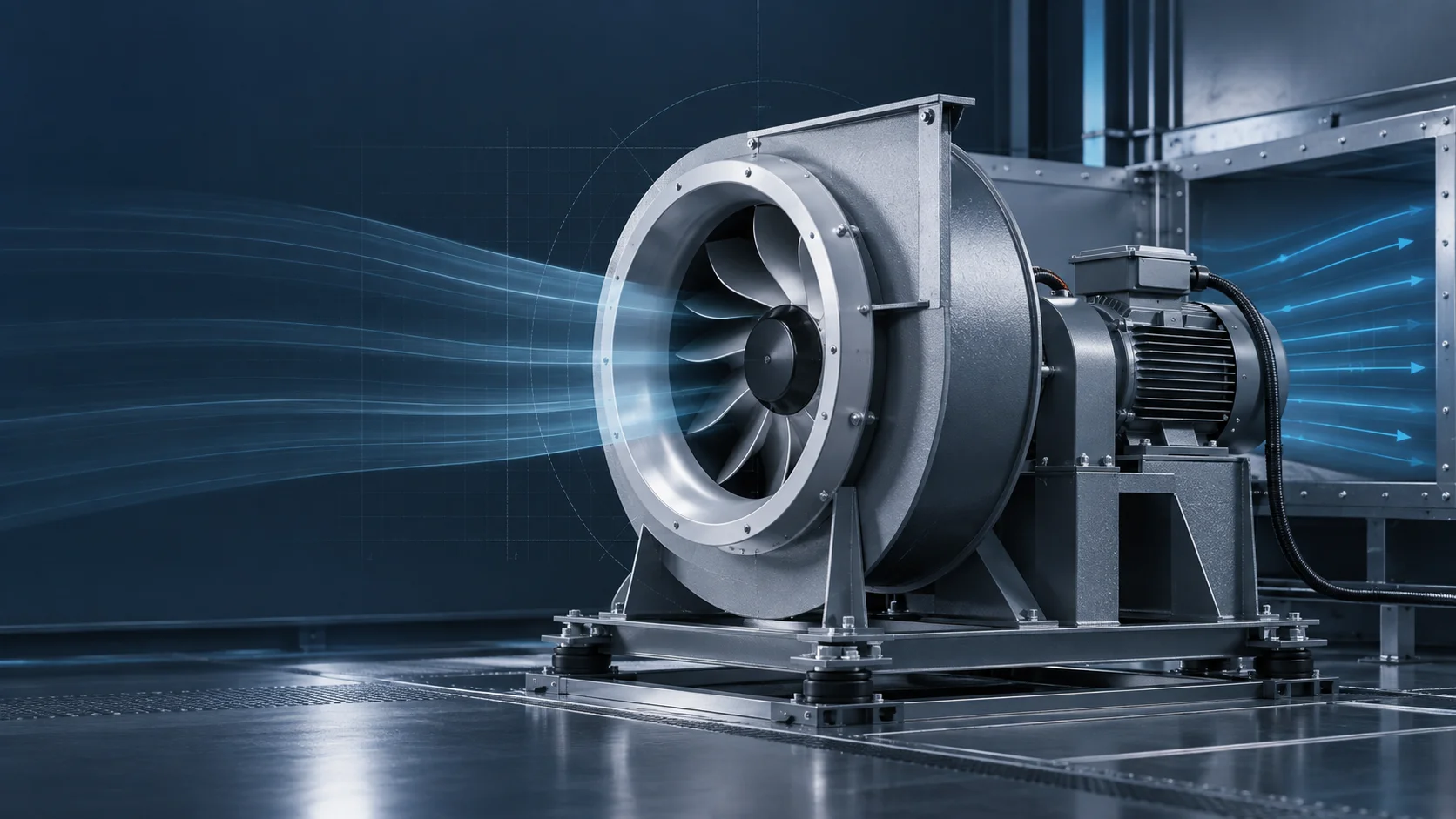
The fan is a single-inlet AC centrifugal blower. Usefully, the choice holds up.
Why AC, not EC
Their architecture is a simple 230V line supply with no DC bus and no need for variable speed. Consequently an EC motor would add cost and a control interface nobody would wire up.
What the forward-curved impeller buys and costs
Many small blades move real volume against static pressure inside a small housing. In short, exactly what a compact ventilation unit needs.
However, it is a trade rather than a free win. The design prioritises pressure and airflow per unit of space over the lowest possible noise. At 59 dB(A) this blower is competitive for its performance class, and it is not quiet in absolute terms.
So anyone choosing it because it fits should learn that during design-in checks, not from the first prototype.
The parts that decide service life
Here the housing is galvanized sheet steel, for rigidity and corrosion resistance. Meanwhile maintenance-free ball bearings were specified rather than sleeve.
That bearing choice matters more than it looks. A blower embedded deep inside an OEM product is not something an end user will ever service, so its bearings are effectively the product life.
What a 3D model does not tell you
The deserves dwelling on. A STEP file answers one question convincingly, then stays silent on several others.
Certainly it confirms the fan fits. However, it says nothing about inlet clearance, discharge obstruction, whether your housing will resonate, or where the operating point lands once ductwork is attached.
Those four are where design-in problems actually come from, and none of them are geometry.
Technical Specifications
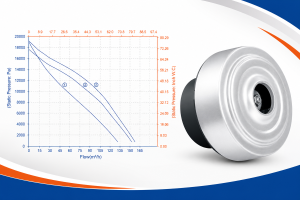
Meanwhile the pressure figure below is what this blower was chosen for. Meanwhile the dimensions are what the design-in checks confirmed.
| Parameter | Value |
|---|---|
| Model | LWFA4E120-092SS-01 |
| Voltage | 230 V |
| Frequency | 50 Hz |
| Input Power | 54 W |
| Current | 0.24 A |
| Speed | 1760 RPM |
| Max Air Flow | 263 m³/h |
| Max Static Pressure | 294 Pa |
| Noise | 59 dB(A) |
| Protection Class | IP54 |
| Insulation Class | F |
| Capacitor | 2µF |
| Dimensions (H x D x W) | 182.5 x 174 x 115 mm |
| Material | Galvanized sheet steel |
| Bearings | Maintenance-free ball bearings |
| Operating Temperature | -30°C to +60°C |
| Certifications | CE, RoHS, ETL, BSCI, ISO |
Technical Documentation
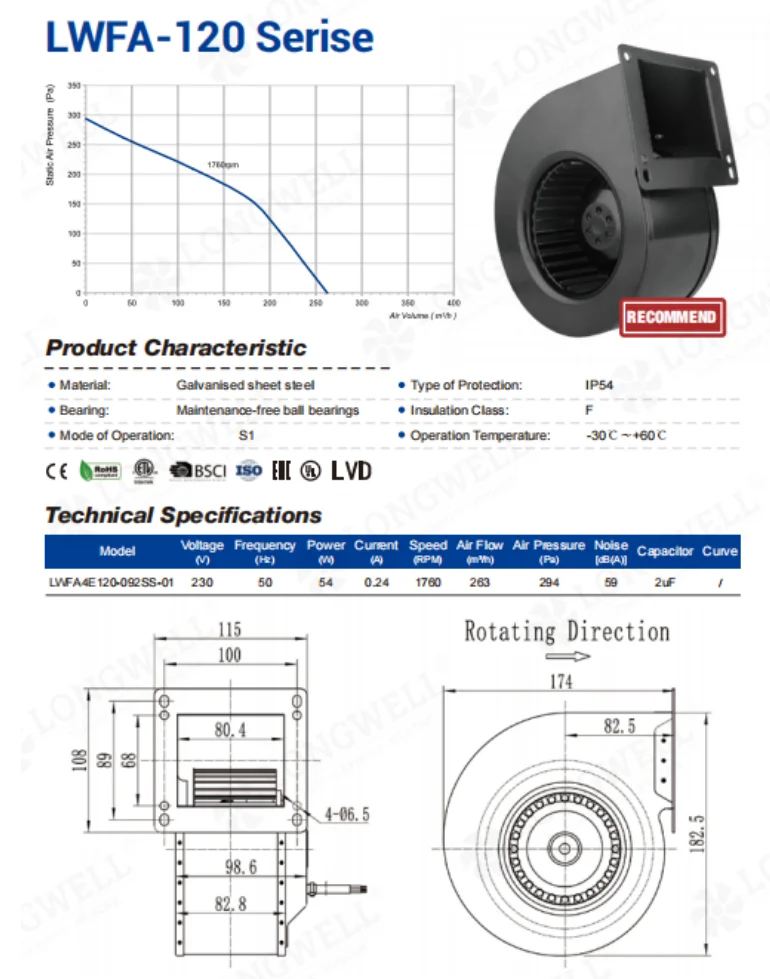
The technical datasheet provides the complete performance curve, dimensional drawings, and electrical specifications needed by an engineer for initial evaluation.
LWFA4E120-092SS-01.stp
Here the sTP file is the 3D CAD model required by OEM mechanical designers for precise integration, fitment checks, and assembly modeling in their host system.
Design-in checks worth doing
A 3D model settles geometry. Meanwhile these are the design-in checks it leaves to you.
- Leave clearance at the inlet. A centrifugal blower needs unobstructed air into the eye. Mounting it close to a wall or a panel starves the inlet and costs airflow that no datasheet figure will warn you about.
- Recheck the operating point with your ducting attached. The 294 Pa maximum is at zero flow. Where your system curve crosses the fan curve is the number you will actually get, and it is always lower.
- Test the housing for resonance, not just fit. A stiff blower in a thin enclosure produces a drum. Run the assembly before committing tooling, since panel resonance is far cheaper to fix at prototype stage.
- Confirm the IP rating applies where you mount it. IP54 protects the motor. It does not make the assembly weatherproof, and an enclosure opening near the fan can undo it entirely.
See our centrifugal fan range, the forward curved fan section, or centrifugal blowers. Airflow testing follows AMCA 210.
Questions about this blower
How much inlet clearance does a centrifugal blower need?
As a working rule, leave at least half the inlet diameter clear in front of the eye. Less than that begins to restrict flow, and the loss does not appear on the fan curve because the curve was measured with a clear inlet. Where space is tight, tell us and we will advise on the specific model.
Why is 59 dB(A) considered competitive here?
Because it is measured against what the blower delivers. Moving 263 m3/h against 294 Pa from a housing this small takes real tip speed, and tip speed makes noise. Compared with other fans at the same duty and size it is a good figure. Compared with a large slow fan it is not.
Will the fan still make 294 Pa in my system?
No, and it is not meant to. That figure is maximum static pressure at zero airflow, which is one end of the curve. Your real operating point sits where your system resistance crosses the curve, delivering less pressure and some airflow. Ask for the curve rather than the maximum.
What else should I ask for alongside the STEP file?
Here the P-Q curve, the noise figure with its measurement conditions, and the electrical connection detail including capacitor value where one sits outside. Those three plus the geometry cover almost every design-in check, without needing a second round.
Sizing something comparable?
Share the airflow, pressure, voltage and control interface, and we come back with a tested curve and a drawing. Meanwhile custom work runs to 90 days for spec sheets and samples. Since 1990 Longwell has supplied fans to HVAC and industrial OEMs.
Browse Related Products:
🏆 ISO 9001 / ISO 14001 / ISO 45001 | CE (TÜV) | UL/ETL | ATEX Zone 21/22 | AMCA 210/211 / ISO 5801 tested
Choose the right centrifugal fan
Longwell manufactures 1,130 centrifugal fans in-house. Send airflow, static pressure and voltage — an engineer replies with a matching model, performance curve and price within one working day.